
Origin of Heavy Elements: Has a New Cosmic Forge Been Found?
A 2017 discovery proved neutron star mergers forge gold, but the cosmic books didn't add up. Now, scientists have found a new, violent forge that may create the universe's heaviest treasures.
Key Findings
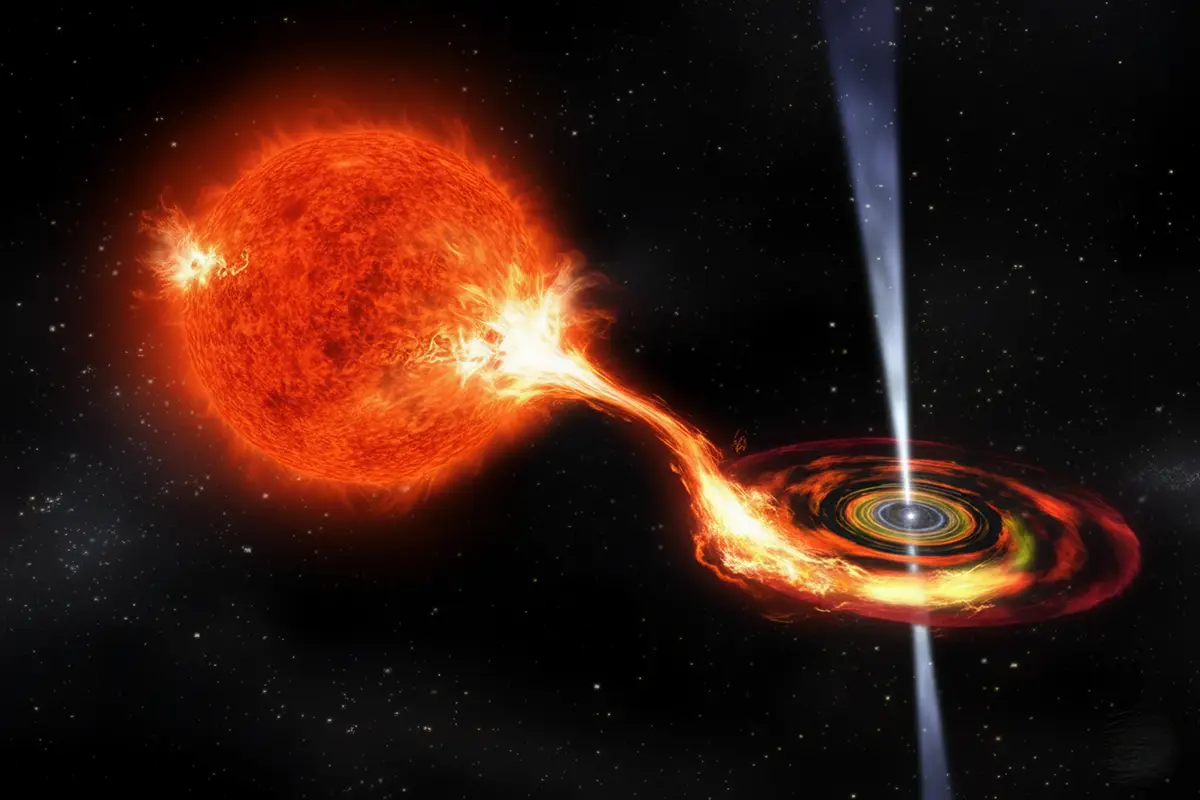
- A neutron star spiraling into a red supergiant can trigger a Common Envelope Jet Supernova (CEJSN).
- The jets from this event create ideal conditions for the r-process to forge heavy elements.
- This CEJSN model is especially good at creating the heaviest elements, like gold and platinum.
- This new model helps explain element abundances in old stars that neutron star mergers alone cannot.
Primary Source
Source: Robust r-process Nucleosynthesis beyond Lanthanides in the Common Envelop Jet Supernovae
Author(s): Shilun Jin and Noam Soker
Cosmic Alchemy: Have Scientists Found a New Forge for Gold and Platinum?
You’ve most probably heard the famous phrase that, “We are made of star stuff”~ Carl Sagan. It is a profound scientific truth. The iron in your blood and the calcium in your bones were all forged inside the thermonuclear hearts of stars that lived and died long before Earth existed. Stars are the universe’s element factories1NASA Imagine the Universe!. (n.d.). Stars. https://imagine.gsfc.nasa.gov/science/objects/stars1.html. They patiently fuse lighter elements together to build heavier ones. This process, called stellar nucleosynthesis2NASA Science. (n.d.). How Do Stars Make the Elements? Astrophysics. https://science.nasa.gov/astrophysics/focus-areas/how-do-stars-make-the-elements/, creates the ingredients for life, like carbon, nitrogen, and oxygen.
But this stellar production line has a hard stop. The process of fusion, which powers a star, stops working once it creates iron. This leaves us with a huge mystery. If the universe began with just hydrogen and helium after the Big Bang3NASA Science. (n.d.). What Is Big Bang Nucleosynthesis? Universe. https://science.nasa.gov/universe/questions/what-is-big-bang-nucleosynthesis/, and fusion stops at iron, where did all the elements heavier than it come from? Where did the universe get its gold, platinum, and uranium? For decades, scientists have hunted for the violent, extreme “cosmic forges” that could create these treasures. In 2017, we had a breakthrough. Astronomers witnessed the collision of two neutron stars. These are the incredibly dense cores left behind after massive stars explode4NASA Science. (n.d.). Neutron Stars. Universe. https://science.nasa.gov/universe/neutron-stars/. The event, named GW170817, was detected via gravitational waves and light5LIGO Caltech. (n.d.). GW170817: Observation of Gravitational Waves from a Binary Neutron Star Inspiral. https://www.ligo.caltech.edu/page/gw170817. It was a “smoking gun,” proving these mergers are a major source of heavy elements.
Therefore, you might think the mystery was solved. But there was a new problem. When scientists looked closely at the amounts of elements created, the cosmic books didn’t quite add up. Neutron star mergers alone could not explain the sheer amount of gold or the specific “chemical fingerprints” we see in the universe’s most ancient stars. This meant a piece of the puzzle was still missing. Now, researchers Shilun Jin and Noam Soker from the Technion in Israel have proposed a brand new, incredibly violent forge (see Primary Source box above). They call it a “Common Envelope Jet Supernova,” and it might be the missing factory that creates the very heaviest elements in the cosmos.
What is the Core Finding of This New Research?
The new study proposes a completely new way to forge heavy elements. The main finding is that when a dense, dead star (a neutron star) is caught in a death spiral with its giant companion star, it can trigger a unique and powerful explosion. As the neutron star plunges into the core of the giant star, it unleashes powerful jets. These jets blast through the star, creating a perfect, short-lived furnace. This furnace has the exact conditions needed to create the universe’s heaviest elements, like gold and platinum, in large amounts (see Primary Source box above).
How Does a Star’s Core Stop at Iron?
To understand why this new theory is so important, we first have to ask a question. Why do stars stop making elements at iron? A star’s life is a constant battle between gravity (pulling in) and fusion (pushing out). Fusing light elements, like hydrogen into helium, releases a huge amount of energy. This energy is what holds the star up. The star continues this process, fusing heavier and heavier elements: helium to carbon, carbon to oxygen, and so on. Each step releases energy.
This all stops at iron. Iron’s nucleus is the most stable in the universe, based on its nuclear binding energy. Fusing iron atoms together does not release energy; it consumes it. When a massive star’s core becomes full of iron, its engine suddenly dies. With no outward energy to fight it, gravity wins in an instant. The star collapses catastrophically, triggering a core-collapse supernova6NASA Imagine the Universe!. (n.d.). Supernovae. https://imagine.gsfc.nasa.gov/science/objects/supernovae1.html. This explosion scatters all the elements the star made during its life, but it cannot forge the elements heavier than iron.
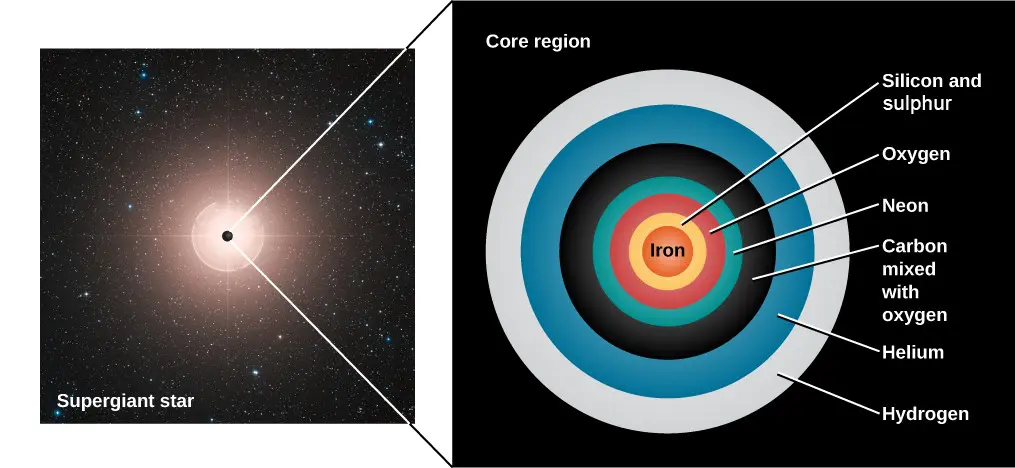
A visual representation of a supergiant star and its “onion-layered” interior, illustrating how elements are fused in concentric shells until an inert iron core forms. This explains why stars cease producing energy through fusion at iron. (Edited slightly for British spelling). Credit: Lumen Learning / OpenStax Astronomy
What is the ‘r-Process’ and Why Does it Need Neutrons?
So, how do we get gold? We need a completely different method that avoids the “iron problem”. This method is called neutron capture. Because neutrons have no electric charge, an atomic nucleus can absorb them easily. If the new nucleus is unstable, a neutron can transform into a proton via beta decay, changing the atom into the next element on the periodic table7Jefferson Lab. (n.d.). Beta Decay. Science Education. https://education.jlab.org/glossary/betadecay.html. The specific process for making the heaviest elements is called the rapid neutron-capture process, or r-process.
The r-process requires truly insane conditions. You need extremely high temperatures (around 1 billion K) and an unbelievably high density of free neutrons (perhaps 1024 per cubic centimetre). In this neutron “soup,” an atomic nucleus (like iron) is bombarded so quickly. Up to 100 captures per second can occur. This means it absorbs many neutrons all at once, long before it can beta decay. This makes it extremely heavy and unstable. When this flood of neutrons stops, the unstable nucleus undergoes a rapid cascade of beta decays. Neutrons turn into protons, and the nucleus “climbs” up the periodic table, becoming stable elements like gold, platinum, and uranium. The whole event happens in just a few seconds.
Why Wasn’t the 2017 Neutron Star Merger the Final Answer?
The 2017 detection of GW170817 was a monumental discovery. For the first time, we saw an r-process forge in action. We detected the light, known as a kilonova, from freshly made heavy elements in the explosion’s debris8European Space Agency (ESA). (n.d.). What is a kilonova? Science & Exploration. https://www.esa.int/Science_Exploration/Space_Science/What_is_a_kilonova. It was proof that neutron star mergers are a key source.
However, new questions appeared. The 2017 merger was very good at making one group of heavy elements (the lanthanides, elements 57-71 on the periodic table9Britannica. (n.d.). Lanthanide. https://www.britannica.com/science/lanthanide). But it seemed to underproduce the very heaviest ones, like gold and platinum. Also, when astronomers look at very old, metal-poor stars (stars formed early in the universe before many heavy elements existed10CNEOS JPL/NASA. (n.d.). Metal Poor. Glossary. https://cneos.jpl.nasa.gov/glossary/metal_poor.html), they see a consistent “fingerprint” of r-process elements. This fingerprint is hard to explain if mergers, which are relatively rare and take time to happen, are the only source. There had to be another forge, one that specializes in creating the heaviest elements.
What is This New ‘Common Envelope Jet Supernova’?
This is where the new research from Shilun Jin and Noam Soker comes in (see Primary Source box above). They used computer models to ask a new question. What happens when a neutron star is orbiting not another neutron star, but a massive, bloated star called a red supergiant11NASA Imagine the Universe!. (n.d.). Supergiants. https://imagine.gsfc.nasa.gov/science/objects/supergiants1.html?
Their model shows a dramatic story. As the red supergiant expands, it swallows its neutron star companion. Both stars are now inside a shared “common envelope” of gas12Wikipedia. (n.d.). Common envelope. https://en.wikipedia.org/wiki/Common_envelope. The drag from this gas causes the neutron star to lose energy and spiral inward, plunging toward the supergiant’s core. As it falls, the neutron star’s immense gravity pulls in a huge amount of material, forming an accretion disk13NASA Imagine the Universe!. (n.d.). Accretion Disks. https://imagine.gsfc.nasa.gov/science/objects/accretion_disks1.html. This disk “spins up” the neutron star, which then unleashes two powerful, focused jets from its poles. These jets blast their way out of the supergiant’s core, triggering a massive explosion: a Common Envelope Jet Supernova (CEJSN).
How Does This New Model Solve the ‘Gold’ Problem?
This is the most exciting part. According to the team’s calculations (see Primary Source box above), the conditions inside these jets are a perfect factory for the r-process. More importantly, they are specialized. The model shows that a CEJSN event is “exceptionally efficient” at producing the very heaviest elements, those in the “third r-process peak” which includes gold and platinum.
This discovery suggests the universe has at least two types of forges. Neutron star mergers (like in 2017) are great at making one set of elements (lanthanides). But these new Common Envelope Jet Supernovae may be the primary source of the universe’s most precious metals. This diversity of forges could finally explain the different chemical fingerprints we see in ancient stars (see Primary Source box above).
Is There Another New Theory?
Amazingly, yes. The hunt for r-process forges is heating up. Both the merger and CEJSN models rely on a pre-existing supply of neutrons (the neutron star itself). But another recent study proposes an even more radical idea. It focuses on “collapsars,” which are giant, rapidly spinning stars that collapse to form a black hole at their centre14Wikipedia. (n.d.). Collapsar. https://en.wikipedia.org/wiki/Collapsar.
This theory suggests the event creates its own neutrons from scratch. As the new black hole forms, it launches powerful jets filled with high-energy light (gamma rays). These gamma rays are so energetic that they can strike protons in the surrounding star material and instantly transmute them into neutrons. This process, called “hadronic photoproduction,” creates the dense neutron soup needed for the r-process in a place where none existed before15Mumpower, M. R., et al. (2024). Let There Be Neutrons! Hadronic Photoproduction from a Large Flux of High-energy Photons. The Astrophysical Journal, 982(2), 81. https://doi.org/10.3847/1538-4357/ad4cda. This fundamentally changes the search. The question is no longer just “Where are the neutrons?” The question is now “What physical processes can create neutrons?”
How Will We Know if These Theories Are Right?
These new ideas are powerful, but for now, they are complex computer models. They rely on many assumptions about nuclear physics that are hard to test. The r-process, after all, happens in a few seconds at billions of degrees. It creates exotic atomic nuclei that are so unstable they might only exist for a few milliseconds. How can we possibly check the models?
The answer is to build a “supernova on Earth”. This is exactly what scientists are doing at the Facility for Rare Isotope Beams (FRIB) at Michigan State University. FRIB is a cutting-edge particle accelerator with a very specific job16Michigan State University. (n.d.). What is FRIB? FRIB. https://frib.msu.edu/science/what-is-frib.php. It is designed to create the very same rare, unstable nuclei that are born inside stellar explosions.
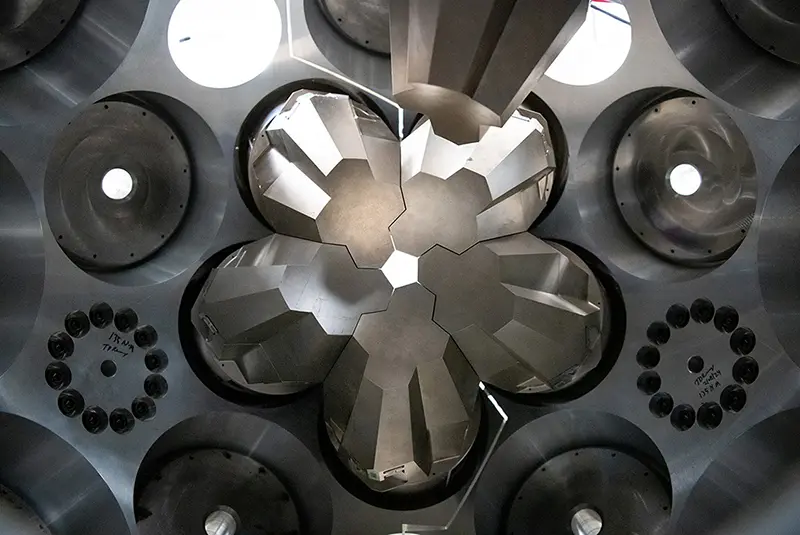
A detailed view of the sophisticated internal components of a detector array like GRETA at FRIB. Instruments like these precisely track gamma rays emitted by rare isotopes, providing crucial data for nuclear astrophysics. Credit: Berkeley Lab / FRIB
How Can FRIB Recreate a Cosmic Forge?
FRIB does not create an explosion. Instead, it creates the ingredients. It works by firing a beam of heavy, stable ions (like uranium) at nearly half the speed of light into a target. The collision shatters the uranium, creating a spray of the rare, neutron-rich isotopes that are the stepping stones of the r-process.
Scientists can then study these exotic nuclei for the few milliseconds they exist. They can measure their mass, how they decay, and their probability of capturing another neutron. This “ground truth” data is exactly what the theorists need. They can plug these real-world measurements into their computer models of CEJSNe and collapsars. This will make the models much more accurate. By comparing the model’s new predictions with what our telescopes observe in the cosmos, we can finally figure out which of these violent forges is the true source of our gold. This will truly complete the story of how the stars built the universe.