There’s an overhead projector in the corner of a lot of school halls, unplugged, with a box of pens sitting on the glass. Paul Zaloom spent twenty years using one as a stage. He’d lay found objects on it and throw a giant sadistic dentist up the wall, ten feet tall, coming for your teeth. His own website calls the overhead projector one of the “relentlessly low-tech devices” he works with. The word doing the work in that sentence is relentlessly. He isn’t apologising for the kit. The kit is the argument.
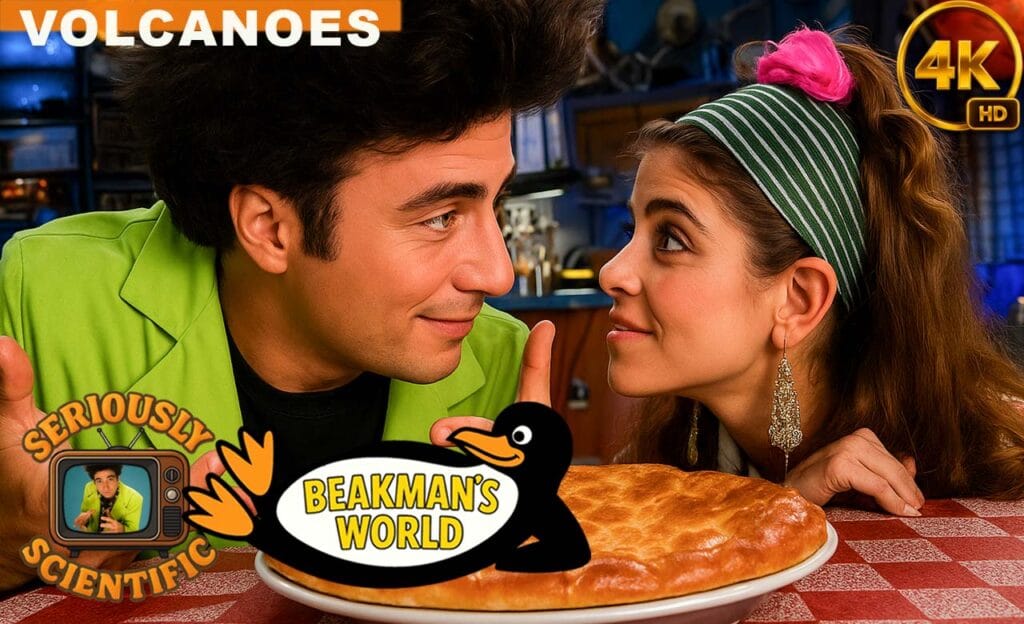
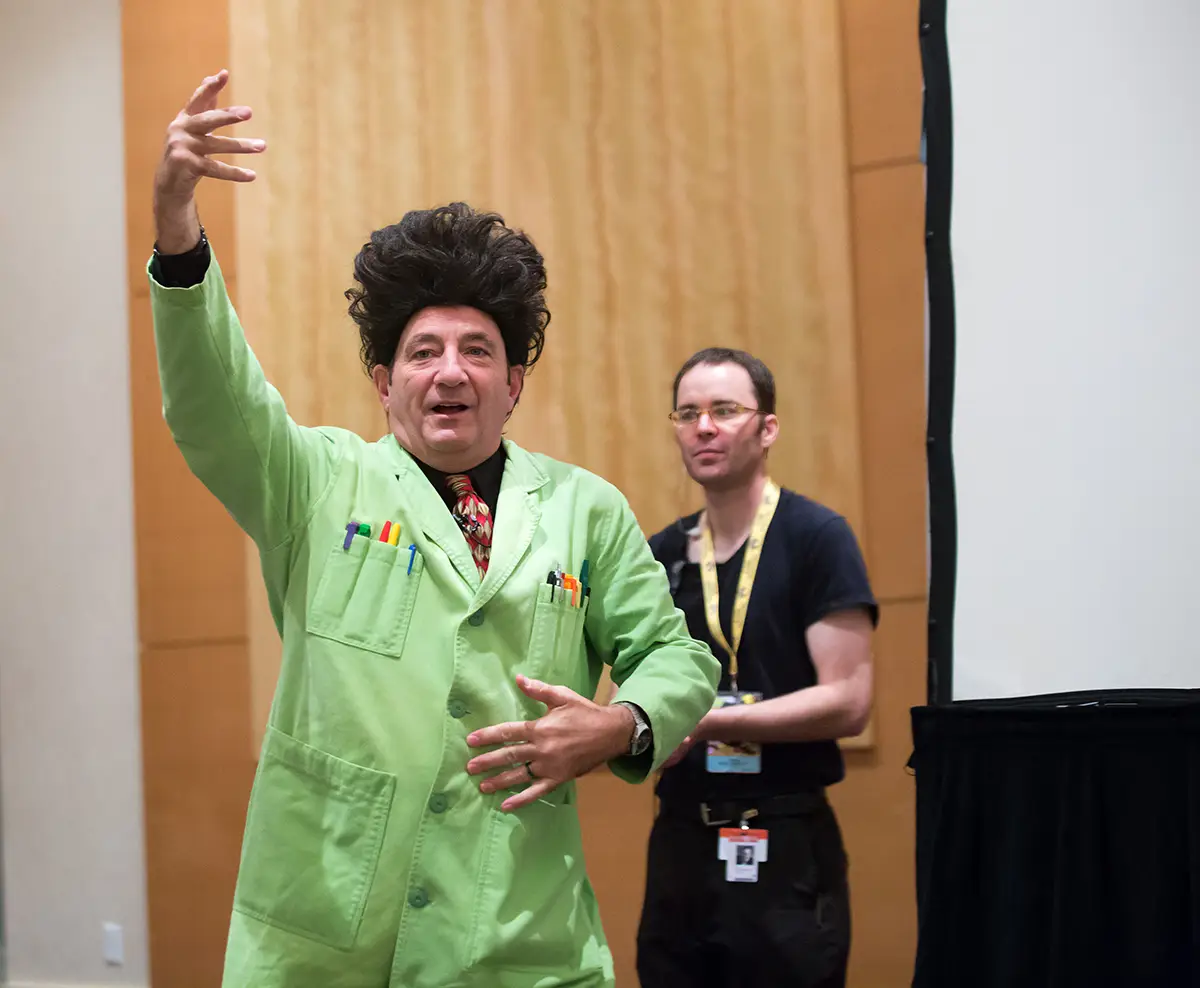
Eight years after he started doing that in theatres, he was on CBS on a Saturday morning in a green lab coat, explaining static electricity to eleven million children.
Nobody at the time thought those were the same job. They were.
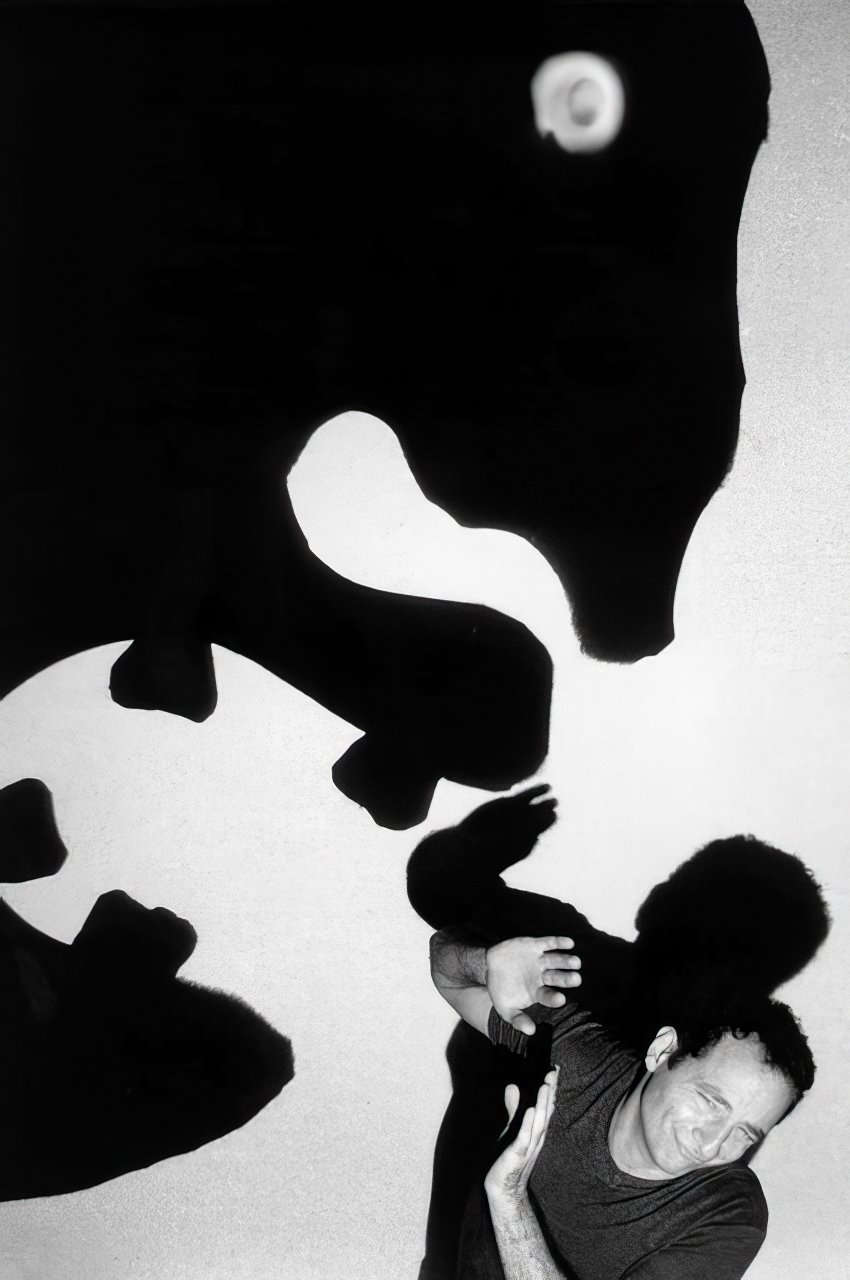
The overhead projector as a stage. On Zaloom’s own site this one is captioned “a giant, sadistic dentist rises from the overhead projector to threaten Zaloom with bankruptcy after torturing the puppeteer, his teeth, and his gums.” Photograph © Howard Wise, from zaloom.com.
Nineteen, and a very large puppet
Zaloom was born in Garden City, New York, on 14 December 1951 and went to Goddard College in Vermont, which he has cheerfully described as a wild hippie college. While he was there he fell in with the Bread and Puppet Theater. That decided everything else.
Bread and Puppet was founded by Peter Schumann and it does what its name says. It builds enormous puppets out of cardboard, scrap cloth and papier-mâché, walks them through the streets to argue against a war and hands out free sourdough bread at the end. Schumann’s position was that theatre should be as basic and as necessary as food, so it shouldn’t need a building, a budget or a ticket.
A nineteen year old absorbed two things there that he never put down. The first is that a complicated idea can be carried by simple materials. The second is that the audience is everybody, not the people who already know.
He became ringmaster of the company’s annual Domestic Resurrection Circus in Glover, Vermont. He kept doing it for twenty-seven years. Think about that against the television career. Every summer, for nearly three decades, the man off the science programme was standing in a Vermont field in a wide hat, bellowing at a crowd, with a line of hand-painted flags behind him.
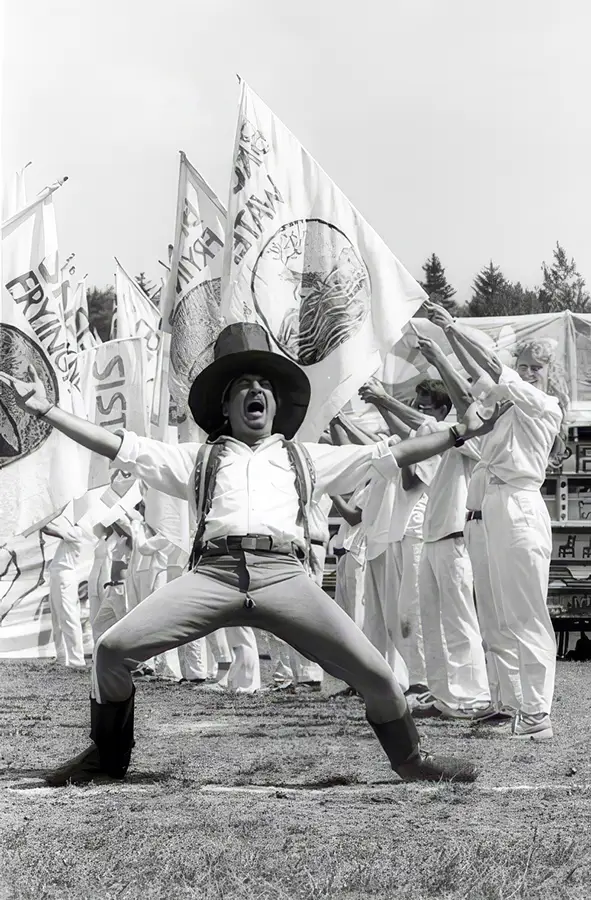
Zaloom announcing the Bread and Puppet Theater’s Domestic Resurrection Circus in Glover, Vermont. He was ringmaster for twenty-seven years. Photograph © Ron Simon, from zaloom.com.
The Theater of Trash
He went solo at the end of the seventies with a piece called The World of Plastic. The thing he invented there now has a name in puppetry: object theatre. No characters, no marionettes, no carved heads. He takes things that already exist and performs them: a coffee pot, a humidifier, a distributor cap, a hubcap.
In 1984, in a show called Creature from the Blue Zaloom, he staged a space battle between a hubcap and a broken child’s toy. In 1986 he called an entire show The Theater of Trash. The subjects underneath the junk were not gentle: the arms race, civil defence leaflets, indoor pollution, religious intolerance, censorship of the arts.
I want to be plain about why this matters on a science site, because it would be easy to file it under “interesting hobby”. A hubcap standing in for a spacecraft and a plastic bottle standing in for the atmosphere are the same manoeuvre. You take an object the audience already owns, strip out everything that makes it precious and let it carry an idea it wasn’t built for. Every good demonstration a teacher has ever done works that way. Zaloom had ten years of hard practice at it before anyone pointed a television camera at him.
The theatre world took him seriously for it. He won a Village Voice Obie, a Guggenheim Fellowship, a Bessie, four fellowships from the National Endowment for the Arts and four Jim Henson Foundation grants. He played the Kennedy Center and Lincoln Center. He wasn’t a children’s entertainer who dabbled in art. He was an award-winning avant-garde artist who took a children’s job.
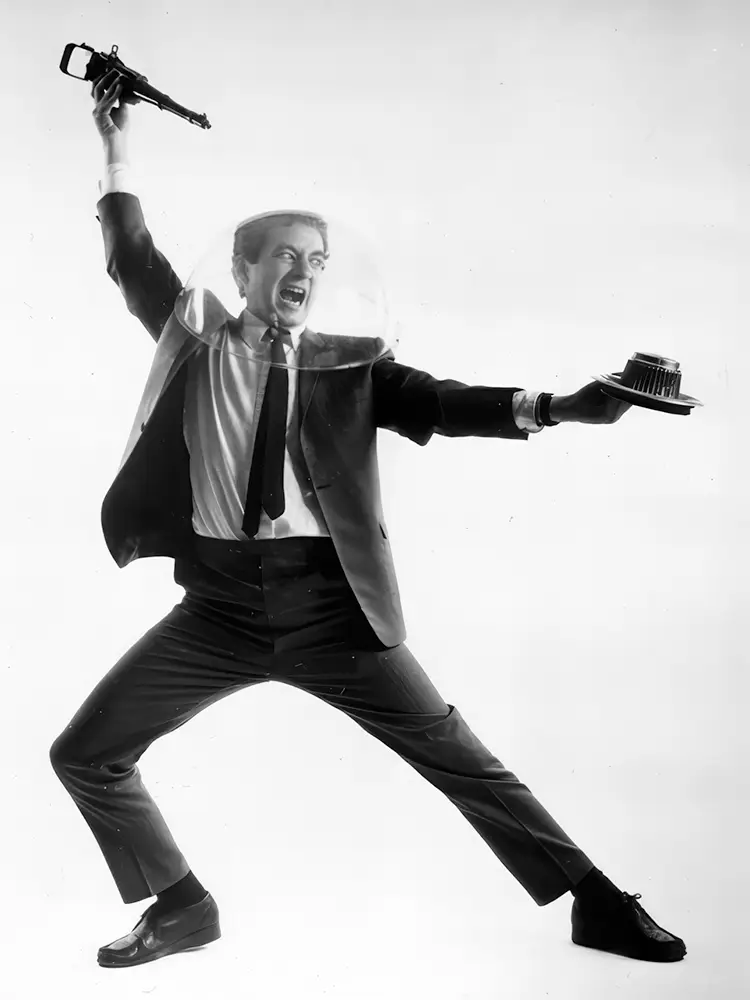
A suit, a salad spinner worn as a space helmet, a gun and a cake. His site’s caption has him “looking into the future with his cheerful smile and recently acquired extra limbs.” Photograph © Howard Wise, from zaloom.com.
A comic strip in a Marin County newspaper
The other half of the story starts with a man called Jok Church, who had a job at Lucasfilm answering the letters children sent to George Lucas.
Reading thousands of those letters gave him an idea. On 14 July 1991 he gave a strip called You Can with Beakman and Jax free to his local paper, the Marin Independent Journal. It answered real questions from real children and, instead of supplying the answer, set out an experiment they could run at home to find it. Church deliberately picked questions he didn’t know the answer to, so he’d be learning alongside them. He also had a rule about what he was for.
To make sure my readers are not intimidated by the world through which they walk.
It went from one local paper to 52 million readers in thirteen countries. Around eighty per cent of the letters came from girls, which was not what anyone expected from a science strip in 1991 and is worth mentioning to a class.
Church died of a heart attack in San Francisco on 29 April 2016, aged 66. The strip ran on for another eleven weeks and stopped.
A live-action cartoon
Columbia Pictures Television optioned the strip in 1992. The brief for casting was a specific one: not a sitcom dad, somebody unorthodox. They found a forty year old political puppeteer.
Beakman’s World premiered on The Learning Channel on 16 September 1992 and went into syndication three days later on 225 stations, a record for a first-year show. CBS took it for Saturday mornings from 18 September 1993. Four seasons, 91 episodes, showing at its peak in close to ninety countries.
The production was aiming at the same audience Bill Nye was; it went about it a different way. The stated goal was a live-action cartoon. Mark Mothersbaugh of Devo wrote the theme with Denis M. Hannigan; Wayne White designed the set, having come off Pee-wee’s Playhouse. Both of those are punk credentials rather than educational ones and the tone follows from them: a cluttered lab, jokes that run faster than the science and a host who never once behaves like a teacher.
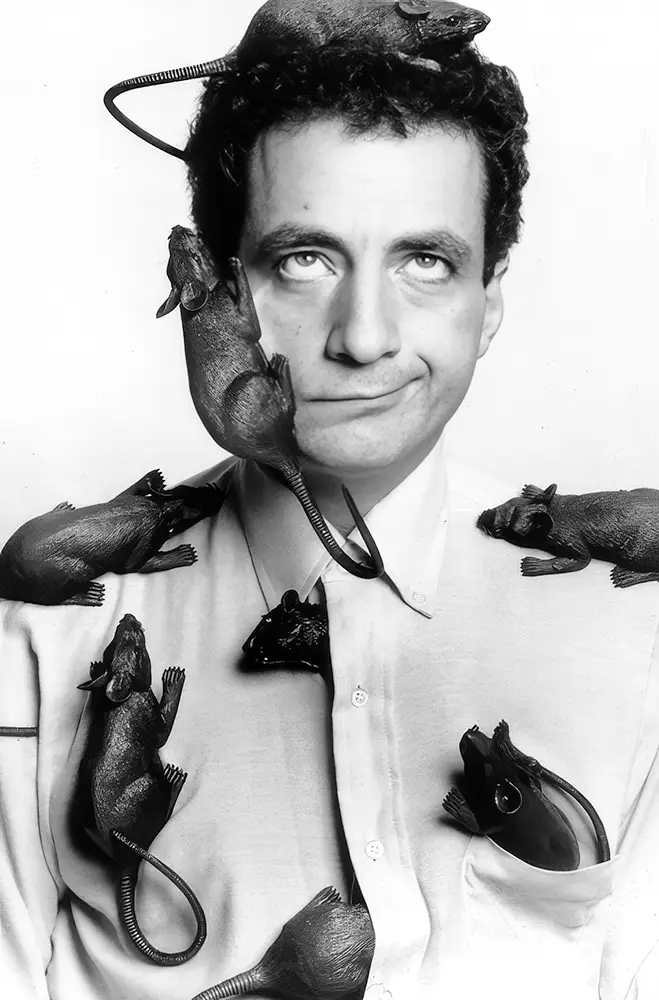
Zaloom covered in rats, from his solo show Sick but True, 1992. The same year Beakman’s World premiered and gave him a sidekick in a rat suit. Photograph © Jim Moore, from zaloom.com.
The regulars did specific jobs. Mark Ritts played Lester, a man in a rat suit, permanently aggrieved, forever suggesting his agent had ruined his life. Lester takes the audience’s side; he’s the one asking why he should care, which is the question a class actually has. Three lab assistants came and went, Alanna Ubach as Josie, Eliza Schneider as Liza and Senta Moses as Phoebe. Two puppet penguins called Don and Herb opened and closed each show from the South Pole. Hold that thought about the penguins.
Mark Ritts died in 2009, aged 63.
What Mr Wizard said about it
In March 1994, Education Week ran a piece on the new wave of science programmes and went to Don Herbert for comment. Herbert had been Mr Wizard since 1951. He had done it properly and he had done it first. He wasn’t impressed.
He said the new shows don’t “just do plain science. They have to sugarcoat it.” Then he put the real objection: “If you are only trying to get their attention and not get them involved, that’s one thing. What we try to do on Mr Wizard is to get them involved intellectually.”
That deserves a straight answer rather than a shrug, because he had a point and so did they. Herbert had children in a studio doing the work and the camera held still while they did it. Beakman cuts every four seconds. If the cutting is doing the entertaining, the child is a spectator, and a spectator learns very little.
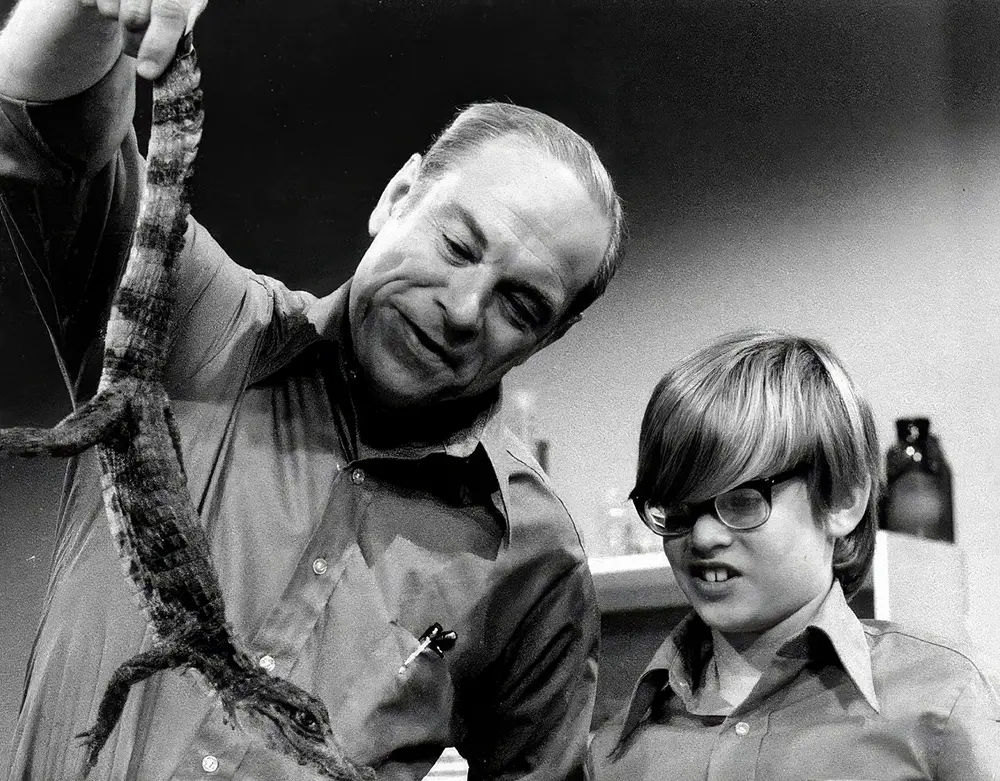
Don Herbert, Mr Wizard, doing it the slow way: one animal, one child, one long look. He had been at it since 1951 and he thought the new science shows sugarcoated it. Publicity photograph, public domain in the United States, published without a copyright notice, via Wikimedia Commons.
The defence is that Herbert had no competition and Beakman had MTV. A programme nobody watches teaches nobody anything. The Beakman answer to Herbert is that the pace buys the attention and the experiment then has to earn it. Whether it did depends on the episode and on the day.
The same article has one more thing in it that’s worth your time. Bill Nye, whose own programme launched the year before, took a swipe at Beakman in it: “If you come to a show with no knowledge about how airplanes fly, you won’t get any lift from Beakman’s short discussion of it.” He was making the same complaint Herbert had made about him. Both biographies are on this site now. You can watch them argue about each other in 1994 while a class decides who was right.
Then there are the penguins. Somebody on that production named the two puppets who topped and tailed every episode Don and Herb. The show took the criticism, made a joke out of it and put a permanent tribute to the man on screen ninety-one times. That’s a better response than a press release.
Big in Mexico
The American run ended in 1997. In most of the world the story would stop there.
In Latin America it didn’t. El mundo de Beakman became genuinely enormous, in Mexico especially, and stayed that way for decades after it stopped being made. When Zaloom turned up in Mexico City he found thousands of adults waiting, plenty of whom told him some version of the same sentence: I’m a doctor today because of you.
In August 2016 he played the Jaime Torres Bodet auditorium at the Instituto Politécnico Nacional, alongside the city’s international book fair. Not a nostalgia signing. The full live show, in a science institute, to an audience who had grown up and gone into science.
The harder part
Zaloom doesn’t own Beakman’s World. The consequences are worse than they sound.
Talking to the Mexican press in 2016, he explained why the live show was the only thing on offer: rights restrictions meant the programme couldn’t run on television or online; only the stage performances were permitted. His face is on ninety-one episodes he wasn’t allowed to put in front of anyone.
Some of that has since loosened. You can find remastered versions on here. The point stands though, because it wasn’t his decision either way.
If that sounds familiar, it’s because the Bill Nye page ends in the same place by a completely different route. Nye sued Disney over the accounting on his own show, fought it for seven years and lost in 2024. Different mechanism, same unfortunate conclusion: the person whose face is on the programme is very often not the person who owns it.
What a teacher can take from him
Three things, and none of them need a green coat.
Use the objects you already have. Not because budgets are tight, though they are, but because a familiar object is a better teaching tool than an unfamiliar one. A child who has held a hubcap can follow a hubcap. Zaloom’s whole career is a forty-year argument for this.
Let the demonstration go wrong in public. He came out of live performance, where you can’t stop and go again. It shows. A demonstration that fails and gets talked through in front of the class teaches more about science than one that works, because working is what a video does and diagnosing is what a scientist does.
Say what you don’t know. Jok Church built the strip on questions he couldn’t answer, on purpose, so he’d be finding out at the same time as the reader. Try it once a term.
Where to go next
Beakman’s World and Bill Nye the Science Guy were made for the same children in the same years and they solved the problem differently. Read the Bill Nye biography next, then decide which of them Don Herbert was right about. Everything on the site is in the full catalogue.
Sources
- Paul Zaloom, biography and career, Wikipedia
- Biography and photographs, zaloom.com
- Paul Zaloom, on Bread and Puppet and object theatre, World Encyclopedia of Puppetry Arts
- Beakman’s World, production, cast and broadcast history, Wikipedia
- You Can with Beakman and Jax, with Jok Church’s stated aim, Wikipedia
- Media: A Blizzard of Wizards, for the Don Herbert and Bill Nye quotes, March 1994, Education Week
- El show de Beakman regresa al IPN, 26 August 2016, Excélsior
- Beakman’s World, full episodes, Indoor Recess, Sony Pictures Television