When David Attenborough joined the BBC in 1952, he’d seen exactly one television programme in his life. Almost nobody in Britain owned a set. He’d applied for a job in radio and been turned down; somebody passed his application along to the small and slightly embarrassing television service instead.
He turned a hundred on 8 May 2026. That spring, BBC One was broadcasting his new series.
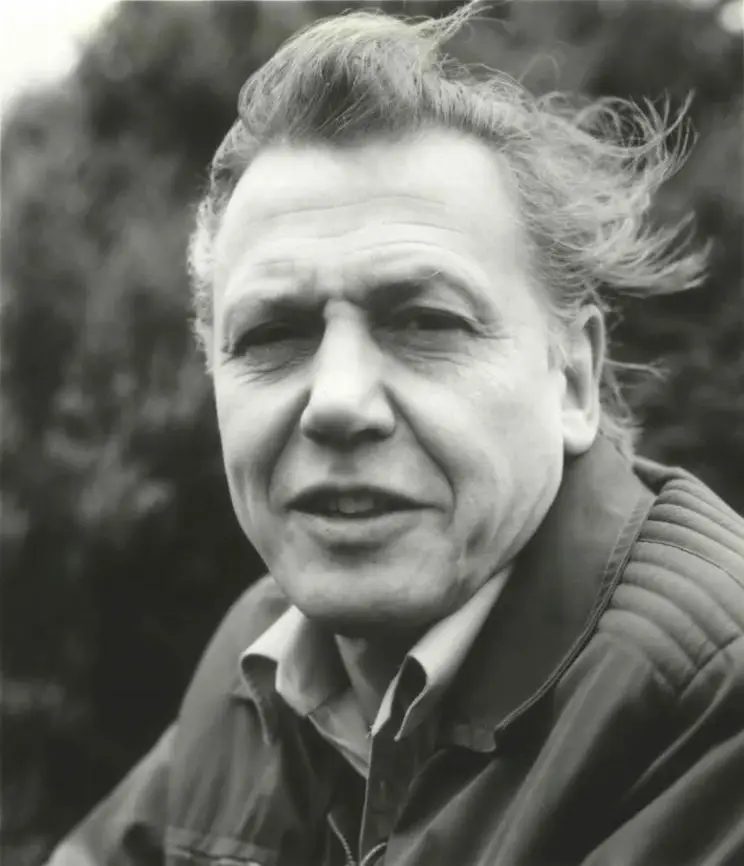
A BBC press photograph from 1982, taken in the years around Life on Earth. Via Wikimedia Commons.
Leicester, and a room full of fossils
He was born on 8 May 1926 in Isleworth and grew up in Leicester, where his father Frederick was Principal of University College. The family lived on campus, so a small boy had a university on his doorstep and the run of it.
He filled his room with fossils and stones and specimens. His older brother Richard became an actor and then a film director; the younger one, John, went into the motor trade and ended up running Alfa Romeo in Britain. During the war their parents took in two Jewish girls who’d been got out of Germany and raised them alongside their own three sons.
He read natural sciences at Clare College, Cambridge, geology and zoology, then did his national service in the Royal Navy. Neither of those obviously leads to a television career. In 1952 nothing did, because there was barely any television to have a career in.
Zoo Quest, and what it was actually for
In 1954 the BBC and London Zoo went into partnership on a series called Zoo Quest. Attenborough was the producer. Jack Lester, the zoo curator who was supposed to present it, fell ill before transmission. Attenborough stepped in front of the camera at short notice because there was nobody else.
Be plain about what the programme was. Zoo Quest filmed expeditions that went out to collect live animals and bring them back to London Zoo. The animals were the point and catching them was the story. Nobody would commission that now, and he’s said as much himself. It ran until 1963 and it made him.
The best job he ever quit
In 1965 the BBC made him Controller of BBC Two; he stopped making programmes to run a channel. He was good at it in a way that’s quietly shaped British culture ever since.
He commissioned Monty Python’s Flying Circus. Then Kenneth Clark’s Civilisation, followed by Jacob Bronowski’s The Ascent of Man, which is the direct ancestor of every serious documentary series since, including his own. He brought colour television to Britain, with BBC Two going first.
He also invented a snooker programme. Pot Black exists because Attenborough wanted something that would demonstrate colour to people thinking about buying a set and worked out that coloured balls on green baize would do it better than anything else on television, which is the same instinct that runs through everything he made: find the thing that shows the point by itself.
In 1969 he was promoted again to Director of Programmes for BBC Television and was being talked about as a future Director-General. In 1973 he resigned. He didn’t want to run the BBC; he wanted to go and film animals.
Everything he’s known for came after he gave up the biggest job he was ever offered.
Life on Earth
Life on Earth went out in 1979. Thirteen episodes and three years of filming, built on a structure nobody had attempted on television before: the entire history of life, in order, from single cells to us.
It changed what a wildlife programme was. Before it the genre ran on expeditions and personalities. After it the animal was the subject and the presenter was the guide.
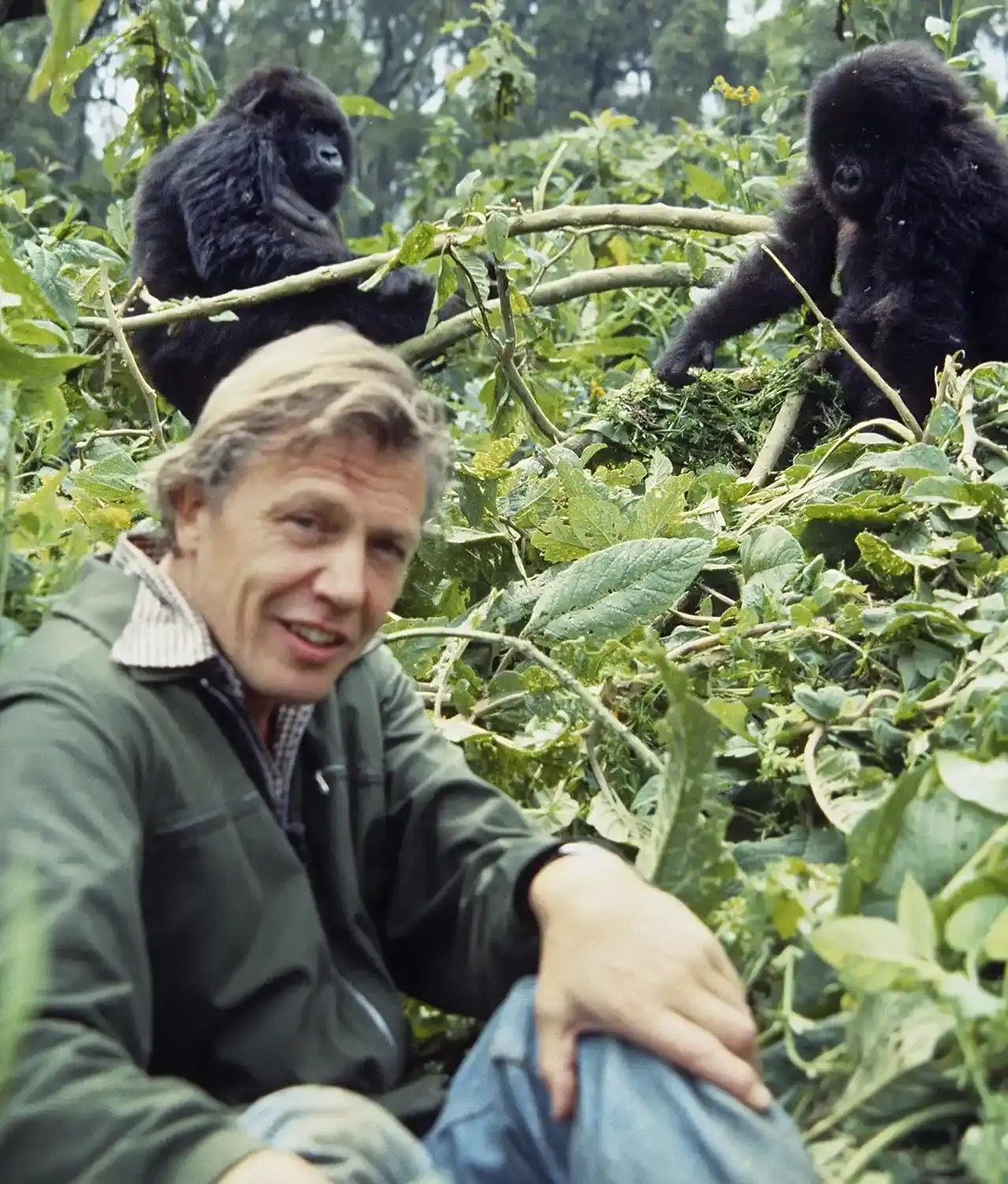
Rwanda, 1978. He had a script. Two young mountain gorillas arrived and started going through his hair, so he abandoned it and improvised instead. Photograph by John Sparks for the BBC Natural History Unit, from Life on Earth.
The most famous few minutes of it were an accident. In Rwanda in 1978 he sat down among the mountain gorillas to deliver a piece to camera he’d written in advance. Two young gorillas came over and started going through his hair. He abandoned the script and improvised it lying on his back, whispering, while they climbed on him.
Look at that photograph again and notice where he is in the frame. Bottom left, small and slightly out of focus. The gorillas have the top of the picture and he’s tucked into the corner. None of that was an accident.
The method
If you teach, this is the part worth stealing.
He whispers. Everything else on television is trying to be louder than the thing next to it. He goes the other way and makes you lean in. Compare that with Bill Nye, who cut his programme at the speed of MTV because MTV was on the other channel. Opposite techniques, identical thinking: work out what you’re competing with, then decide deliberately.
He gives you the number, not the adjective. He doesn’t say a creature is amazing. He tells you it can detect a change of one thousandth of a degree and lets you arrive at amazing on your own. The judgement is left to the viewer, which is why it sticks.
He gets out of the way. He’s on screen for a fraction of the running time, and when he is he’s usually smaller than whatever he’s showing you.
One idea per programme. An episode of Life on Earth covers one step in the story and doesn’t wander. Watch the Galapagos episode on evolution and count how many times he comes back to the same single point from a different animal. That’s the whole technique.
The slightly grey area
He’s probably the most trusted person in Britain, which is exactly why this section matters and why I’d show it to a class.
Zoo Quest was an animal collecting programme. Nine years of going out to bring wild animals back to a zoo, filmed as adventure. He was young, it was 1954, and he hasn’t pretended otherwise since. Say it to students rather than letting them find it.
He was wrong about climate change, then quiet about it, for a very long time. He was sceptical that humans were causing it until a lecture changed his mind around 2004. Even then he stayed largely off the subject for years, arguing that people came to his programmes for beauty and would switch off if he lectured them. In 2013 the BBC cut a climate reference out of Africa for an international edit.
Critics went further than “he’s being cautious”. The writer George Monbiot argued, repeatedly and in print, that the format itself was the problem: film a coral reef or a rainforest as untouched wilderness and you tell the audience, without ever saying it, that everything’s fine. In 2018 he accused Attenborough of creating a false impression of the world.
Then, at ninety two, he made Climate Change: The Facts, following it at ninety four with A Life on Our Planet, which he called his witness statement. He didn’t soften it. He said the natural world is collapsing and that he’d watched it happen across a single lifetime, his own.
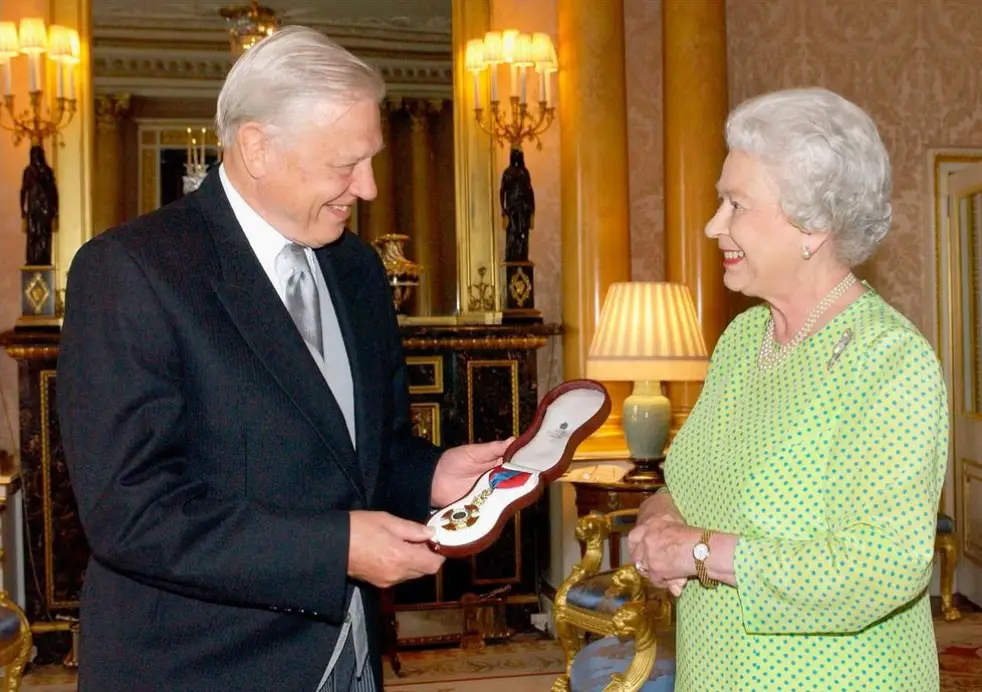
Receiving the Order of Merit from Queen Elizabeth II in 2005. The establishment took him to its heart across exactly the decades when, by his own later account, he was not saying the thing that mattered most.
And the population remarks. In a 2013 Radio Times interview he described humans as “a plague on the Earth” and called sending famine relief to Ethiopia “barmy”. He’s been a patron of Population Matters for years. The criticism is fair and it isn’t really about tone: consumption in wealthy countries does far more environmental damage per person than population growth in poor ones, so framing the problem as too many people in Africa points the finger in the wrong direction.
I’m not putting this here to knock him down, but because of what happened next. A man who’d been wrong about the biggest thing in his own field, publicly, for decades, looked at the evidence and changed his position in his nineties, when he had every excuse not to bother.
Which is worth a great deal more than never having been wrong in the first place.
Still going
He released Ocean in 2025, at ninety nine, arguing that bottom trawling is destroying the seabed and that protecting the sea is the fastest recovery available to us. In April 2026 Secret Garden went out on BBC One: five episodes about the wildlife living in ordinary British gardens, made with the Open University.
All of it seventy four years after he joined an organisation he assumed wouldn’t last, in a medium he’d barely seen.
Where to go next
Start with Galapagos: Origin and follow it through to Evolution, which is the closest thing on this site to Life on Earth in miniature. Then try Kingdom of Plants, or Deep Sea Bioluminescence if you want the strangest thing he’s ever filmed. Everything is in the David Attenborough hub.
Sources
- David Attenborough, life and career, Wikipedia
- In a World of Their Own, on nature documentaries and what they leave out, George Monbiot
- Africa TV series edited over climate change comment, BBC News
- David Attenborough climate change TV show a call to arms, BBC News
- Secret Garden, 2026 series, Wikipedia
- The world is celebrating David Attenborough’s 100th birthday, Time