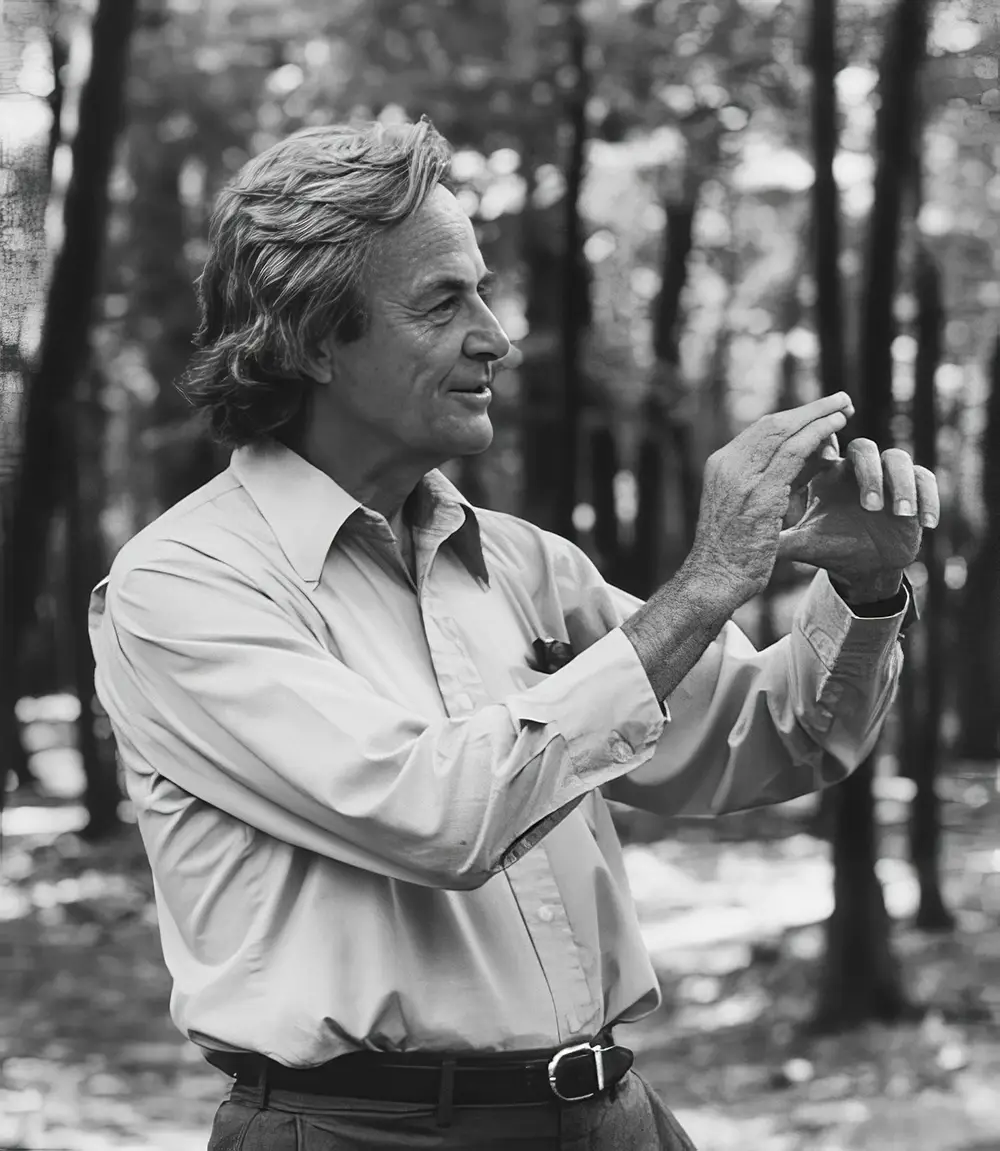
There’s a photograph of Richard Feynman’s blackboard at Caltech, taken shortly after he died in February 1988. In the top left corner, in his own handwriting, there’s a line he’d left up for months: What I cannot create, I do not understand.
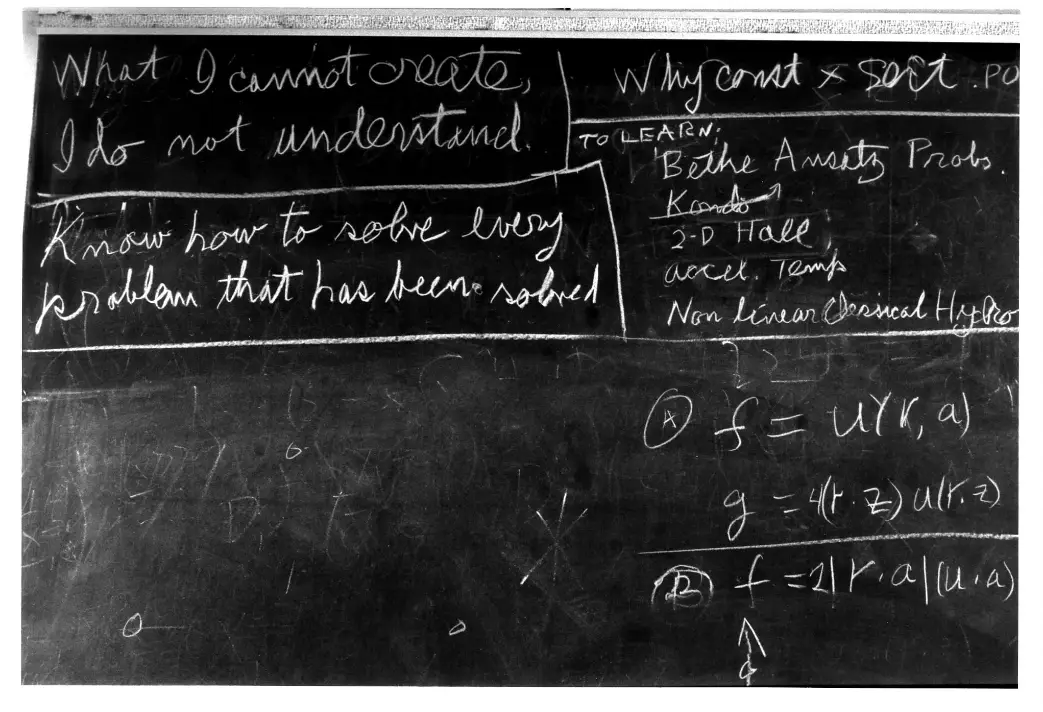
Feynman’s office blackboard, photographed after his death in February 1988. The two lines top left were still up. Courtesy of the Caltech Archives and Special Collections.
That sentence is the reason he is on this site. Feynman spent fifty years insisting on a brutal test for understanding; it’s one most of us fail most of the time. Can you build the thing? Can you derive it from scratch, without looking? Can you explain it to somebody who doesn’t already know the answer? If not, you’ve memorised a label rather than learned anything.
He was also, by his own written account, a man who treated women badly and thought it was funny. Both of those things are true and this page covers both, because pretending otherwise would fail his own test.
His father taught him the difference between a name and a thing
Feynman was born on 11 May 1918 and grew up in Far Rockaway, in Queens. His father, Melville, sold uniforms for a living and had wanted to be a scientist. He couldn’t be one, so he built one.
The story Feynman told most often was about a bird. Some boys at summer camp had teased him for not knowing what a particular bird was called. He already knew what his father would say about that, because his father had said it many times: you can learn that bird’s name in every language on Earth and still know absolutely nothing about the bird. Then you look at what it is doing. Why is it pecking at its feathers like that? Because lice are eating the flakes of protein that come off. And the lice have mites feeding on their waste, and so on down. That’s knowledge. The name is just a noise humans agreed on.
Melville also made abstractions physical. Reading his son a passage about a dinosaur twenty five feet tall with a head six feet across, he stopped and translated it: that means if it stood in our front garden it could get its head to this window, but not through it, because the window is too narrow. Every number became a picture you could stand next to.
Feynman never stopped doing this. Watch him talk about atoms jiggling forty years later and you are watching his father’s method, still running.
Los Alamos, at twenty four
He went to MIT as an undergraduate and to Princeton for his doctorate, which he finished in 1942. Princeton was a shock. The place was formal in a way Far Rockaway wasn’t and he was famously undone at his first tea by being asked whether he took cream or lemon. He said he would have both. The dean’s wife laughed at him. He decided fairly quickly that he’d rather be the person who asked stupid questions than the person who never asked.
Almost straight out of his PhD he was recruited to the Manhattan Project and by 1943 he was at Los Alamos in the Theoretical Division under Hans Bethe. He got promoted to group leader while still in his mid twenties, the youngest man there to run a group. He co-authored the formula used to calculate a fission bomb’s yield and he took over the computing effort, wiring up IBM punched-card machines into what was effectively a parallel processing system before anybody used that phrase.
He also cracked the safes. Not as a prank, or not only as a prank. The most secret documents in the world were sitting in filing cabinets whose combinations people had left on factory default or set to mathematical constants, so Feynman opened them and left notes inside to prove the point. The security officers responded by circulating a memo telling everyone to keep Feynman away from their safes. He thought that was the funniest possible outcome and also exactly the wrong lesson.
Arline
Running underneath all of this was Arline Greenbaum, his girlfriend from high school. She had tuberculosis and in 1942 it was going to kill her. His parents told him not to marry her. He married her anyway, on 29 June 1942, then drove her from the ceremony straight to a hospital.
When he moved to Los Alamos he put her in a sanatorium in Albuquerque and drove the two hours across the desert to see her every weekend. She died on 16 June 1945. The Trinity test, the first atomic detonation in history, was one month later.
He went back to work and didn’t cry. He held it back for months, until he walked past a shop window in Oak Ridge, saw a dress and thought that Arline would have liked it. Sixteen months after her death he wrote her a letter. It says plainly that he loves his wife and that his wife is dead. He never sent it, for the obvious reason. He never showed it to anyone either. It was found among his papers after he died.
The diagrams
He arrived at Cornell in late 1945 burnt out, grieving and convinced he was finished as a physicist. His way out was to stop trying to be useful.
In the cafeteria someone threw a plate in the air and Feynman noticed that the wobble and the spin weren’t the same speed. He worked out the ratio for no reason at all except that he wanted to know. Bethe asked him what the point was. There was no point; that was the point. He’d started playing again. Within a couple of years that play had walked him back into the biggest unsolved problem in physics.
Quantum electrodynamics, QED, is the theory of how light and matter interact. In the 1940s it was in trouble. Push the calculations far enough and they returned infinity, which is not a measurement of anything. Feynman’s escape route was to change the picture entirely. Instead of asking which path a particle takes from A to B, he treated it as taking every possible path at once, including absurd ones, and added the contributions up. That’s the path integral formulation and it made the infinities cancel.
Then he did the thing that changed how physics is taught. He worked out that each term in the horrible algebra could be drawn. A straight line is a matter particle such as an electron. A wavy line is a force carrier such as a photon. Where lines meet, something happens. Read the picture, write the maths.
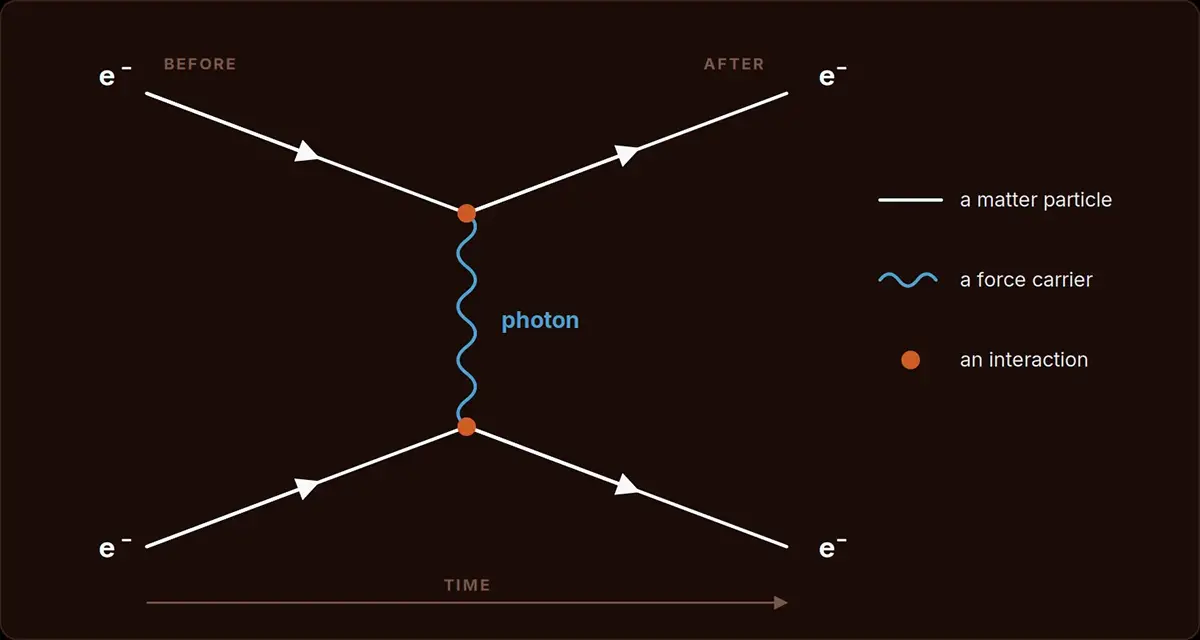
The simplest useful Feynman diagram. Two electrons come in, swap a photon, and leave. Everything you need to read it is on the picture.
Feynman diagrams are not photographs of particles and they aren’t snapshots in time. They’re bookkeeping and that’s exactly why they are powerful. A calculation that used to take a specialist several pages became a drawing an undergraduate could do on a napkin. Particle physics stopped being the private property of people who were very good at algebra.
The 1965 Nobel Prize in Physics went to Feynman, Julian Schwinger and Sin-Itiro Tomonaga, who had each solved the same problem separately and by very different routes.
| Physicist | Route to the answer | What it is like to use |
|---|---|---|
| Sin-Itiro Tomonaga | Made quantum field theory properly relativistic | Rigorous, field based, slow to picture |
| Julian Schwinger | Quantum action principle and operator formalism | Dense, formal, very hard to teach |
| Richard Feynman | Sum over every possible path, drawn as diagrams | Visual, particle based, teachable in an afternoon |
All three answers agree. Feynman’s is the one that ended up on the whiteboards, which tells you something about what survives in science: not always the most rigorous version, but the version people can actually think with. QED went on to become the most accurately tested theory we have, matching experiment on the magnetic moment of the electron to around ten decimal places.
The Lectures, and the thing nobody mentions about them
Between 1961 and 1964 Feynman redesigned and taught the introductory physics course at Caltech. The recordings were edited into three volumes, The Feynman Lectures on Physics, which have never been out of print and which most physicists own.
Here is the part that gets left out. The course was built for first year undergraduates and it didn’t work for them. The freshmen found it too fast and too abstract, and attendance among them fell away as the two years went on. The seats kept filling up, but with graduate students and faculty who had come to watch a master rebuild their own subject from the ground up. Feynman said in his own preface that he didn’t think he’d done well by the students he was actually hired to teach.
If you teach, that’s worth sitting with. The books are magnificent. As a course, delivered to the audience it was designed for, it partly failed. Being brilliant at the board and being a good teacher are two different skills; the second is about the learner rather than the performance.
For a successful technology, reality must take precedence over public relations, for Nature cannot be fooled.
Fun to Imagine
In 1983 the BBC sat Feynman in a chair, pointed a camera at him and let him talk. No script, no graphics, no presenter. He was 65 and had already had cancer once.
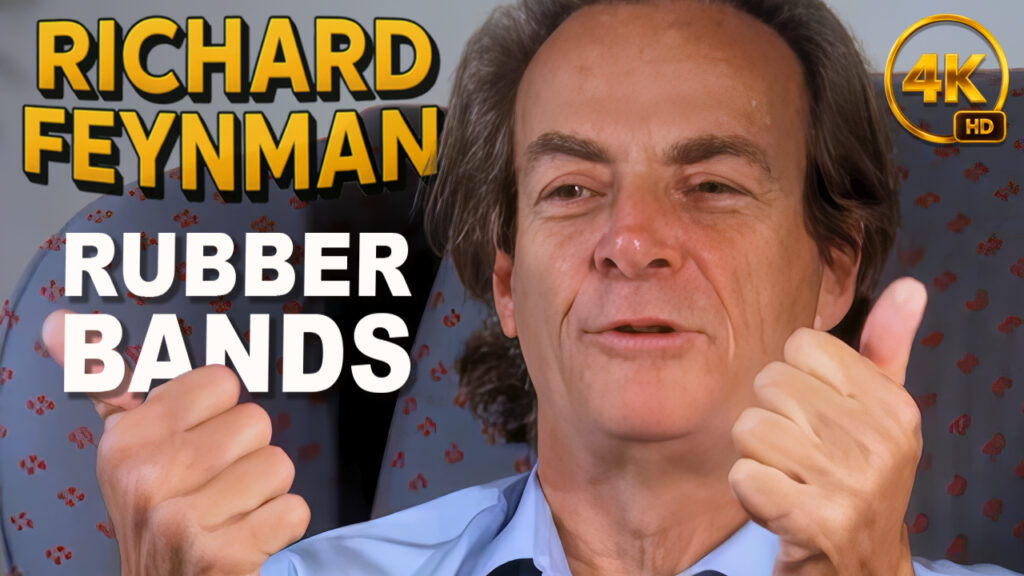
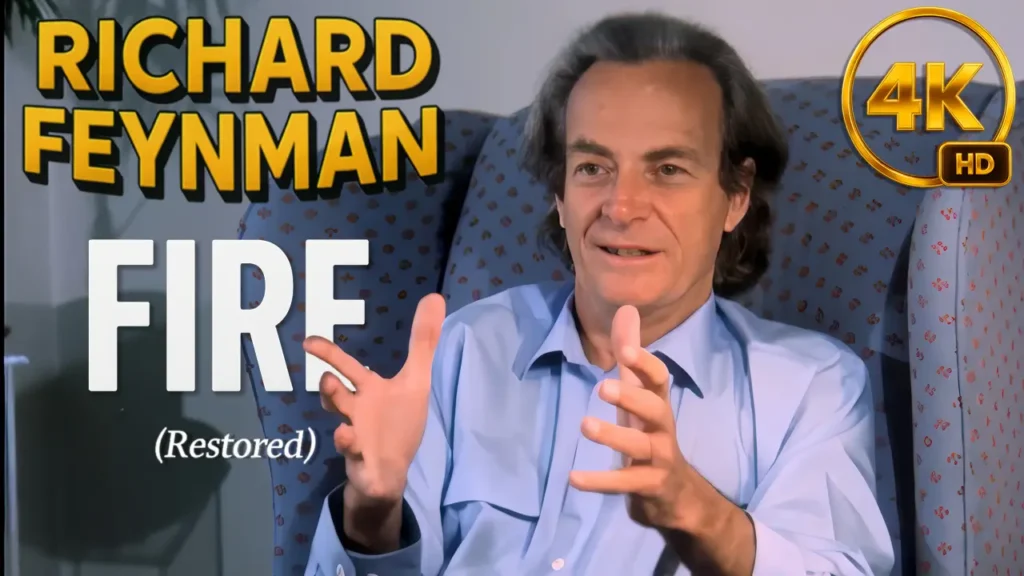
What came out is the best argument I know for why a good explanation beats a good animation. He takes a glass of water and gets you down to the atoms bouncing off each other. He takes a fire and traces the heat in the log back to sunlight that fell on a leaf. He takes a rubber band, stretches it and shows you that the reason it pulls back is molecular chaos, not springiness.
The three episodes we host are the core of it:
- Jiggling Atoms, on why everything you can touch is made of things in constant motion
- Fire, on where the energy in a burning log actually came from
- Rubber Bands, on entropy doing something you can hold in your hand
The same series contains his answer to an interviewer who asked him why magnets repel each other. He refuses to answer. He then spends seven minutes explaining, patiently and without a trace of condescension, why the question cannot be answered at the level it was asked, because every answer would be in terms of something the questioner accepts without understanding it either. It’s one of the most honest pieces of science communication ever filmed and it’s essentially the same move Julius Sumner Miller made every time he said “why is it so?”
The O-ring
On 28 January 1986, Challenger broke apart seventy three seconds after launch and seven people died. Feynman, by then seriously ill, was talked onto the Rogers Commission investigating it.
He hated it. The hearings were full of managers giving answers that were technically true and completely useless. So he went around them, straight to the engineers who built the thing and asked them what they thought had happened. They told him about the rubber O-rings sealing the joints of the solid rocket boosters and about how those seals behaved when it was cold. It had been very cold that morning.
On 11 February 1986, on live television, Feynman asked for a glass of iced water. He took a sample of the O-ring rubber, squeezed it in a C-clamp, dropped it in the water for a couple of minutes, took it out and released the clamp. The rubber didn’t spring back. There was nothing left to argue about.
His more important contribution was written, not televised. He insisted on attaching a personal appendix to the commission’s report and in it, he set out a number that should be taught in every engineering course. NASA management put the odds of a catastrophic failure at about one in one hundred thousand. The engineers doing the actual work put it at about one in one hundred. The organisation wasn’t short of data. It was short of anyone willing to carry the engineers’ number upstairs. He closed the appendix with the line about Nature not being fooled.
The grizzly grey area
Feynman’s memoirs, Surely You’re Joking, Mr. Feynman! and What Do You Care What Other People Think?, sold in enormous numbers and built the public image: bongos, safes, Brazil, the wisecracking outsider.
They’re also the source of the case against him. Nobody had to dig this up. He wrote it down himself, cheerfully, as material.
He describes learning a technique for picking up women in bars that starts from deciding to regard them with contempt, on a theory that they respond to being treated badly. He describes deceiving women to get them into bed and presenting it as a solved problem, the same tone he uses for the safes. He held meetings in a topless bar and testified in court to keep it open. He drew nude portraits of women, some of them students, at an institution where he was one of the most powerful men in the building.
The usual defence is that it was a different time. That defence is weak in his case for two reasons. First, the power gap between a Nobel laureate and a young woman at his own university wasn’t a period detail; it was the whole mechanism. Second, the tone isn’t that of a man following the customs of his era. It is the tone of a man who found the whole thing amusing and expected you to as well.
I still post his videos and I want to be straight with you as to why. He proved himself to be human, and on that count not a very good one, but his physics is still great. The teaching in Fun to Imagine is still the best I’ve seen anybody do on camera, and refusing to show it wouldn’t undo a single thing he did to anybody.
What I’m not willing to do is hand you a watered down version. The Feynman most students meet, the loveable genius with the bongos and the safes and the Brazilian samba band, is a marketing cut of a real person. You should have the whole life in front of you and make your own mind up about the man. That’s the entire point of this site. I put up the evidence and you do the thinking. Learn his method and try to avoid his bad habits.
Where to go next
Start with Jiggling Atoms, which is seven minutes long and will change how you look at a glass of water. Then work through the rest of the Fun to Imagine series.
The second line on that Caltech blackboard, under the one about creating things, reads: Know how to solve every problem that has been solved. Which is a different thing from knowing the answers.
Sources
- Richard P. Feynman, Biographical, The Nobel Prize
- Richard Feynman, Biography, Nobel Prize and Facts, Britannica
- Richard Phillips Feynman, 1918 to 1988, Biographical Memoirs of Fellows of the Royal Society
- Manhattan Project Scientists: Richard P. Feynman, US National Park Service
- Appendix F, Personal Observations on the Reliability of the Shuttle, Rogers Commission Report
- How Legendary Physicist Richard Feynman Helped Crack the Case on the Challenger Disaster, Literary Hub
- Surely You’re a Creep, Mr. Feynman, The Baffler