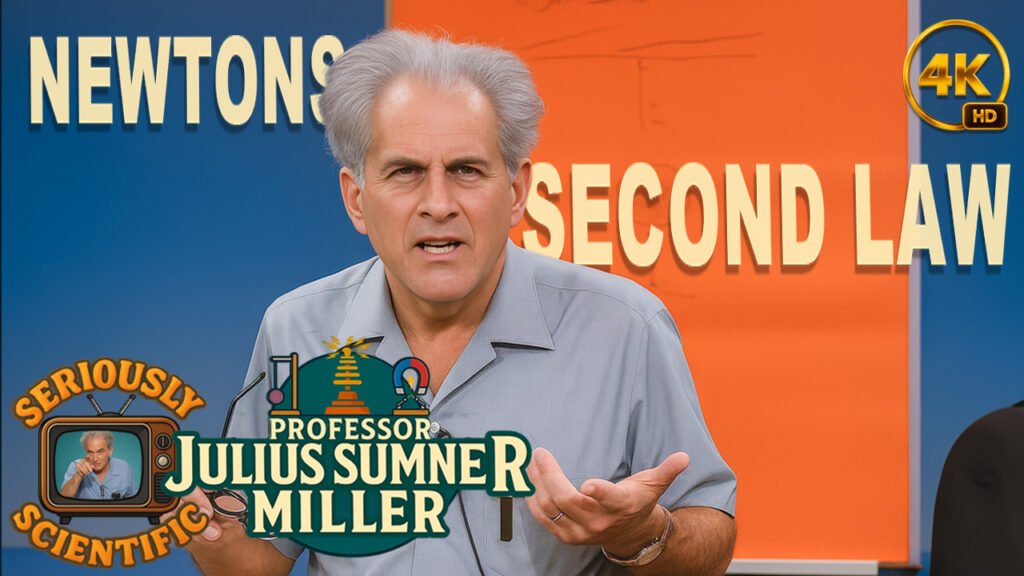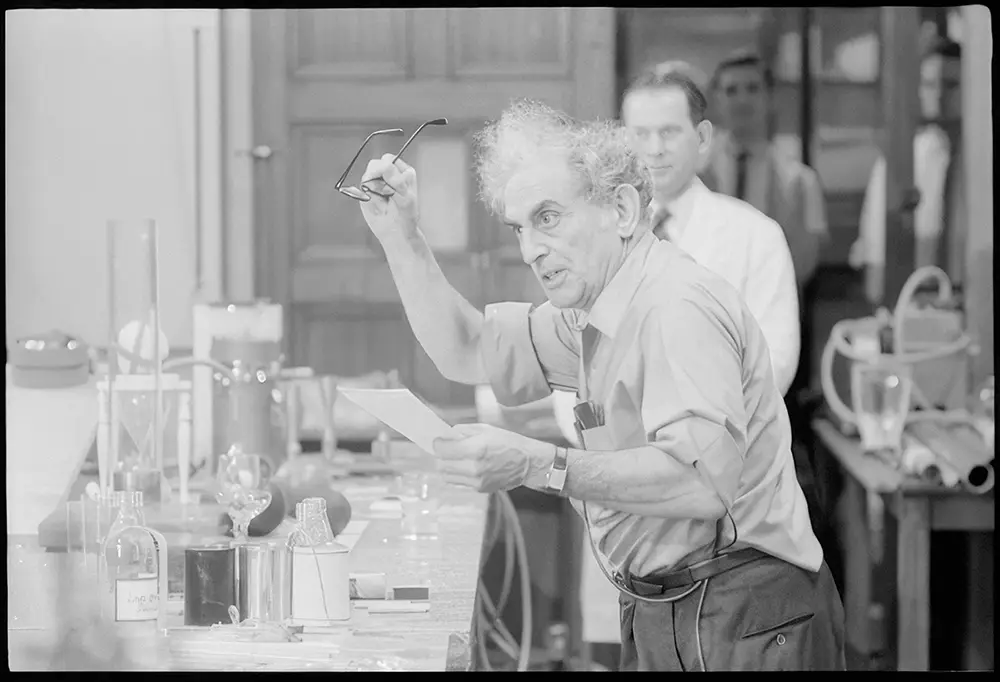
He would set up an experiment, do something that could not possibly work, but it would work. Then he would lean into the camera, eyebrows going in all directions, and ask: “Why is it so?”
And then he wouldn’t tell you.. He wanted students and viewers to work for comprehension.
He did that on national television, in ten minute episodes for twenty three years. It is the single bravest decision in the history of science broadcasting and almost nobody has had the nerve to copy it since.
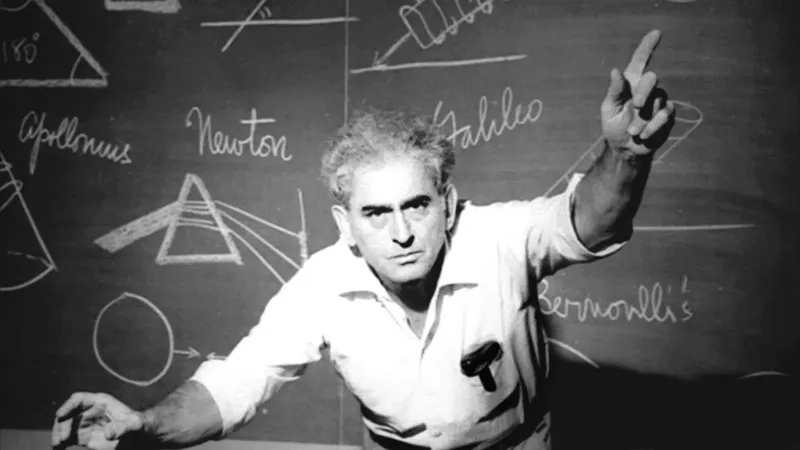
Mid-question. The names behind him are Apollonius, Newton, Galileo and Bernoulli, and the diagrams are conic sections, a prism, an inclined plane and the angles of a triangle. He put the whole syllabus on the board and then asked you something it did not answer. From Why Is It So?, ABC Television.
The youngest of nine, and two years as a butler
Julius Sumner Miller was born on 17 May 1909 in Billerica, Massachusetts, the youngest of nine children on a family farm. His father was Latvian. His mother was Lithuanian and spoke twelve languages. Neither of them had the education their son went on to get.
He took a BS from Boston University in 1932 and a master’s in physics there in 1933, then a second master’s from the University of Idaho in 1940. In between, because the 1930s were the 1930s and physics degrees did not feed anybody, he spent two years working as a butler.
He taught in the physics department at Dillard University in New Orleans, one of the historically Black colleges, in 1937 and 1938 and again from 1941 to 1952. In 1950 a Carnegie grant took him to Princeton, where he spent time with Albert Einstein at his home and at the Institute for Advanced Study. In 1953 he joined El Camino College in Torrance, California, where he stayed for twenty one years.
El Camino is a community college. Not Caltech, not MIT. He spent his career teaching first and second year students who were mostly not going to become physicists, which is worth a reference, because it is exactly the audience he was so good at.
Professor Wonderful
Disney found him first. From 1962 to 1964 he appeared on the Mickey Mouse Club as “Professor Wonderful”, filming demonstrations at Disneyland. American children got him in short bursts between cartoons.
Australia got the whole man.
Twenty seven trips to the other side of the world
In 1962 Professor Harry Messel invited him to Sydney University to teach at the annual summer science school for high school students. He came back twenty six more times over the next twenty four years.
The Australian Broadcasting Commission put him on television in 1963 and left him there until 1986. Why Is It So? was ten minutes long, recorded in the physics department at Sydney Univer
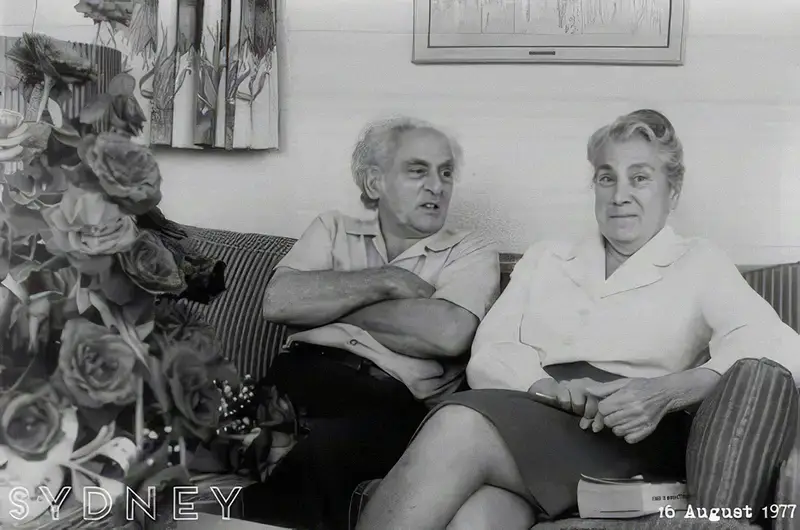
Julius and Alice Sumner Miller in Sydney, 16 August 1977. Him mid-sentence with his arms folded, her listening with the patience of a woman who has heard this one before. They married in 1934, as recorded in the Australian Dictionary of Biography.
sity, and consisted of one man, a bench full of apparatus, and a silent assistant called Mr Anderson who handed him things.
He opened the same way every time: “How do you do, ladies and gentlemen, boys and girls. I am Julius Sumner Miller, and physics is my business.”
He married Alice Marion Brown in 1934, six years before his second master’s and nearly twenty before he ever stood in front of a camera. They had no children. She came out to Australia with him on at least some of the trips.
The catchphrase went into the language. Australians who could not name a single law of motion could tell you “why is it so?” in his voice, thirty years after he died. There are not many science broadcasters anywhere who managed that.
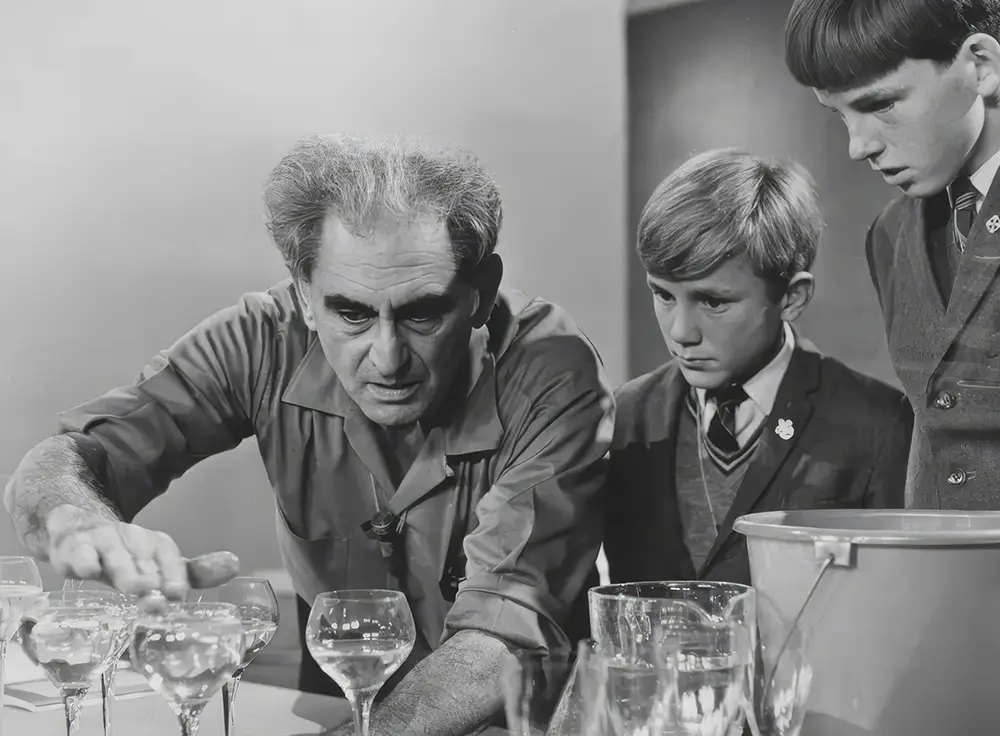
Working with school students on a set of tuned glasses. Fill them to different depths and each one sings at a different pitch, which is a lesson about resonance that costs nothing and that nobody forgets. See more from the series at Australian Screen, National Film and Sound Archive.
The method, which is the whole point
Withholding the answer sounds like a gimmick. It isn’t. It’s a considered position about how learning works and he was consistent about it for twenty three years, even though it must have driven the ABC crew mad.
His stated aim was to “stir your imagination, awaken your interest and arouse your curiosity”. Not to inform you. The demonstration is the hook, the question is the payload and the silence afterwards is where the actual work happens. If he tells you the answer, you file it. If he refuses, you have to go and find it, then the thing you find is yours.
He did not restrict this to television. In 1966 he wrote a daily science question for The Australian. He published Millergrams: Some Enchanting Questions for Enquiring Minds the same year, then a second volume in 1967 and a third collection came out after his death. A Millergram is a short physical puzzle with a real answer that you are expected to work out rather than be told.
If that sounds familiar, it should. The Science Puzzles on this site are Millergrams with better graphics. He got there sixty years ago with a newspaper column.
He who is not stirred by the beauty of it is already dead.
It is also the same instinct that made Richard Feynman refuse to explain why magnets repel. Two men, opposite ends of the academic ladder, who both understood that the honest answer to a good question is often another question.
A glass and a half
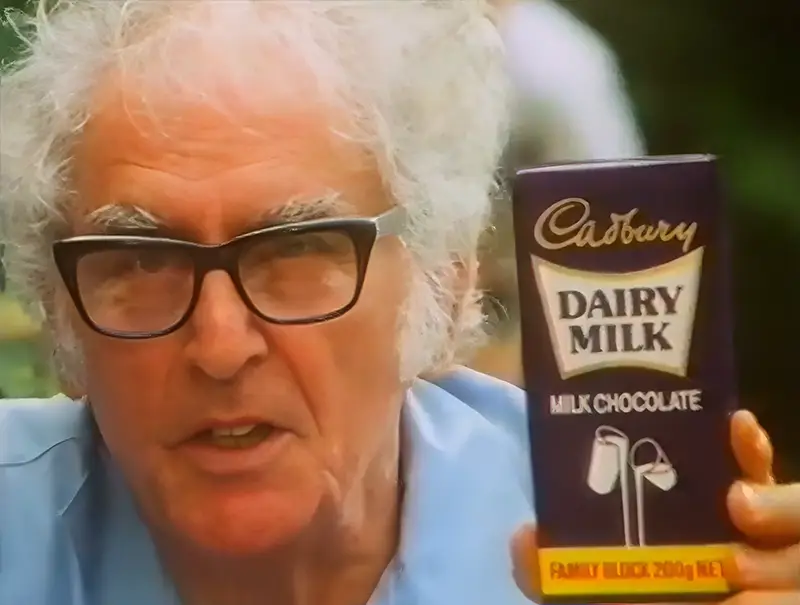
The commercial that made him famous to people who never watched the programme. “A glass and a half of full cream dairy milk” was Cadbury‘s advertising line, not a measurement, which is a distinction he spent his career teaching people to make.
In the 1980s he appeared in Australian television commercials for Cadbury’s chocolate, telling the country that each block contained “a glass and a half of full cream dairy milk”. He also advertised Ampol petrol and non-stick saucepans.
For a large part of the Australian public this is the only Julius Sumner Miller there is. A funny old professor selling chocolate. Whether that is a tragedy or a triumph depends on what you think science communication is for, and I will come back to it.
The slightly grey area
Three things but nothing too controversial, unlike others mentioned on these pages.
The advertising. Plenty of scientists at the time thought a physicist endorsing chocolate and petrol cheapened him and, by extension, them. There is a real argument there about lending scientific credibility to a commercial claim, “a glass and a half” was a marketing line, not a measurement. The counter-argument is that he was a community college lecturer, not a tenured professor at a rich university, and that the ads put his face in front of millions of Australians who then watched his programme. Both of those things are true at once.
The title. The Australian Dictionary of Biography records a BS in 1932, an MA in 1933 and an MS in 1940. It records no doctorate. He was a professor, which was his actual job title, but in Australia he was very widely called “Doctor Miller”, including in print. As far as I can establish that was the public promoting him rather than him claiming it, though he never seems to have made a point of correcting anybody either.
The method has limits. He angered colleagues by saying, loudly, that students were not learning and that intellectual life in America was in trouble. He could be scathing. And the refusal to explain, brilliant as it is, assumes a learner who already has enough confidence to go and dig. For a student who is already lost, “why is it so?” followed by silence is not a provocation, it’s a door closing. He was teaching a self-selecting audience of the curious. If you use his episodes in a classroom, you are the part he left out, and that’s your job, not a flaw in his.
Where to go next
Start with Dramatic Demonstrations in Physics: Inertia, then Newton’s Second Law. More are being added: the full set lives in the Julius Sumner Miller hub.
Then go and do the puzzles below without looking at the answers first. He would have insisted.
Sources
- Miller, Julius Sumner (1909 to 1987), Australian Dictionary of Biography
- Why is it so?, ABC Science
- Why Is It So?, curator’s notes, Australian Screen, National Film and Sound Archive
- Julius Sumner Miller, biography and career, Wikipedia
- Julius Sumner Miller made physics fun for everyone, Hackaday