
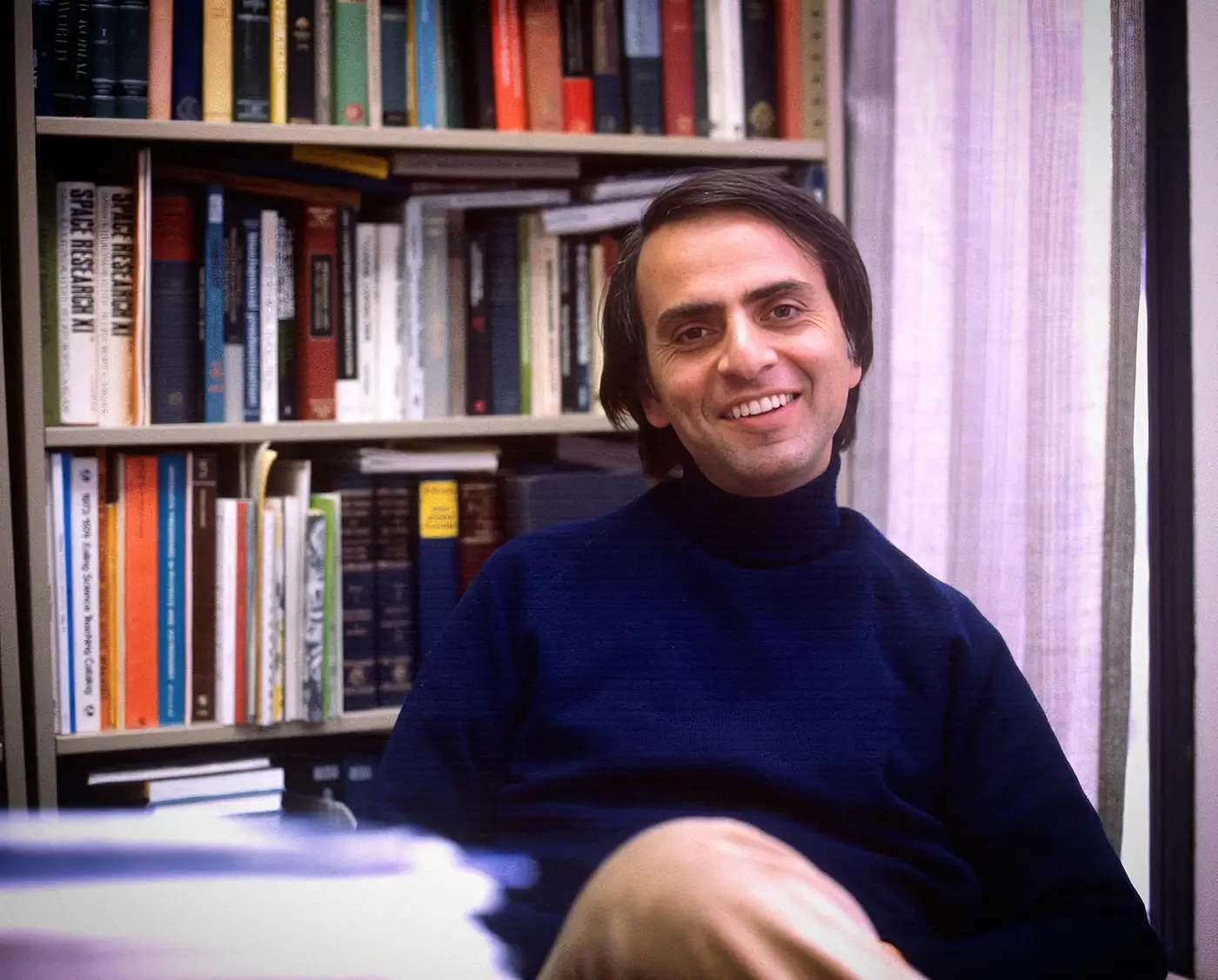
In 1992 the National Academy of Sciences was asked to admit Carl Sagan and said no. He was blackballed in the first round, which forced a full debate and a second vote in front of the whole membership. He finished under fifty per cent, nowhere near the two thirds he needed. The most famous scientist alive could not get into the room where American science kept its own.
That vote is where I want to start, because everything people still argue about with Sagan is inside it. Was he a working scientist who happened to be good on television, or a television personality with a doctorate? The answer matters, and it isn’t close.
Part I: The Making of a Mind
Brooklyn
Carl Edward Sagan was born on 9 November 1934 in Brooklyn. His father Samuel cut cloth in a garment factory and had come over from what’s now Ukraine; his mother Rachel had a fierce, unschooled intelligence and nowhere to put it. Sagan said later that between them they handed him the two habits of mind science actually runs on. Wonder from one, scepticism from the other. He called them uneasily cohabiting modes of thought, which is right, because most people manage one or the other.
The origin story he told about himself is the library card. He was five, he asked for a book about stars, the librarian brought him one about film stars, and eventually somebody found the right shelf. There he read that the stars are suns, very far away, and the scale of everything opened up at once.
I’d treat that story the way you’d treat any story a broadcaster tells about himself forty years later. It’s very neat. But the 1939 New York World’s Fair, which he visited as a small boy, is documented and does more work anyway. The Fair was an entire exhibition built on the promise that the future would be engineered, with sound made visible on an oscilloscope and light made audible through a photocell. He didn’t need a metaphor for science as a way of seeing things otherwise invisible. He’d walked through one.
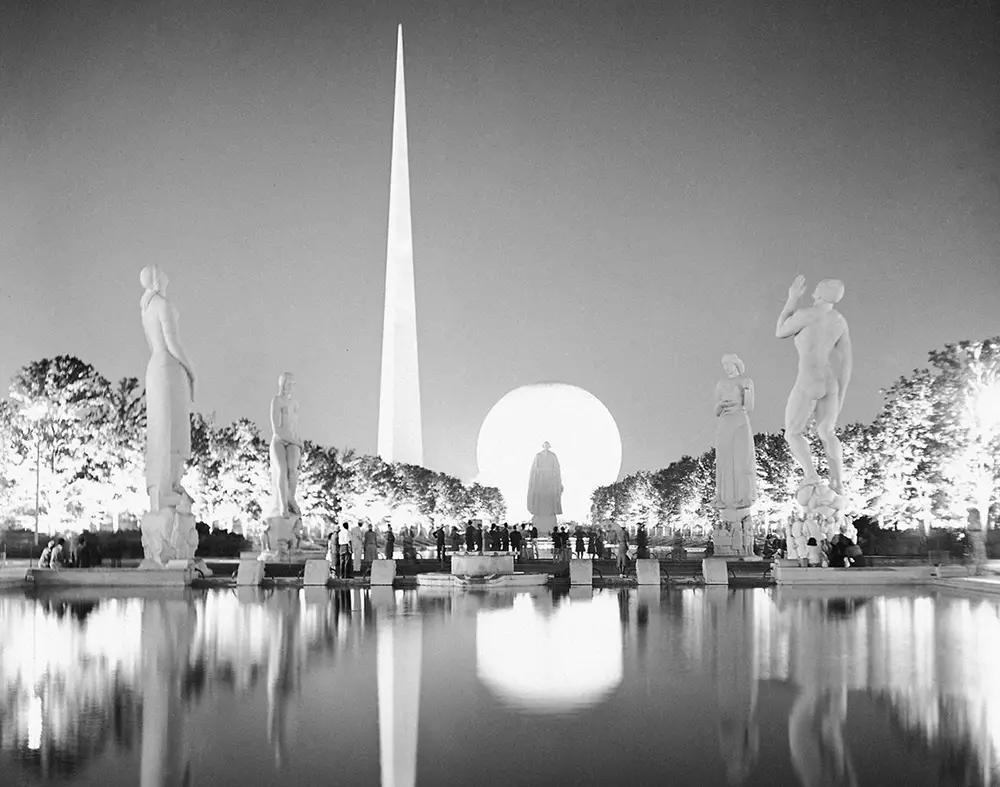
The Trylon and Perisphere at the 1939 New York World’s Fair, lit at night above the statues of the Court of Peace. Carl Sagan visited the Fair as a small boy. More images in The Atlantic’s photo essay on the Fair.
Chicago
He finished at Rahway High School in New Jersey in 1951, aged sixteen, and he went to the University of Chicago. The choice shaped him more than any individual teacher did.
Chicago at that time ran a Great Books curriculum, and the science degrees weren’t exempt from it. A physicist was expected to have read Aristotle and to know what Bach was doing. Sagan came out of it with four degrees in six years: an AB in 1954, a bachelor’s in physics in 1955, a master’s in physics in 1956, then a doctorate in astronomy and astrophysics in 1960. He worked in the laboratory of H. J. Muller, who had won a Nobel Prize for showing that X-rays cause mutations, and he wrote on the origins of life with the chemist Harold Urey. He was in the building when Stanley Miller and Urey ran the experiment that produced amino acids from a flask of simple gases and a spark.
His doctorate was supervised by Gerard Kuiper at the Yerkes Observatory in Wisconsin, and among his instructors was Subrahmanyan Chandrasekhar. The thesis was called Physical Studies of Planets. Kuiper’s own account records that it passed over what he called some faculty opposition, because it was unusually speculative for the time; it asked whether organic molecules could arise on other worlds, and most planetary science in 1960 wanted no part of that question.
Hold on to that detail. The first time senior colleagues were uneasy about Sagan reaching beyond the acceptable, he was twenty-five and hadn’t been on television in his life.
Venus, and the end of a beautiful idea
Before Sagan, the popular picture of Venus was a warm swamp world under permanent cloud. Science fiction had run with it for decades, and he had grown up on that fiction.
His work helped kill it. Venus is closer to the Sun than we are, but the surface heat couldn’t be explained by sunlight alone, because the cloud deck reflects most of it straight back to space. What Sagan modelled was a runaway greenhouse: an atmosphere of carbon dioxide so thick that infrared radiation from the ground can’t escape, so the heat accumulates until the surface sits at something like 470 degrees Celsius. Hot enough to melt lead. Mariner 2 flew past in 1962 with a microwave radiometer and found temperatures in that region, which settled the argument.
For a teaching site this is the single most important thing on his scientific record, and it’s the section I’d fight to keep if the article had to lose one. The physics that makes Venus lethal is the same physics that makes Earth habitable, running at a different setting. Sagan spent the rest of his life pointing at that, long before it was a comfortable thing to point at. A man who worked out what runaway carbon dioxide does to a planet was never going to be quiet about what we were doing to ours.
He also lost something he’d loved to get there. He was honest about that.
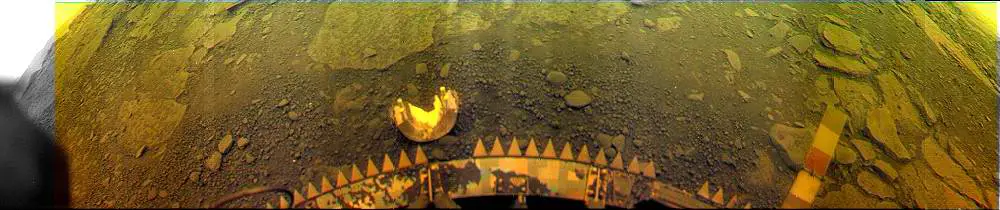
The surface of Venus, photographed by the Soviet Venera 13 lander on 1 March 1982. Flat slabs of basalt under a yellow sky, with part of the lander’s toothed base ring across the bottom and the ejected camera lens cover on the ground. Sagan’s runaway greenhouse calculations described this place decades before anyone saw it. Original data: Soviet Academy of Sciences. Digital restoration by Don P. Mitchell, mentallandscape.com. Reproduced unaltered.
Part II: Working the Missions
Mars, and being right about dust
Mars had its own beautiful idea attached to it. Astronomers had watched dark patches spread across the surface each Martian spring and recede again, a seasonal wave of darkening, and the obvious reading was vegetation. Plants. On Mars.
Sagan and his student James Pollack argued it was wind. Dust, moved by seasonal winds, alternately burying and uncovering darker rock underneath. Unglamorous, and correct.
The payoff came in 1971 when Mariner 9 arrived at Mars and found the entire planet hidden under a global dust storm. The mission had to wait weeks for the air to clear. For most of the team that was a frustration; for Sagan and Pollack it was a full-scale natural experiment in what suspended dust does to a planet’s surface temperature. They watched the ground beneath the storm cool. That measurement mattered enormously twelve years later, and we’ll come back to it.
He worked the Mariner and Viking missions properly, arguing details rather than fronting press conferences. He pushed for the Viking landers to carry a lamp, on the grounds that if anything on Mars moved at night nobody would ever know. Colleagues found the idea faintly ridiculous. His answer was that not looking guarantees not finding, which is difficult to argue with even when the odds are terrible.
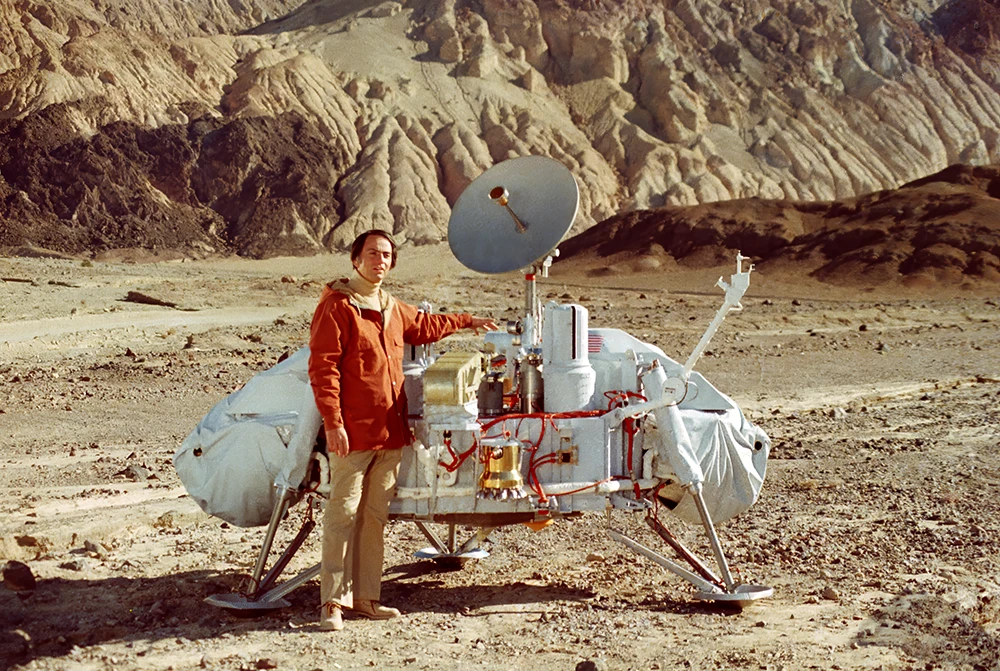
Carl Sagan with a model of the Viking lander in Death Valley, California, 1980. He helped select the Viking landing sites and served on the imaging team, and he argued hard for instruments that might catch something the mission wasn’t designed to look for. Credit: COSMOS: A PERSONAL VOYAGE / Druyan-Sagan Associates, Inc.
The Golden Record
In 1977 NASA asked him to chair a committee to decide what two departing spacecraft should carry as a message from Earth. He’d done a version of this before, designing the engraved plaque bolted to Pioneer 10 and 11 with the astronomer Frank Drake, drawn by his second wife Linda Salzman Sagan.
The Voyager record was a much bigger undertaking: a gold-plated copper disc holding 115 images, greetings in fifty-five languages, natural sounds and about ninety minutes of music running from Bach to Chuck Berry.
The creative director of the project was a twenty-seven year old writer named Ann Druyan, and the best idea on the record is hers. She asked Sagan whether, if she recorded her own brainwaves, a civilisation a billion years from now might read the thoughts behind them. His reply was that a billion years is a long time. Nobody could say no to that, so she was volunteered to supply the brainwaves herself.
She prepared a script to steer her thoughts through the history of Earth, the evolution of life and the rise of civilisations. Then, on 1 June 1977, she and Sagan had a telephone call in which they realised they were in love and agreed to marry. The recording session had already been booked. She lay down in a New York hospital on 3 June with electrodes reading her brain, her heart, her eyes and her muscles, working through her prepared itinerary with the other thing running underneath all of it.
An hour of that was compressed into roughly one minute of audio. Both Voyagers carry it. Voyager 1 launched on 5 September 1977 and is now more than 25 billion kilometres out, which makes a woman falling in love the furthest-travelled private moment in human history.
If you want to see where the spacecraft carrying it actually is, we have an interactive Voyager tracker on this site that runs on the real mission data.
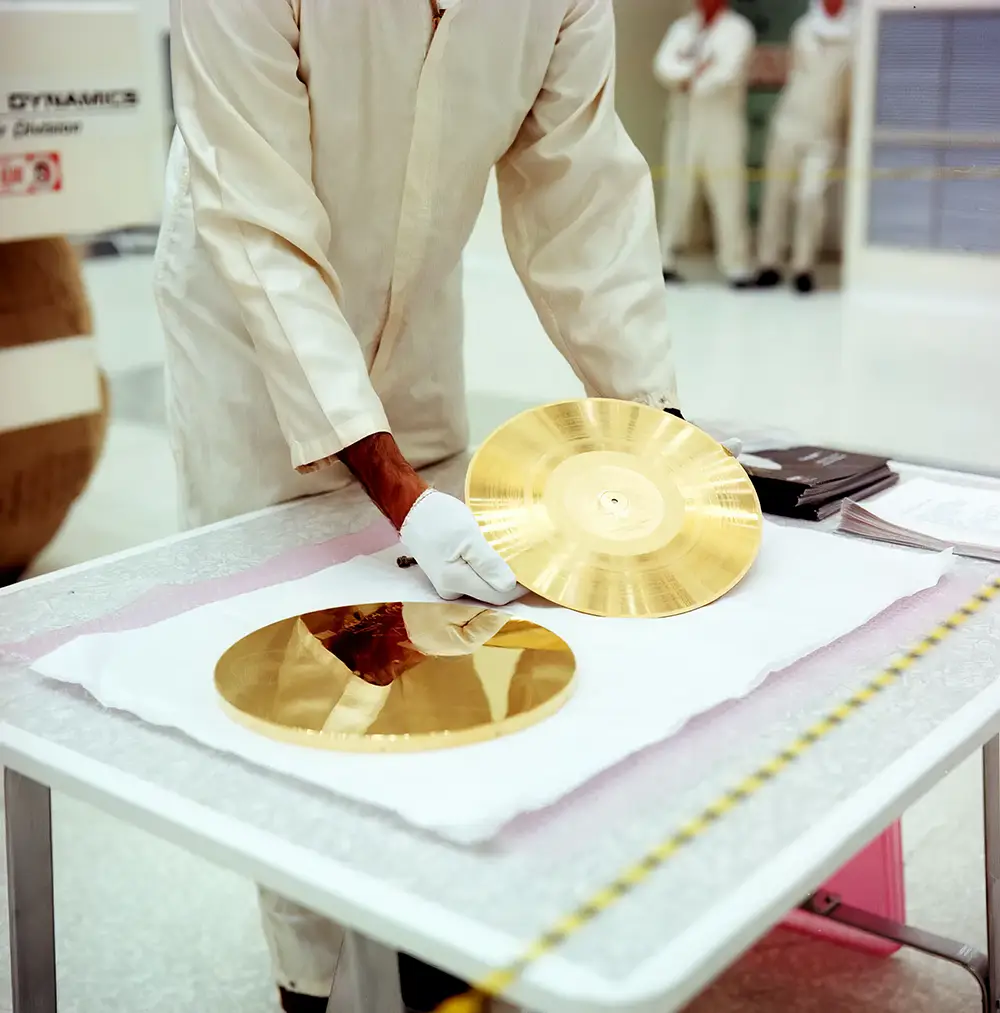
A technician places the Voyager Golden Record beside its cover in a clean room, 1977. The disc is gold-plated copper, 30 centimetres across, and carries 115 images, greetings in fifty-five languages and about ninety minutes of music. Credit: NASA/JPL-Caltech. From NASA’s gallery on the making of the Golden Record.
Part III: The Public Scientist
Cosmos
Cosmos: A Personal Voyage went out on PBS from 28 September 1980, thirteen episodes, written by Sagan with Ann Druyan and Steven Soter, who had been one of his doctoral students. Adrian Malone produced it, bringing across the ambition of the big BBC authored series, and Vangelis supplied a score that people can still hum forty-five years later.
The devices were the making of it. The Ship of the Imagination let him move through scale without a cut feeling arbitrary. The Cosmic Calendar compressed the age of the universe into a single year, so that everything written down by any human being lands in the last few seconds of 31 December. Every science teacher reading this has drawn that calendar on a board.
It reached more than sixty countries and something upwards of five hundred million people, took two Emmys and a Peabody and stayed the most-watched series in the history of American public television until The Civil War in 1990. The companion book sat on the New York Times bestseller list for seventy weeks.
Set it against the other people on this site and the difference is clear. David Attenborough’s authority comes from the animal in front of him, and Bill Nye’s from the demonstration on the bench. Sagan’s came from the argument. He’d spend eight minutes building a case and trust you to follow, and the trust was the flattering part; audiences noticed being treated as capable adults.
“We are a way for the universe to know itself.”
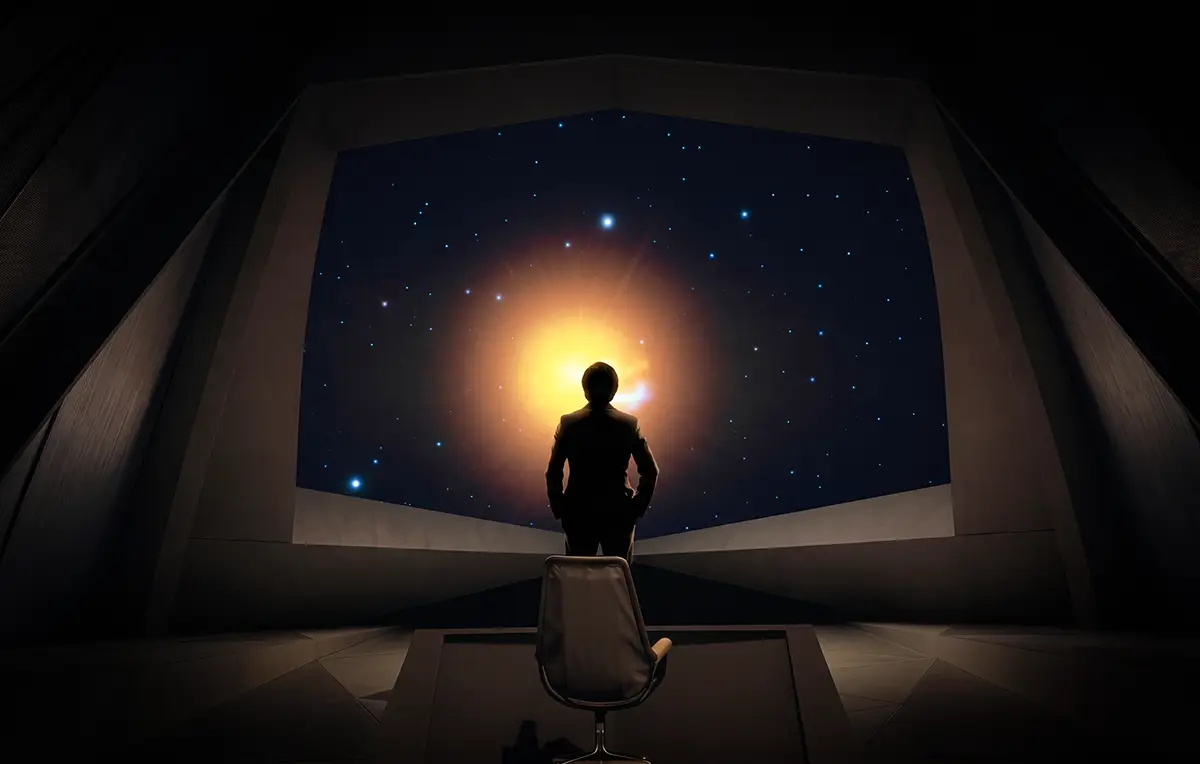
The bridge of the Ship of the Imagination. The device let Carl Sagan move between the scale of an atom and the scale of a galaxy without the cut ever feeling arbitrary, which is most of why the series still works. Artwork by Seriously Scientific, created from a still from Cosmos: A Personal Voyage.
The Planetary Society
Fame turned out to be usable. By 1980 Sagan could see public support for planetary exploration draining away, with NASA’s budget under pressure and no obvious constituency to defend it, so he founded The Planetary Society with Bruce Murray of the Jet Propulsion Laboratory and the engineer Louis Friedman. The idea was simple enough to be radical: ordinary people who cared about space could join something, pay a subscription and be counted.
It worked. The Society grew into the largest non-profit space organisation in the world and Sagan led it until his death, using it to lobby Congress directly. Its most consequential save was SETI, the search for extraterrestrial intelligence, which Congress cancelled and which survived on private money afterwards. Whatever you think of the odds on SETI, the principle he was defending is the one this site is built on. Science that the public pays for belongs to the public, and the public will defend it if anybody bothers to ask.
Johnny Carson, and the showman charge
He was on The Tonight Show more than two dozen times. Carson was a keen amateur astronomer and gave him real airtime rather than a novelty spot, and Carson’s affectionate impression of him, turtleneck and all, put the phrase “billions and billions” into American English. Sagan pointed out for the rest of his life that he never said it.
The charge that follows from all this is the one this site keeps running into. Bill Nye gets it for the Cadbury adverts. Julius Sumner Miller got it for the same reason, from the same people, thirty years earlier. Once a scientist is entertaining, some of his colleagues stop counting him as a scientist.
My own answer is that the charge has the causation backwards. Sagan went on Carson because thirty million people were watching Carson and almost nobody was reading the Astrophysical Journal. Whether that’s beneath a serious scientist depends entirely on what you think science is for; if it’s a private conversation between qualified people, he was wasting his time, and if it belongs to everybody who pays for it, he was doing the most important job available.
Nuclear winter
The Mars dust work came back in 1983.
The chain starts with Paul Crutzen and John Birks, who suggested in 1982 that the smoke from fires after a nuclear exchange could block enough sunlight to matter. Richard Turco took that further, realised the temperature drop could be severe and coined the name. The paper appeared in Science on 23 December 1983 under five authors, Turco, Toon, Ackerman, Pollack and Sagan. It has been known ever since by their initials as TTAPS. Its finding was that a large exchange would loft enough soot into the stratosphere to drop temperatures across the Northern Hemisphere for months, and that the cold and dark would kill far more people than the weapons.
Be accurate about Sagan’s part in it. He wasn’t the principal modeller; Turco, Toon, Ackerman and Pollack did the atmospheric physics, and three of them were at NASA Ames. What Sagan brought was standing. The Ames director was nervous about publishing anything that would antagonise the Reagan administration, and Sagan had the public weight to face that down so the work could come out at all.
He then took it to the public in Parade before the paper was published, which is genuinely the wrong way round, and his critics were right to say so. Edward Teller attacked both the science and the motive. Later modelling revised the severity downwards without overturning the core result, and the underlying question, what quantities of soot at what altitude do to a climate, is still live research.
I’d put it like this. He was mostly right about the physics, mostly right about the stakes and careless about the order of operations in a way that handed his opponents an easy shot. Those can all be true together.
Pale Blue Dot
Around 1980 he began asking the Voyager imaging team to turn a camera round and photograph the Earth on the way out. He was told no for most of a decade, and the objection wasn’t unreasonable: pointing the instrument that near the Sun risked damaging it, in exchange for a frame that would carry no measurable data at all. Sagan never claimed otherwise. His argument was that the picture would show us something about ourselves, which isn’t a scientific case and he knew it.
NASA Administrator Richard Truly eventually intervened to get it done. On 14 February 1990 Voyager 1, then about 6 billion kilometres out and past Neptune, swept sixty frames across the solar system for a family portrait. The cameras were shut down permanently about half an hour later. The data reached Earth on 1 May.
In one frame the Earth appears inside a shaft of sunlight scattered inside the camera optics, at a size of 0.12 of a pixel. Less than one picture element. Sagan built a book around it in 1994, and the phrase everybody remembers describes our planet as a mote of dust suspended in a sunbeam.
The image did what he wanted, though it took his words to make it land. Nobody looks at that frame cold and feels anything; the dot has to be pointed out. He understood that a photograph is only ever as good as the sentence beside it, which is a thing more scientists could stand to learn.
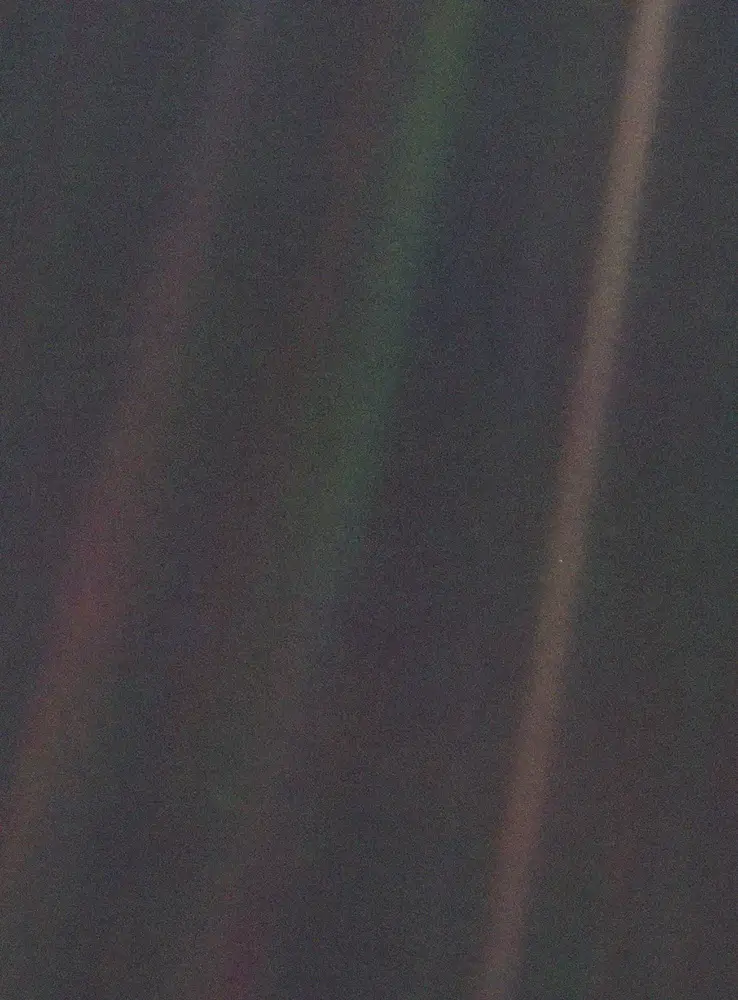
Earth photographed by Voyager 1 on 14 February 1990 from about 6 billion kilometres away, at a size of 0.12 of a pixel. The bands of light are sunlight scattered inside the camera optics, not a feature of space. Sagan spent most of a decade arguing for this picture. Credit: NASA/JPL-Caltech (PIA00452). Follow the spacecraft that took it on our Voyager tracker.
Part IV: The Reckoning
The Velikovsky business
Immanuel Velikovsky was a psychiatrist who argued, in a run of bestselling books from 1950, that Venus had been ejected from Jupiter as a comet a few thousand years ago, passed close to Earth, and caused the events described in Exodus. He had a large and loyal readership, most of whom were not scientists.
In 1974 the American Association for the Advancement of Science put Velikovsky and Sagan on the same platform. The room was full. Sagan took the physics apart: the energy needed to fire a planet out of Jupiter, the orbital mechanics that would have to follow, the sheer improbability of a body on that trajectory settling into the near-circular orbit Venus actually occupies. On the substance he was plainly right, and Velikovsky never recovered his standing.
Historians of science have been less kind to how he did it. Some of Sagan’s own numbers in that session were rough, he was witty at a much older man’s expense in front of a press pack that loved it, and the session was billed as a debate when the outcome was decided before anybody sat down. Velikovsky’s supporters have made a meal of this for fifty years and they aren’t entirely wrong about the manner.
I include it because it’s the mirror image of what happened to him eighteen years later. In 1974 Sagan was the establishment deciding who counted as a scientist. In 1992 he was on the other side of the same door.
What the Academy did, and why
Back to 1992, and to the pattern behind it, because the vote wasn’t the first of its kind.
Harvard had already refused him tenure in 1968, twenty-four years earlier. He went to Cornell, ran the Laboratory for Planetary Studies for the rest of his life and held the David Duncan chair from 1977, so it hardly ruined him. But it was the same judgement arriving early.
When his name went to the National Academy in 1992 his research record wasn’t seriously in question. Stanley Miller, of Miller-Urey, argued for him. He was blackballed anyway in the first round, the membership debated it, and the second vote left him under fifty per cent. Accounts from the room point at the television work. Colleagues thought Cosmos was fluff, and that a man who had time for it couldn’t have been serious enough about the rest.
The effect has a name now, the Sagan Effect, and it’s measurable: scientists who talk to the public are assumed to be weaker researchers for doing it. Studies since have found little support for the assumption.
Two years later the same Academy gave him its Public Welfare Medal. Make of that what you like.
The Demon-Haunted World, and the end
His last major book, published in 1995, was the one aimed most squarely at people like us. The Demon-Haunted World is an argument that a society which can’t tell evidence from assertion will be governed by whoever asserts most confidently, and it contains the Baloney Detection Kit, a plain checklist for testing a claim. It works in a classroom exactly as it was meant to.
He’d been ill while writing it. Sagan had myelodysplasia, a bone marrow disorder, and he spent his last two years fighting it through three bone marrow transplants donated by his sister. He died in Seattle on 20 December 1996 of pneumonia, a complication of the disease, aged sixty-two. Ann Druyan’s account of his last months is that he never sought refuge in illusions, which given what he’d spent his life arguing is the only ending that would have satisfied him.
He was working to the end. He’d joined the board of the SETI Institute, he was seeing Contact through to film, and he had papers in progress with his last graduate student.
What’s left
Seth MacFarlane bought Sagan’s papers for the Library of Congress in 2012, and the collection opened to the public the following year: 1,705 boxes, from his school report cards to his correspondence with half the scientists of the twentieth century. A few hundred items are digitised and free to read. It’s an extraordinary teaching resource that almost nobody uses.
The Mars Pathfinder landing site is the Carl Sagan Memorial Station. The American Astronomical Society gives a Sagan Medal for communicating science to the public, which is a quiet joke at the Academy’s expense and a good one.
And the thing he made is still moving. The record with Ann Druyan’s nervous system on it is more than 25 billion kilometres away and going, and it’ll outlast the planet that made it by a margin nobody can write down usefully.
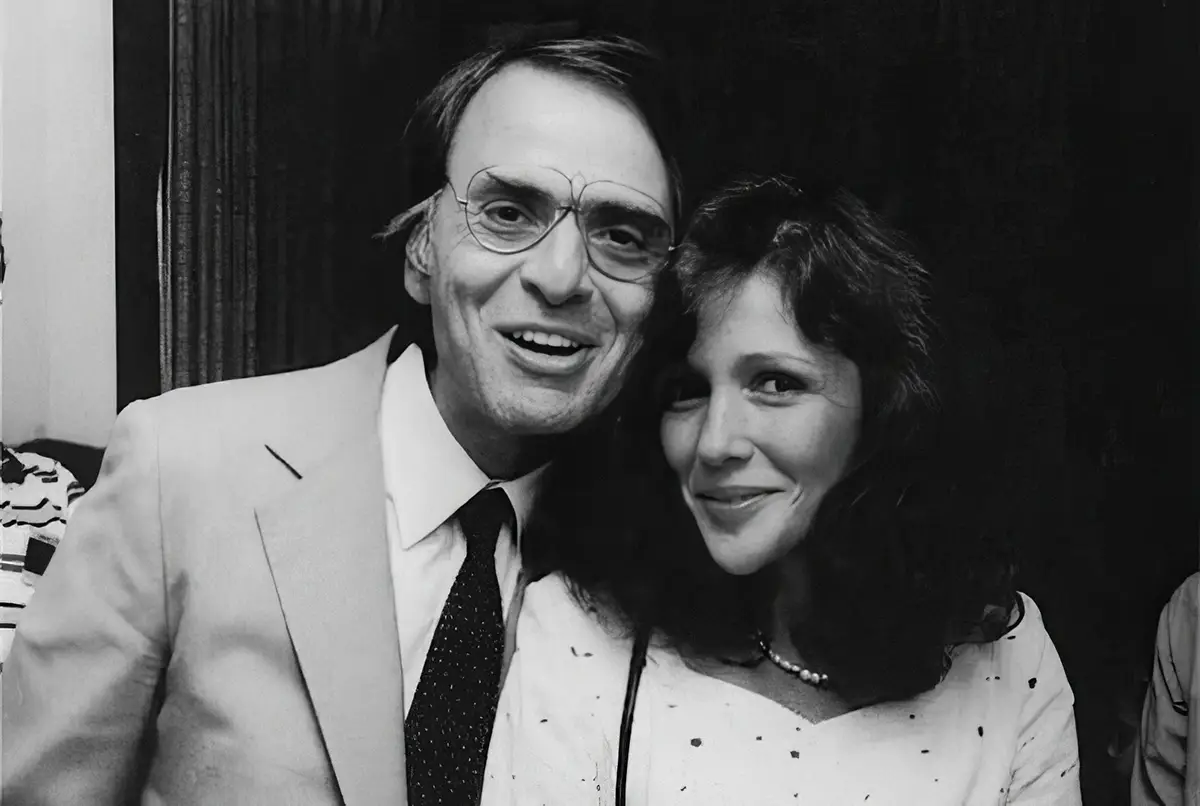
Carl Sagan and Ann Druyan. She was creative director of the Voyager Golden Record project, co-wrote Cosmos with him and Steven Soter, and it is her nervous system recorded on the disc now leaving the solar system. They married in 1981 and worked together until his death. Credit: Library of Congress.
Sources
- Carl Sagan, a Biographical Memoir by David Morrison – National Academy of Sciences
- Carl Sagan (1934–1996), obituary – Bulletin of the American Astronomical Society
- Astronomy Loses Its Most Popular Voice – Science
- Has Contemporary Academia Outgrown the Carl Sagan Effect? – Journal of Neuroscience
- Nuclear Winter: Global Consequences of Multiple Nuclear Explosions, Science, 23 December 1983 – University of Washington
- Nuclear Winter: U.S. Government Thinking During the 1980s – National Security Archive
- When Carl Sagan Warned the World About Nuclear Winter – Smithsonian Magazine
- Iconic pale blue dot photo turns 30 – Cornell Chronicle
- A Pale Blue Dot – The Planetary Society
- Finding Our Place in the Cosmos: From Galileo to Sagan and Beyond – Library of Congress
- Library of Congress Officially Opens the Seth MacFarlane Collection – Library of Congress
- Sagan papers archived at Library of Congress – Cornell Chronicle