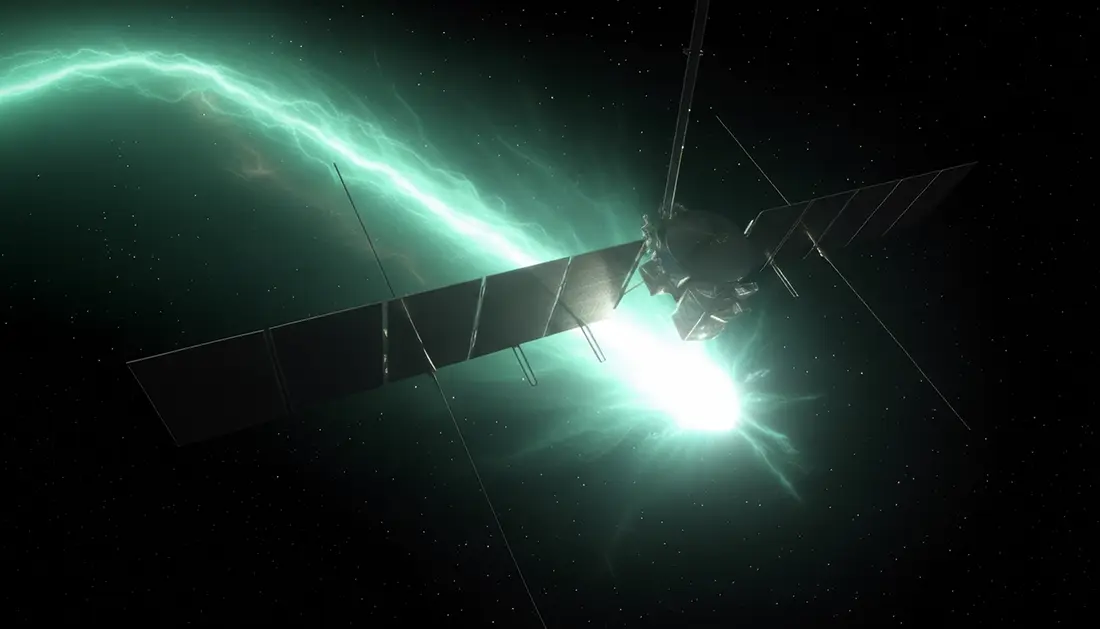
In the vastness of space, planning is everything. And humanity has gotten incredibly good at it. We launch billion-dollar robotic explorers on trajectories calculated years in advance to hit tiny targets millions of kilometers away. NASA’s Europa Clipper spacecraft, for example, is currently on a precise, multi-year journey to study Jupiter’s icy moon, Europa.1The Planetary Society. (2025). The Europa Clipper launch: What to expect. https://www.planetary.org/articles/europa-clipper-launch-what-to-expect But the universe is full of surprises. A new study reveals that by pure cosmic chance, Europa Clipper’s path is about to cross with a visitor from another star. Therefore, a mission designed to search for life on an icy moon is about to accidentally become the first probe in history to directly “taste” the material from another solar system.
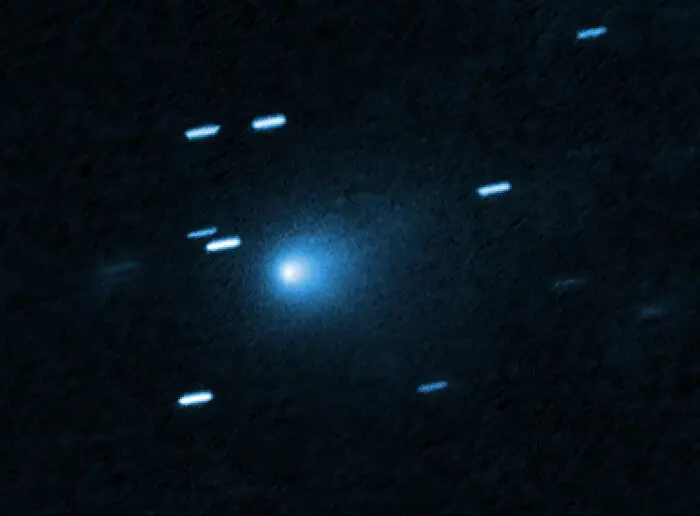
This is not science fiction. This is a real, unfolding event that has scientists scrambling to prepare for a once-in-a-lifetime opportunity. The visitor is an interstellar comet named 3I/ATLAS,2The Guardian. (2025). 3/1 Atlas: a rare comet from beyond our solar system is being closely tracked - what can it teach us?. https://www.theguardian.com/science/2025/oct/08/a-rare-comet-from-beyond-our-solar-system-is-being-closely-tracked-what-can-it-teach-us and in late 2025, two of our spacecraft are set to fly right through its tail.3IFLScience. (2025). NASA's Europa Clipper And ESA's Hera Will Fly Through Comet 31/ATLAS's Ion Tail – Will They Be Able To Catch Something?. https://www.iflscience.com/two-spacecraft-to-fly-through-comet-3iatlass-ion-tail-will-they-be-able-to-catch-something-81195
What Exactly Is This Interstellar Visitor?
For almost all of history, we believed everything in our sky belonged to our Sun. Comets and asteroids, we thought, were all leftovers from our own solar system’s formation, 4.6 billion years ago. That idea was shattered in 2017 with the discovery of 1I/ʻOumuamua, a strange, cigar-shaped object that zoomed through our system on a path that proved it came from deep space.4Northeastern Global News. (2025). Comet or alien spaceship? An astrophysicist explains what we know about interstellar traveler 31/Atlas. https://news.northeastern.edu/2025/09/08/3i-atlas-comet-interstellar-traveler/ Then came 2I/Borisov in 2019, which looked more like a normal comet. Now, we have 3I/ATLAS.
Discovered in 2025, 3I/ATLAS is the third and largest of these interstellar guests. It’s a “dirty snowball” of ice, rock, and dust, just like the comets from our own solar system. The key difference? It was born in a completely different star system, long ago. It was likely thrown out of its home system by the gravity of a large planet and has been wandering the galaxy for millions, maybe billions, of years. Now, it’s making a single, one-time pass through our neighborhood before it disappears back into the interstellar void forever.

A comet’s structure includes the central nucleus, the surrounding coma, a vast hydrogen envelope, a yellowish dust tail curving along its orbit, and a straight blue plasma (ion) tail pushed directly away from the Sun by the solar wind. Credit: ESA
How Can a Spacecraft Fly Through a ‘Tail’?
When you picture a comet, you probably imagine a bright fuzzy head and a long, glowing tail. What many people don’t know is that most active comets actually have two tails. Both are created as the Sun’s heat boils ice off the comet’s nucleus, but they are formed by different forces.5NASA. (n.d.). Comets. NASA Science. https://science.nasa.gov/solar-system/comets/
- The Dust Tail: This is the bright, curved tail we see in most photographs. It’s made of tiny, solid dust particles, like smoke. The gentle pressure of sunlight itself pushes this dust away from the comet. It’s bright because it reflects sunlight.
6LASP, University of Colorado. (n.d.). The Outer Planets: Comets. https://lasp.colorado.edu/outerplanets/kbos_comets.php - The Ion Tail: This is the tail our spacecraft will visit. It’s invisible to the naked eye and made of gas. As the Sun’s ultraviolet light hits the gas, it strips away electrons, turning the gas molecules into charged particles called ions (or plasma). This stream of plasma is then grabbed by the solar wind, a fast-moving magnetic wind blowing constantly from the Sun. The solar wind flings this ion tail straight back, like a windsock, for millions of kilometers.
7UT Austin Astronomy Outreach. (n.d.). Comet Ion Tails. http://outreach.as.utexas.edu/marykay/highschool/CometTails.pdf
The new study found that the paths of both Europa Clipper and ESA’s Hera spacecraft will cross this invisible “windsock” of plasma. They won’t be near the comet’s bright, dusty head. They will be more than 8 million kilometers “downwind,” but that’s still close enough to fly right through this stream of interstellar gas.8Universe Today. (2025). Hera And Europa Clipper Will Pass Through 31/ATLAS' Tail. https://www.universetoday.com/articles/hera-and-europa-clipper-will-pass-through-3iatlas-tail
Which Spacecraft Can Actually ‘Taste’ the Comet?
It turns out that this accidental encounter is a tale of two very different robots. Flying through the tail is one thing. Being able to “taste” it is another. It all depends on the scientific instruments each spacecraft is carrying.
The “Blind” Explorer: ESA’s Hera
The European Space Agency’s Hera spacecraft is on a completely different mission. It’s heading to the Didymos-Dimorphos asteroid system. Its job is to be a cosmic detective and study the crater left by NASA’s DART mission, which intentionally crashed into the asteroid in 2022. Because Hera’s job is to map rocks, its instruments are all visual. It has powerful cameras, a laser altimeter, and imagers. An ESA spokesperson confirmed it is not equipped with any in-situ instruments, like plasma or magnetic field sensors, that could measure the tail.9ESA. (n.d.). Hera's Asteroid Deck and instruments. European Space Agency. https://www.esa.int/Space_Safety/Hera/Hera_s_Asteroid_Deck_and_instruments It has no tools for tasting plasma. So, while Hera will fly right through the tail, it will be completely blind to it. It will pass through a scientific goldmine without any way to collect the gold.
The “Lucky” Explorer: NASA’s Europa Clipper
Europa Clipper, on the other hand, is perfectly and accidentally equipped for the job. Its main goal is to see if Jupiter’s moon Europa has a liquid water ocean under its ice shell. To do this, it has to understand the complex plasma and magnetic fields around Jupiter. Because of this, NASA equipped it with two crucial instruments.10NASA. (n.d.). Europa Clipper Spacecraft Instruments. NASA Science. https://science.nasa.gov/mission/europa-clipper/spacecraft-instruments/
- PIMS (Plasma Instrument for Magnetic Sounding): This is basically the spacecraft’s “tongue.” It’s a cup designed to catch charged plasma particles. It can measure exactly what they are made of (water, carbon dioxide, etc.), how dense they are, and how fast they are moving.
- ECM (Europa Clipper Magnetometer): This is the spacecraft’s “compass.” It measures the strength and direction of magnetic fields. It will be able to feel the disturbance in the solar wind as the spacecraft passes through the comet’s magnetic “wake.”
These two instruments, designed to study a moon, make Europa Clipper the perfect tool for tasting a comet. It’s an incredible stroke of luck.

A detailed model of NASA’s Europa Clipper spacecraft, equipped with specialized instruments like PIMS (Plasma Instrument for Magnetic Sounding) to analyze plasma, making it uniquely suited to “taste” the tail of comet 3I/ATLAS. Credit: NASA/JPL-Caltech
Why Is This Direct Sample So Important?
Until now, we have only studied interstellar objects from a huge distance. We use telescopes to look at the light reflecting off them. This is called remote sensing. It’s like trying to figure out what a cake is made of just by looking at it from across the room. You can guess the flavor of the frosting, but you have no idea about the ingredients inside.
This encounter is our first chance to do in-situ science, which means “in position.”11Copernicus. (n.d.). What is in-situ data?. Copernicus In Situ. https://insitu.copernicus.eu/about/what-is-in-situ-data Europa Clipper will not just *look* at the comet’s tail. It will fly right through it and catch the particles in its PIMS sensor. This is like walking across the room, taking a big scoop of the cake, and tasting it. We will know the exact ingredients. We will get a direct chemical analysis of the ices from another star system. This is a profound first for humanity.
What Could This ‘Cosmic Fossil’ Tell Us?
This comet is more than just a visitor. It’s a time capsule. Some calculations suggest 3I/ATLAS may be incredibly old, possibly billions of years older than our own Sun.12Business Today. (2025). Mystery from beyond: 31/ATLAS fires a 10,000-km Jet towards the Sun in dazzling display. https://www.businesstoday.in/science/story/mystery-from-beyond-3iatlas-fires-a-10000-km-jet-towards-the-sun-in-dazzling-display-499490-2025-10-24 It might be a relic from a period called “cosmic noon,” an era 9 to 13 billion years ago when our galaxy was rapidly forming most of its stars.13Loeb, A. (2025). 3I/ATLAS (C/2025 N1): Direct Spacecraft Exploration of a Possible Relic of Planetary Formation at "Cosmic Noon". arXiv. https://arxiv.org/abs/2508.15768 By “tasting” its ingredients, we could answer some huge questions.
Is the chemistry of our solar system common? Do other star systems form with the same building blocks of water, carbon, and organic materials that led to life on Earth? Or is every system chemically unique? This comet holds a chemical fingerprint from its home, and for the first time, we’re about to read it. This data will help us understand our own origins and whether the conditions for life might be common throughout the galaxy.
Is This a Guaranteed Discovery?
While the opportunity is amazing, success is not guaranteed. This is a high-risk, high-reward observation. The spacecraft will be passing more than 8 million kilometers from the comet’s nucleus. At that vast distance, the ion tail will be extremely thin and faint. The comet’s material could be at the absolute lowest limit of what the PIMS instrument can even detect.
Success will depend on two unpredictable things. First, the comet needs to be very active, spewing out a lot of gas as it gets heated by the Sun. Second, the solar wind conditions have to be just right to carry that material all the way to our spacecraft. Mission controllers at NASA have very little time to prepare for this unexpected event. They will be pushing Europa Clipper and its instruments to their absolute limits. We will all have to wait and see if they can catch a ghost.