








































































Comets and Meteors
You have probably looked up at the night sky and seen a streak of light flash across the darkness. People call them shooting stars, but what are they really?
Are Shooting Stars Actually Stars?
They are not stars at all! A shooting star is actually a tiny piece of space rock or dust burning up as it hits the Earth's atmosphere at incredible speeds. Bill Nye the Science Guy explains that this friction creates the bright streak of light we see from the ground.
It crashes into the Earth! If a rock is large enough to survive the fiery trip through our atmosphere and actually strikes the ground, we call it a meteorite. These space rocks can leave massive craters behind.
Put Your Instincts to the Test
Think about what you already know about the objects zooming through our solar system. Pick an answer for each question, then see if your instincts were right.
Comets are icy, while asteroids are rocky. Bill Nye the Science Guy famously describes comets as "dirty snowballs" because they are made of frozen gases, ice, and dirt. Asteroids are dense chunks of rock and metal left over from the formation of our solar system.
The sun melts the ice and blows the material away. As a comet gets closer to the sun, the solar wind and intense heat cause the frozen gases to vaporise. This creates a massive glowing tail of dust and gas that always points away from the sun.
It will be incredibly dense and heavy. Because many meteorites are made largely of iron and nickel, they feel much heavier than a normal Earth rock of the exact same size. Furthermore, they are usually cold when they hit the ground, as the burning happens only on a very thin outer layer during a very short fall.
Understanding the Science
Tap each card to reveal the explanation behind the rocks and ice flying through our solar system.
Key Concepts
Comets
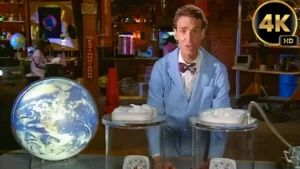
Tap to learn moreA comet is essentially a giant, dirty snowball flying through space. Bill Nye the Science Guy demonstrates this by mixing dry ice, water, dirt, and a dash of ammonia to create a miniature comet model. These celestial bodies are formed in the deepest, coldest parts of our solar system. When their massive elliptical orbits bring them close to the sun, the solar heat causes their icy outer layers to turn directly into gas. This process creates a glowing coma and a brilliant tail that can stretch for millions of miles across the night sky.
Asteroids
Tap to learn moreUnlike comets, an asteroid is a large, solid chunk of rock and metal. They are the leftover building blocks from the creation of our solar system roughly 4.6 billion years ago. Most of the asteroids in our neighbourhood live in the Asteroid Belt, a massive ring of rocky debris located between the orbits of Mars and Jupiter. While they range in size from tiny pebbles to objects hundreds of miles across, they do not contain enough ice to form a tail like a comet does when heated by the sun.
Meteoroids
Tap to learn moreA meteoroid is simply a smaller piece of space debris. You can think of them as the crumbs left behind by bigger objects. When asteroids crash into each other, or when comets shed dust and rock as they travel near the sun, they create meteoroids. They are smaller than asteroids, ranging from the size of a grain of sand to a small boulder. As long as this debris is floating out in the vacuum of space, it is strictly classified as a meteoroid.
Meteors
Tap to learn moreWhen a meteoroid enters the Earth's atmosphere, its name changes to a meteor. Because the rock is travelling at tens of thousands of miles per hour, it violently compresses the air in front of it. This extreme pressure generates massive amounts of heat through friction. The heat causes the meteor to glow brightly and vaporise, creating the beautiful streak of light we commonly call a shooting star. Most meteors are completely destroyed high up in the sky before they ever get close to the ground.
Meteorites
Tap to learn moreIf a meteor is large enough and tough enough to survive the fiery journey through the atmosphere and actually strike the surface of the Earth, it earns a new title: a meteorite. Bill Nye the Science Guy shows that scientists hunt for meteorites in places like Antarctica because the dark, heavy iron rocks are very easy to spot sitting on top of the bright white snow. Studying meteorites allows scientists to touch and analyse the raw materials that built our solar system.
Elliptical Orbits
Tap to learn morePlanets travel in roughly circular paths around the sun, but comets travel in extreme elliptical orbits. An ellipse is like a stretched out oval. This means a comet spends most of its life freezing in the darkest outer edges of the solar system. As gravity pulls it back inwards, it accelerates rapidly, whipping around the sun at incredible speeds before being flung back out into deep space. This is why famous objects like Halley's Comet are only visible from Earth once every 76 years.
The Oort Cloud
Tap to learn moreWhere do comets come from? Astronomers believe most of them originate in a massive, spherical shell surrounding our entire solar system known as the Oort Cloud. This icy shell is located incredibly far away, sitting nearly halfway to the next closest star. It is filled with billions, or possibly trillions, of dormant icy bodies. Occasionally, a passing star or a gravitational disturbance will knock one of these icy objects out of the Oort Cloud and send it plunging towards our sun, creating a brand new comet.
Impact Craters
Tap to learn moreWhen a large meteorite strikes a planet or a moon, it transfers a massive amount of kinetic energy into the ground. This violent explosion blasts rock and dirt outward in a circular pattern, leaving behind a bowl shaped depression called an impact crater. In the episode, Bill Nye throws a rock into a pan of flour and cocoa powder to show how the ejecta material is thrown outwards. The Earth has been hit many times, but weather and erosion usually wash our craters away, whereas the Moon's craters remain perfectly preserved forever.
Try It: Meteorite Survival Lab
Select a type of space debris and drop it into Earth's atmosphere. Will it burn up, explode mid air, or strike the ground and form a crater?
Apply Your Knowledge
Let us see if you can correctly identify the different types of space rocks based on what you have learned today.
Match the Concepts
Click an object to select it, then click the matching description to place it.
Real-World Challenge
Imagine you are a scientist trying to find fragments of a newly discovered space rock that crashed into a dense green jungle in South America. Based on what you know about the density, colour, and composition of meteorites, what specific clues would you instruct your search team to look for on the forest floor, and why might this be much harder than finding them in Antarctica?
What Has Changed Since This Episode Aired
This episode first aired in 1996. While the core science regarding orbits and atmospheric friction remains completely accurate, modern space missions have expanded our understanding of the universe. Here are three things we know now.
Updated: For a long time, scientists believed that icy comets crashing into a young Earth were the primary source of all the water in our oceans. However, in 2014, the European Space Agency landed a probe directly onto Comet 67P. When they analysed the ice, they discovered its chemical signature did not match the water on Earth. Today, astronomers believe that early asteroids or volcanic outgassing are much more likely candidates for filling our oceans.
Updated: When Bill Nye discussed airbursts like the Tunguska event, scientists had very little modern recorded data on how these explosions behaved. That changed drastically in 2013 when a 20 metre wide meteor exploded over Chelyabinsk, Russia. Captured on thousands of modern dashboard cameras and sensors, the event taught scientists that smaller space rocks can explode much lower in the atmosphere and cause significantly more shockwave damage than older computer models ever predicted.
Updated: During the original broadcast, every comet and asteroid we had ever observed originated from within our own solar system. However, in 2017, astronomers detected a bizarre, cigar shaped object zooming past the sun. Named 'Oumuamua, it was moving far too fast to be trapped by our sun's gravity. It was confirmed as the very first interstellar object, meaning it was a piece of space debris that formed around a completely different star before wandering into our neighbourhood.
Test Your Understanding
Answer these questions and get instant feedback. How many can you get right?
Results
Your score:
Reflection
Before this lesson, you might have thought shooting stars were actually stars. Knowing what you know now about the incredible speeds and friction involved, how does it change the way you look at the night sky?
Episode Discussion
Share your thoughts on this Bill Nye The Science Guy episode