Have you ever watched a seagull calculating the perfect angle to steal a chip and wondered if there is anyone home behind those eyes? It feels personal. It feels intelligent. And for a long time, scientists have debated whether that feeling was real or just us projecting our own human emotions onto a wild animal.
The scientific consensus used to be skeptical. We assumed that while birds could build nests and migrate, they were essentially biological robots. We thought they lacked the “inner light” of consciousness because they were missing the specific brain structure we used to define it. But that consensus has finally shattered. In 2024, a global coalition of scientists signed the “New York Declaration on Animal Consciousness,” formally recognizing that birds likely possess a subjective experience.1Andrews, K., et al. (2024). The New York Declaration on Animal Consciousness. NYU Center for Mind, Ethics, and Policy. https://nydeclaration.com
Therefore, a major new 2025 scientific review has confirmed the biological reality behind this declaration. By synthesizing years of breakthrough studies, researchers have concluded that birds possess the neural “hardware” necessary for consciousness (see Primary Source link above).
The “Lasagna” Problem: Finding the Hidden Cortex
To understand why this confirmation is so revolutionary, we first need to talk about your brain. If you are reading this sentence and understanding it, you are using your neocortex.
In mammals, the neocortex is the seat of all higher intelligence. It handles sensory perception, decision-making, and language. Anatomically, it is very distinct. Imagine a lasagna. The neocortex is made of six distinct layers of neurons stacked neatly on top of each other.
This layered structure is crucial for us. Information flows vertically through the layers like paperwork moving through a corporate office building. It gets sorted, processed, and filed in a strict hierarchy. For over a century, neurobiologists believed that this “six-layer architecture” was the only way to build a complex mind.
The Bird Brain Bias
When scientists first looked at bird brains under a microscope, they didn’t see a lasagna. They saw a fruit salad.
The bird forebrain (the pallium) looked like chaotic clusters of cells huddled together without any order. These clusters are called “nuclei.” Because it didn’t look like our brain, we assumed it couldn’t work like our brain. We assumed birds were stuck with a primitive system only capable of instinct. This is where the insult “birdbrain” came from.
We were wrong. As the new 2025 review highlights, we just didn’t have the right glasses to see the truth.
Seeing the Invisible with Polarized Light
The turning point came when researchers used 3D Polarized Light Imaging (3D-PLI) to look past the clusters.
They shone polarized light through slices of a pigeon’s brain. Because nerve fibers are encased in fat (myelin), they bend light in specific ways. This allowed the team to map the invisible “cables” running between the clusters.
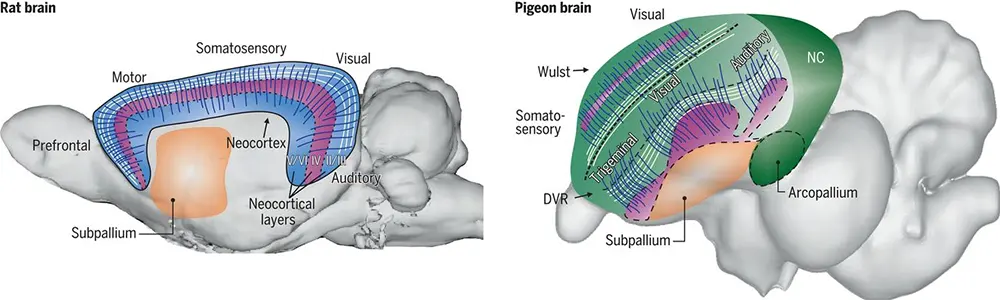
The “Hidden Cortex” Revealed. Left: A rat brain showing the traditional layered neocortex. Right: A pigeon brain analyzed with 3D-PLI, revealing a matching grid-like fiber network (green/purple) hidden inside its dense cell clusters. Credit: Stacho et al. (2020), Science.
The scan revealed a masterpiece of engineering. The bird brain isn’t chaotic at all. It is organized into a magnificent 3D grid. Long fibers run distinct vertical and horizontal paths, connecting the clusters in a circuit that works exactly like the columns in our cortex.2Stacho, M., et al. (2020). A cortex-like canonical circuit in the avian forebrain. Science, 369(6511), 1585-1589. https://doi.org/10.1126/science.abc5534
Here is the analogy. The mammalian brain is like a strict Corporate Headquarters (the layered lasagna). The bird brain is like an agile Silicon Valley startup (clusters of teams). The office layout is completely different. But the work they do – processing data, making deals, planning for the future – is exactly the same.
Do Birds Actually “Feel” Reality?
Knowing the brain can process information is one thing. Knowing if the bird feels it is another. This is the difference between a smoke detector and a human. A smoke detector reacts to smoke, but it doesn’t feel fear.
Does a bird have a point of view? This is the “Hard Problem” of consciousness. To solve it, researchers Andreas Nieder and his team had to trick a crow’s brain into revealing its secrets.
The “Did You See It?” Test
They trained carrion crows to watch a screen for a grey square.
- Sometimes the square was bright. (Easy: “Yes, I see it.”)
- Sometimes the square was gone. (Easy: “No, nothing there.”)
- The Trap: Sometimes the square was incredibly faint. It was right at the threshold of visibility.
In these “faint” trials, the physical light was identical every time. But the crow’s reaction changed. Sometimes it nodded “Yes.” Other times it stayed still for “No.” Since the reality on the screen hadn’t changed, the decision had to be coming from inside the crow.
The researchers monitored individual neurons in the crow’s brain during the test. They found the “neural fingerprint” of consciousness. The neurons did not track the physical light. They tracked the crow’s experience.
If the crow thought it saw the light, the neurons fired. If it didn’t, they stayed silent. This proves the bird was not just reflexively processing photons. It was generating a subjective experience of the world.3Nieder, A., Wagener, L., & Rinnert, P. (2020). A neural correlate of sensory consciousness in a corvid bird. Science, 369(6511), 1626-1629. https://doi.org/10.1126/science.abb1447
The Rooster in the Mirror
But what about self-awareness? We humans are very proud of knowing who we are.
For decades, we used the “Mirror Test” to measure this. If an animal recognized a painted spot on its face in a mirror, it was “self-aware.” Apes pass. Birds usually fail. We thought this meant they were not conscious.
But the new scientific consensus argues that we were just giving them the wrong test. Roosters are evolutionarily programmed to warn their flock about aerial predators. If a rooster sees a hawk, he screams. But he is not suicidal. If he is alone, he stays silent to avoid being eaten.
Researchers put a rooster in a room with a mirror and flew a hawk silhouette overhead.
If the rooster thought the reflection was another bird, he should have screamed to warn his “friend.” He didn’t. He stayed silent.4Hillemacher, S., et al. (2023). Roosters do not warn the bird in the mirror: The cognitive ecology of mirror self-recognition. PLOS ONE. https://doi.org/10.1371/journal.pone.0291416
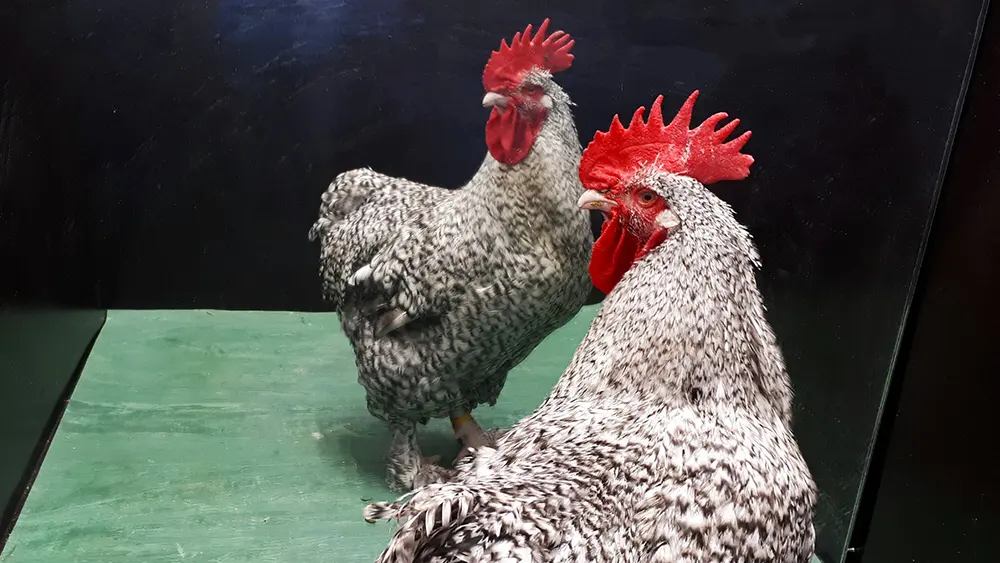
A rooster in the experimental setup used to test situational self-awareness. The study found that roosters recognize their own reflection because they stay silent when seeing a predator threat in the mirror—realizing “that bird isn’t real”—whereas they would normally scream to warn a real companion. Credit: Hillemacher et al. Source: PLOS ONE (2023)
This silence is profound. It means the rooster realized the reflection wasn’t real. He possessed situational self-awareness. He knew “That image is not a bird I can save.” He might not be vain enough to check his hair in the mirror, but he is smart enough to know he is alone.
Why Does This Matter?
The 2025 review concludes that these diverse findings – the hidden cortex, the conscious crow, and the self-aware rooster – paint a unified picture (see Primary Source link above).
We have to rewind the clock 320 million years. That is when the last common ancestor of humans and birds lived. It was a small, lizard-like creature that likely didn’t have much of a mind at all.
Since then, mammals went left and dinosaurs (birds) went right. We evolved separately for hundreds of millions of years. Yet, we both ended up with consciousness.
This is called Convergent Evolution. It is the same reason dolphins (mammals) and sharks (fish) both have fins. The ocean demands a shape that cuts through water, so nature invented the fin twice.
The “ocean” of survival demands intelligence. You need to predict threats. You need to remember food sources. Nature invented the conscious mind twice because it is the ultimate survival app.
The Artificial Horizon
This leads us to a final, curious question about the future.
We are currently trying to build Artificial Intelligence. Critics often say silicon chips can never be conscious because they aren’t biological. But the birds have just proven that the “substrate” – the stuff the brain is made of – might not matter.
If biology can build a mind out of layers (mammals) and also out of clusters (birds), why can’t technology build one out of silicon?
However, there is a catch. The ALARM Theory of Consciousness argues that true awareness starts with “Basic Arousal.” This is the deep, panic-driven drive to stay alive.5Feinberg, T. E., & Mallatt, J. M. (2016). The ancient origins of consciousness. MIT Press.
A rooster feels fear. A crow feels uncertainty. A computer currently feels nothing. We have built machines that can mimic the logic of a cortex, but we haven’t given them the heartbeat of a survivor.
So, the next time you see a crow watching you, show some respect. It isn’t a robot. It is a distant cousin, staring back at you with a mind built on a completely different blueprint, but designed to do exactly the same thing: wonder.