

For decades, the search for the chemical origins of life was limited to the cozy nurseries of our own Milky Way galaxy. We knew that our galaxy provided a well-stocked laboratory with plenty of heavy elements and stable radiation for building life 1Science Alert. (2026). Life’s Ingredients Found Frozen Beyond The Milky Way For First Time. https://www.sciencealert.com/lifes-ingredients-found-frozen-beyond-the-milky-way-for-first-time. But we did not know if these “seeds of life” could survive the much harsher, more primitive environments found in other galaxies. Therefore, researchers recently turned the gold-plated gaze of the James Webb Space Telescope (JWST) toward a massive baby star in a neighboring galaxy to see if the building blocks of life were truly universal.
The results were a landmark achievement for astrochemistry 2Eurasia Review. (2026). Scientists Discover Building Blocks Of Life In Ice Around A Forming Star In Neighboring Galaxy. https://www.eurasiareview.com/21102025-scientists-discover-building-blocks-of-life-in-ice-around-a-forming-star-in-neighboring-galaxy/. Deep within the Large Magellanic Cloud (LMC), roughly 160,000 light-years away, astronomers spotted a treasure chest of complex organic molecules (COMs) frozen in ice. This discovery marks the first time that chemicals like ethanol and acetic acid have been identified in their solid form outside our own galaxy. These findings prove that the fundamental ingredients for biology are far more robust than we ever imagined.
What did the James Webb Space Telescope discover?
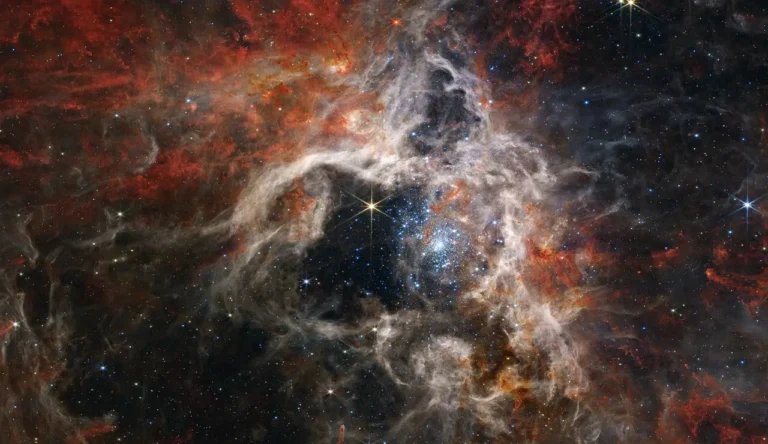
The telescope focused on a massive forming star known as ST6. This “protostar” is located within a star-forming region called N158 in the Large Magellanic Cloud 3Space.com. (2026). JWST makes key detection of complex organic molecules around star in galaxy beyond our Milky Way. https://www.space.com/astronomy/james-webb-space-telescope/jwst-makes-1st-ever-detection-of-complex-organic-molecules-around-star-in-galaxy-beyond-our-milky-way. ST6 is in the very early stages of its life. It is currently wrapped in a gargantuan envelope of gas and dust that spans about 1.6 light-years in diameter. This baby star is incredibly bright and is surrounded by an environment where temperatures stay below 100 Kelvin.
At these freezing temperatures, the chemicals around the star do not float as gas. Instead, they are locked in frozen shells around tiny grains of dust. Using the JWST’s Mid-Infrared Instrument (MIRI), the research team captured infrared light passing through these icy shells. Every molecule absorbs light at a unique frequency, much like a chemical barcode. The team used this data to extract the “fingerprints” of five distinct complex organic molecules.
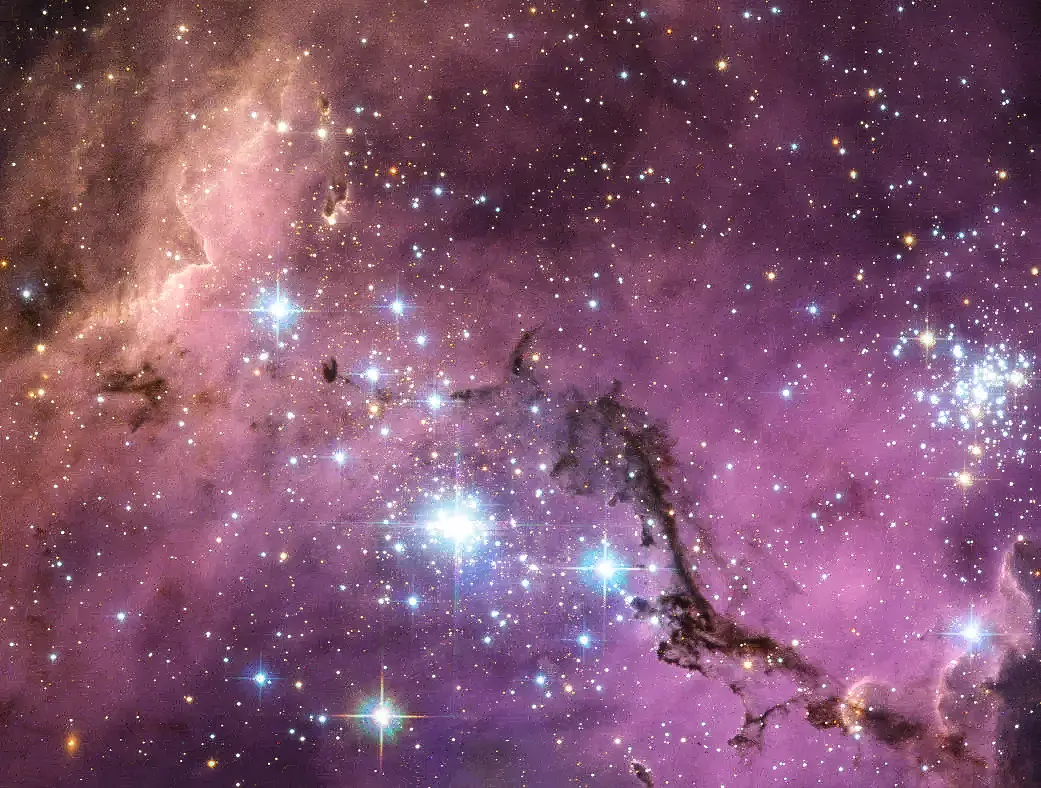
The Large Magellanic Cloud serves as a “natural laboratory” where scientists can watch life’s ingredients form in harsh conditions. Credit: NASA.
How does the “Cosmic Kitchen” cook up life’s ingredients?
To understand how these molecules form in the vast vacuum of space, we have to look at something called grain-surface chemistry. In space, atoms are usually too far apart to bump into each other and bond. However, interstellar dust grains act like solid “meeting points” or workbenches for chemistry. These grains are extremely cold, often reaching temperatures as low as 10 to 15 Kelvin.
Imagine you are trying to bake a complex cake in a massive, dark warehouse. If your ingredients are just floating in the air, they will never mix together. The dust grains are like baking sheets or workbenches scattered throughout the warehouse. Because the sheets are so cold, any passing atoms “stick” to the surface. This is called “freeze-out”. Over millions of years, these sheets become coated in a layer of frozen material known as an ice mantle.
Simple hydrogen atoms can scuttle across these sheets until they find carbon or oxygen to form water or methanol. But building more complex molecules like acetic acid requires a “mixer”. In the Large Magellanic Cloud, intense ultraviolet radiation from nearby stars provides that energy. The light breaks simple molecules apart into reactive fragments called “radicals”. These fragments then snap back together on the surface of the grain to build larger structures. This grain-surface mechanism allows the universe to manufacture life’s building blocks even in the middle of a cosmic void.
Why is “Cosmic Vinegar” so important?
One of the most exciting parts of the ST6 study was the discovery of acetic acid. You might know acetic acid as the main ingredient in household vinegar. While we have seen this molecule in gas form before, finding it as a solid ice is a first for astronomy. This shows that the precursors of biology are actively manufactured on the surfaces of solid particles during star formation.
Even more surprising was the amount of vinegar found 4ScienceDaily. (2025). NASA’s Webb finds life’s building blocks frozen in a galaxy next door. https://www.sciencedaily.com/releases/2025/11/251112011838.htm. Most organic molecules at ST6 were less abundant than those in the Milky Way because the Large Magellanic Cloud has fewer heavy elements. This “half-empty pantry” is called subsolar metallicity. However, acetic acid was found in an overabundance. Scientists believe the high radiation in the LMC drives specific chemical reactions that favor vinegar over other molecules.
To isolate these faint signals, the research team used a powerful computer tool named ENIIGMA. This tool uses genetic algorithms to compare space data with a library of thousands of laboratory ice spectra. It works like a puzzle solver, finding the perfect combination of molecules that match the JWST data. This rigorous check ensured that what they saw was not just noise, but a real signature of complex extragalactic chemistry.
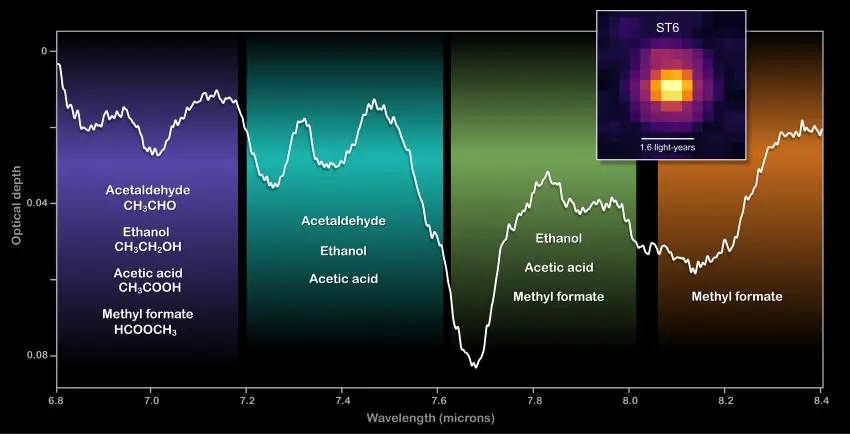
This “chemical barcode,” captured by the JWST’s Mid-Infrared Instrument (MIRI), reveals the distinct fingerprints of frozen organic molecules—including the first solid-state detection of acetic acid—around the protostar ST6. Credit: NASA / ESA / CSA / L. Hustak (STScI).
Can life emerge in a primitive galaxy?
The environment of the Large Magellanic Cloud gives us a window into the early universe. Because the LMC has fewer heavy elements, it mirrors the conditions of galaxies that formed billions of years ago. The fact that complex organic molecules can form here suggests that the seeds of life are far more common than we thought.
One of the biggest mysteries remaining in the data is the presence of glycolaldehyde 5IFLScience. (2026). First-Ever Detection Of Complex Organic Molecules In Ice Outside Of The Milky Way. https://www.iflscience.com/first-ever-detection-of-complex-organic-molecules-in-ice-outside-of-the-milky-way-81472. This is a sugar-related molecule that is a direct precursor to ribose. Ribose is the sugar that forms the structural backbone of RNA. While the signal for this molecule at ST6 is not yet certain, its potential presence is tantalizing. It would mean the seeds of genetic material were available across the cosmos long before Earth ever formed. This aligns with the “RNA World” hypothesis, which suggests that RNA was a key step in early life.
The transition from gas-phase observations to identifying these molecules in ice is a major leap. Before the JWST, instruments like the Spitzer Space Telescope could not tell the difference between these complex molecules. For twenty years, methanol was the only complex molecule we could find in space ice. Now, we can see the entire lifecycle of these organics, from their birth on a grain of dust to their potential home on a future planet.
This study also builds on the JOYS (JWST Observations of Young protoStars) program. That project mapped over 30 protostars in our own galaxy to create a baseline for what “normal” chemistry looks like. By applying those same techniques to ST6, astronomers have played their “first away game” in a neighboring galaxy. They proved that the chemical recipes used to build life in the Milky Way are used everywhere.
What are the next steps for astronomers?
This discovery is a major milestone, but it also shows us how much we still have to learn. Scientists currently face a “Laboratory Data Gap”. To identify a molecule millions of light-years away, we must compare space data with spectra from Earth-based labs. We currently lack high-resolution data for many organic ices at the temperatures found in space. Without these “reference fingerprints,” it is hard to tell similar molecules apart.
The research team now plans to use the JWST to survey more stars in both the Large and Small Magellanic Clouds. By building a larger census of these molecules, astronomers can find out if ST6 is a unique outlier or a common example of extragalactic chemistry. They also want to see if these icy molecules can survive the heat of planet formation to eventually land on a new world.
Ultimately, this discovery places a “time stamp” on the potential for life in the universe. We now know that the building blocks of biology are not a local specialty of the Milky Way. They are a natural consequence of how stars form throughout the history of the cosmos. As we continue to explore the Magellanic Clouds, we are no longer just looking at distant lights. We are observing the universal assembly line for the architecture of life.














So it seems the ingredients are everywhere but why haven’t we found the “chefs” yet? Does this make you more or less confident that we aren’t alone? Let me know below!