Scientific Reference Note: The primary research documentation from Hannover Medical School contains graphic medical photography of open-limb surgeries. While these images are essential for medical documentation, they may be distressing to some readers. Discretion is advised if visiting the primary source link.
A Tantalizing Clue: Can Spider Silk Weave the Future of Human Nerve Repair?
Your nervous system operates a lot like a massive, biological electrical grid. Nerves carry vital, high-speed signals from your brain down to your fingertips and toes. These signals tell your heart to beat. They allow your hands to feel heat. They command your muscles to move. For a clearer look at how this grid is organized, you can explore this anatomy guide to the Peripheral Nervous System. While this system is incredibly efficient, severe trauma can violently rip these wires apart. A tiny gap is relatively easy to fix as the body can naturally heal a small cut. However, a massive gap causes a total blackout. This happens in severe car crashes or during complex cancer surgeries where a large section of the nerve is destroyed. The result is often permanent paralysis and a total loss of feeling in the limb.
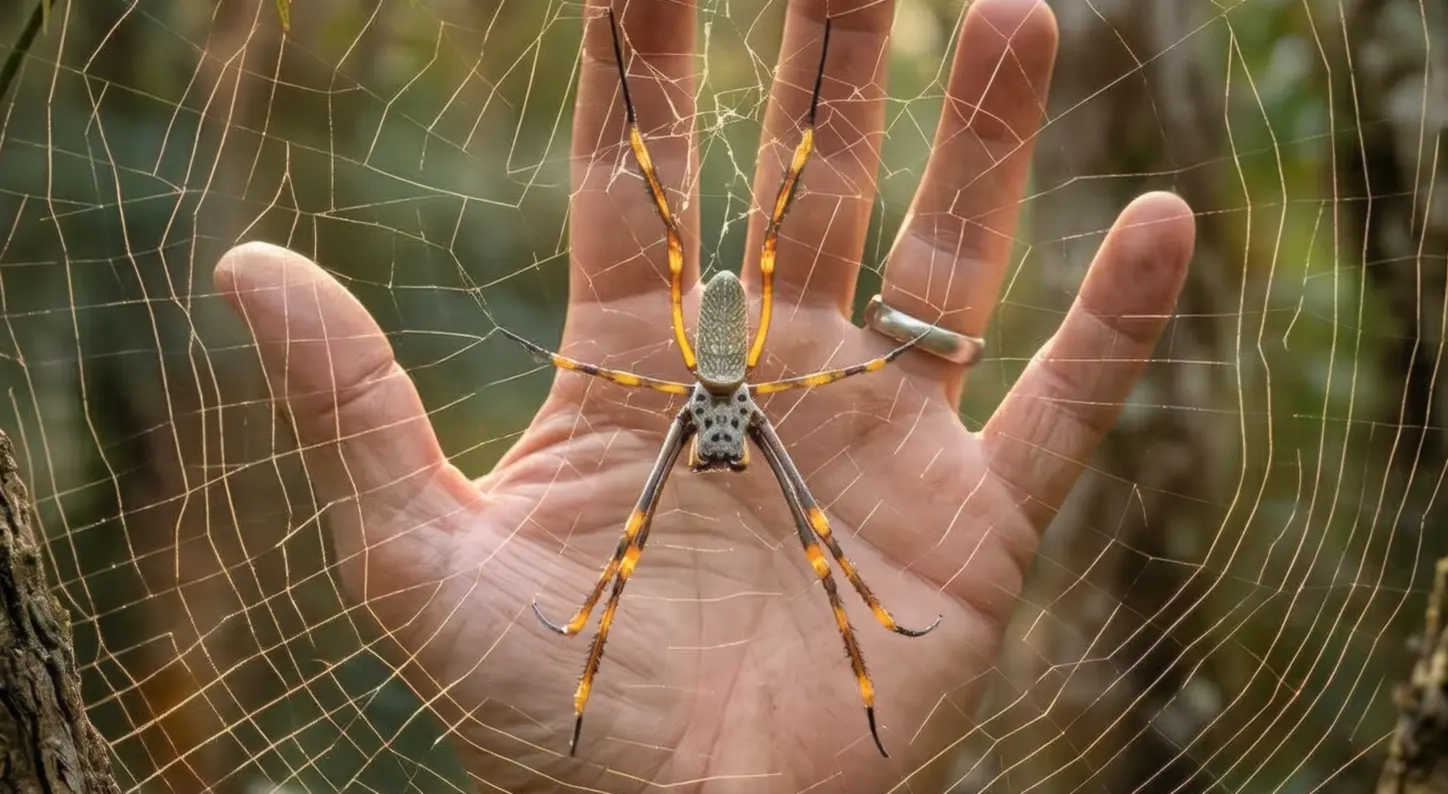
Therefore, reconstructive surgeons needed a radical new way to bridge the chasm. They found the answer in a highly unexpected place. The golden orb-weaver spider has spent millions of years perfecting a material that is stronger than steel and highly elastic. More importantly, it is profoundly compatible with human cells. This ancient material is now the star of a modern medical revolution. It offers a path to recovery for those who have lost the ability to move or feel. These spiders are helping us fix what was once considered unfixable. It is a story of how nature’s simplest threads can solve our most complex medical mysteries.
The biology behind this failure is fascinating and tragic. When a nerve is cut, the section disconnected from the spinal cord simply dies. Doctors call this process Wallerian degeneration. For those interested in the history and science of this discovery, Wikipedia offers a well-illustrated overview of nerve degeneration. The surviving nerve stump desperately wants to grow back. However, it is blind and has no physical bridge to cross the empty space. Without a structure to follow, the nerve grows in random directions. This often leads to a painful, tangled knot of tissue called a neuroma. These knots send constant, agonizing pain signals to the brain. Spider silk becomes the miracle solution by providing the physical map the nerve needs to find its way home.
The Core Finding: From the Lab to Human Trials
For years, scientists struggled to build synthetic plastic tubes to guide nerve growth. The human body often rejected them. Scar tissue would build up to crush the delicate nerve inside. Recent medical reviews confirm that standard synthetic conduits are generally only approved for gaps smaller than three centimeters.1Kehoe, S. et al. (2012). FDA approved guidance conduits and wraps for peripheral nerve injury: A review of materials and efficacy. Injury. https://pubmed.ncbi.nlm.nih.gov/22100523/ For a deeper look at why these materials struggle, you can read this review of artificial nerve conduits. For patients with massive defects, the biological distance was simply too great. It was a dead end for modern medicine until surgeons looked toward biology.
In 2024, researchers at the Hannover Medical School in Germany moved away from artificial plastics. They used actual spider silk to repair catastrophic nerve damage in human patients. They successfully guided growth across gaps of up to 20 centimeters. This breakthrough is restoring sensation and movement to patients who previously had no hope. It proves that nature has already solved the problems we have struggled with for decades.
The Oxford Engineering: The SilkAxons™ Breakthrough
The success of the academic research sparked a new wave of innovation in the United Kingdom. An Oxford University spinout company called Newrotex transformed this discovery into a standardized medical product. Working from the Wood Centre for Innovation in Oxford, the team developed the SilkAxons™ device. This is a precision-engineered medical conduit. It consists of a protective outer tube packed with thousands of microscopic spider silk fibers, perfectly aligned to create a high-speed highway for regenerating nerves. This organization is critical for success. If the fibers were tangled, the nerve would get lost. By keeping them straight, the Oxford team ensured the axons could travel the maximum distance in the shortest time.
In 2026, these devices are being used in landmark clinical trials at the Panama Clinic to repair nerve gaps of 8 to 10 centimeters. This is three times the distance any traditional plastic conduit can handle. The Oxford trial is proving that this technology can be mass-produced and used safely in standardized surgeries. This specific engineering allows the body to accept the material as if it were its own tissue. It turns a wild material into a surgical tool that can be used in hospitals around the world.
Behind the Science: The Trellis and the Vine
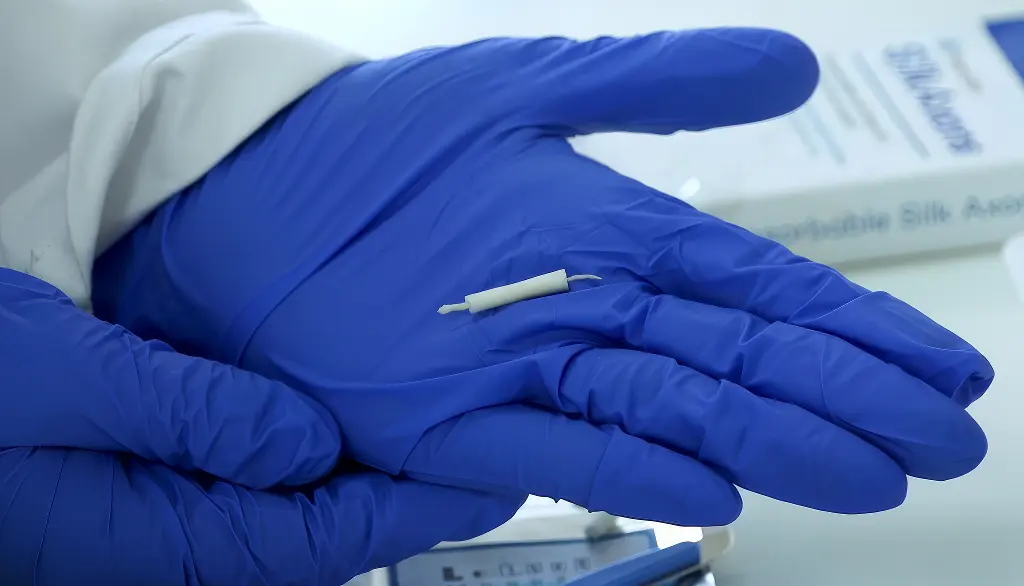
The SilkAxons™ device is a standardized nerve conduit developed by Oxford University spinout Newrotex. Credit: Maxon Group.
So, why is spider silk the magic ingredient? It comes down to basic biology and physical structure. We can understand this by looking at how a garden grows. Inside your body, individual nerve fibers are called axons. Think of a growing axon as a climbing rose vine that needs a trellis to grow straight. Without support, the vine collapses into a tangled knot. In the body, this knot is a neuroma. Spider silk acts as the perfect biological trellis because it is made of proteins called spidroins. For a visual deep dive into the molecular chemistry of spidroins, the University of Bristol offers an excellent educational resource. These proteins are incredibly sticky to human biology. They attract and hold onto growing axons. Researchers proved this cellular attraction in a landmark 2014 study.2Radtke, C. et al. (2014). Spider Silk Constructs Enhance Axonal Regeneration and Remyelination in Long Nerve Defects in Sheep. PLOS One. https://journals.plos.org/plosone/article?id=10.1371/journal.pone.0016990
The Rubber Insulation
There is another crucial player in this process. It is called the Schwann cell. These specialized human cells wrap tightly around your axons. They act exactly like the protective rubber insulation on a copper electrical wire. Without this cellular insulation, the electrical signal from your brain leaks out and fades away. This wrapping process is known as myelination. You can learn more about how Schwann cells insulate nerves at Britannica. Spider silk attracts Schwann cells immediately. This ensures the new nerve can carry strong, clear signals back to the brain at high speed. This dual support for both axons and insulation is what makes the silk implant so effective.3PMC. (2022). In Vitro, In Vivo and Ex Vivo Models for Peripheral Nerve Injury and Regeneration. National Library of Medicine. https://pmc.ncbi.nlm.nih.gov/articles/PMC9413794/ The silk fixes the wiring and the insulation at the same time.
Why It Matters: Ending the Autograft Nightmare
Before spider silk, the gold standard for fixing a major nerve gap was a brutal procedure called an autograft. If you severely damaged a nerve in your arm, a surgeon had to cut a long, healthy nerve out of your leg and transplant it. This required two major surgeries. It doubled the infection risk. It also left the patient with permanent numbness in their leg. The patient essentially traded one injury for another. The new silk clinical trials eliminate this problem entirely. Surgeons can fix the damaged arm without ever cutting into a healthy leg. This is a massive victory for patient comfort and recovery. It is a cleaner and kinder way to heal the human body.
What is Next? The Manufacturing Bottleneck
While the science is a success, the manufacturing remains a challenge. Spiders are highly territorial and cannibalistic. This means we cannot create spider farms to collect silk on an industrial scale. Today, lab workers must carefully sedate and milk live golden orb-weaver spiders by hand using a tiny motorized spool. It is a slow, manual process to get enough silk for one surgery. While r
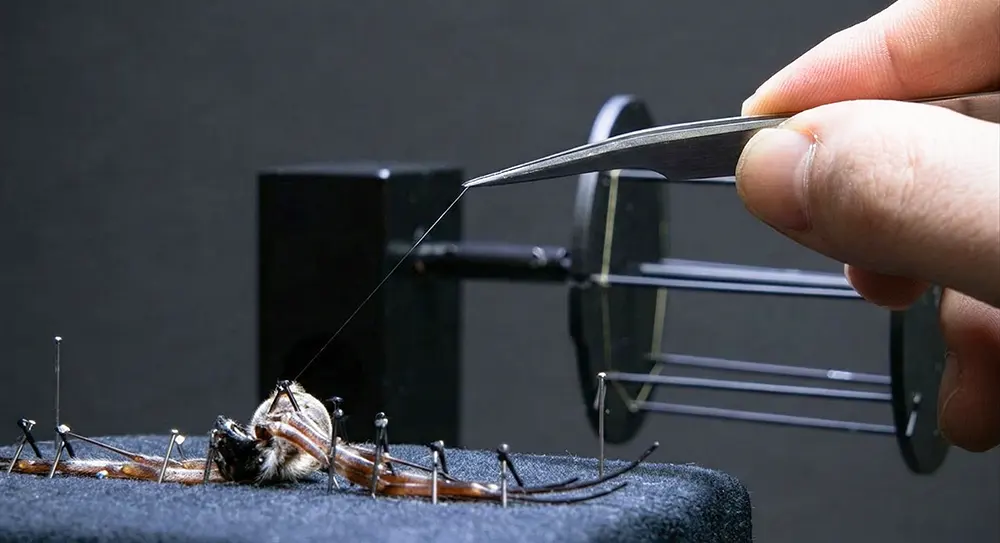
Harvesting high-quality spider silk is a delicate, manual process. This image shows the specific reeling technique used to collect the protein fibers. Credit: Seriously Scientific.
esearchers are trying to engineer bacteria to produce silk proteins in vats, we currently rely on these in
credible arachnids to provide the raw materials for these surgeries. The Science Advances journal has published fascinating research on the future of synthetic spider silk production.
The Ethics of the Harvest: A Humane Process
It is important to note that the spiders involved in this research are treated with extreme care. In laboratories like the Oxford Silk Group, the spiders are not harmed during the milking process. They are gently held in place using soft foam and gauze. This allows the silk to be reeled from their spinnerets for about 20 minutes. After the session, the spiders are immediately hydrated. They are fed a high-protein meal of crickets as a reward for their work. They are then returned to their individual webs to rest and regenerate. This humane, non-lethal cycle ensures that the spiders can live full, healthy lives while contributing to the future of human medicine.
The following video demonstrates exactly how this reeling process works in a controlled laboratory setting. It highlights the precision required to harvest this golden material:
Doctors are still racing against a biological clock. Muscle tissue can die permanently if it goes without a signal for too long. Despite the pressure, the 2026 trials prove that nature’s oldest materials hold the key to human healing. The delicate thread of a spider is weaving a path toward a world without permanent paralysis. We are finally learning to use nature’s own blueprints to repair the human body and restore what was once thought lost forever.