
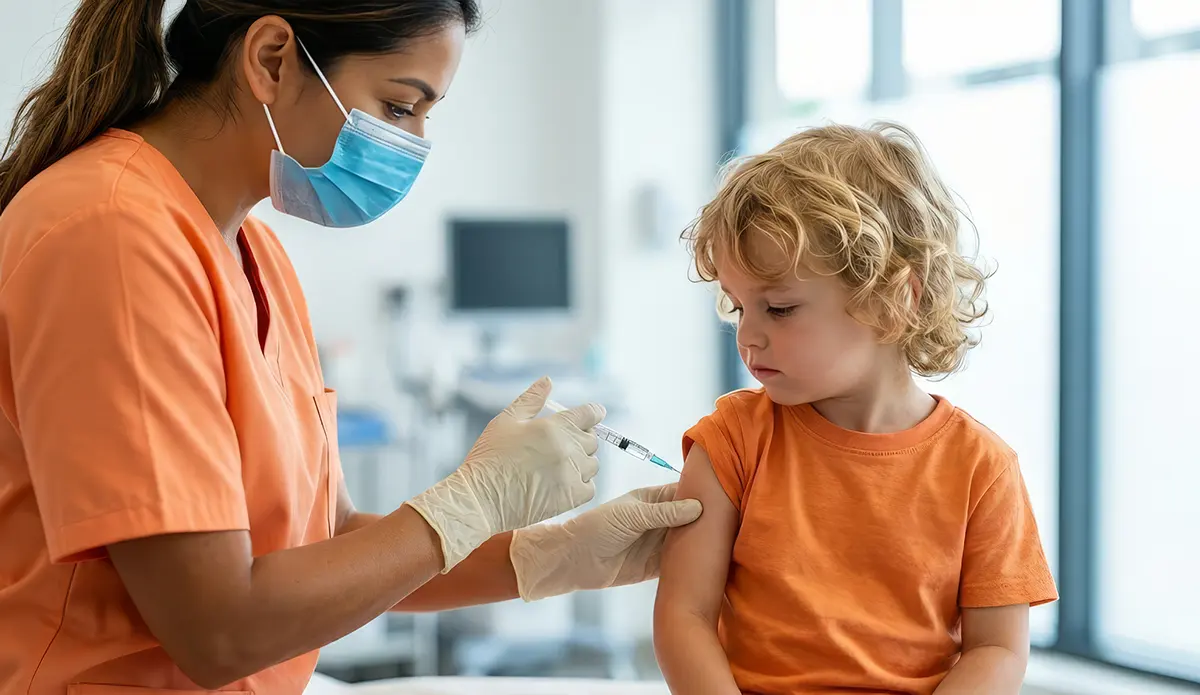
DATELINE: GENEVA – Imagine a stadium filled with 100,000 people. Now imagine 1,500 stadiums just like it. That is the scale of human life preserved by vaccines over the last half-century.
A groundbreaking 2024 study published in the major medical journal The Lancet has quantified this impact for the first time. Since 1974, global immunization efforts have saved 154 million lives. Most of these lives belong to children under the age of five.
But numbers on a page can feel abstract. Where does this “6 lives per minute” figure actually come from? And more importantly, how can the human body handle complex modern vaccines, like the 6-in-1 shot, without becoming overwhelmed?
To understand this, we need to bridge the gap between statistical data and cellular biology.
The Data: Verifying “6 Lives Per Minute”
In science communication, accuracy is paramount. This statistic is derived from a massive global modeling analysis led by the World Health Organization (WHO) and published by Andrew Shattock and his team in 2024.
The researchers analyzed data from 1974 (the start of the Expanded Programme on Immunization) through 2024. They found that over these 50 years, vaccines prevented 154 million deaths.
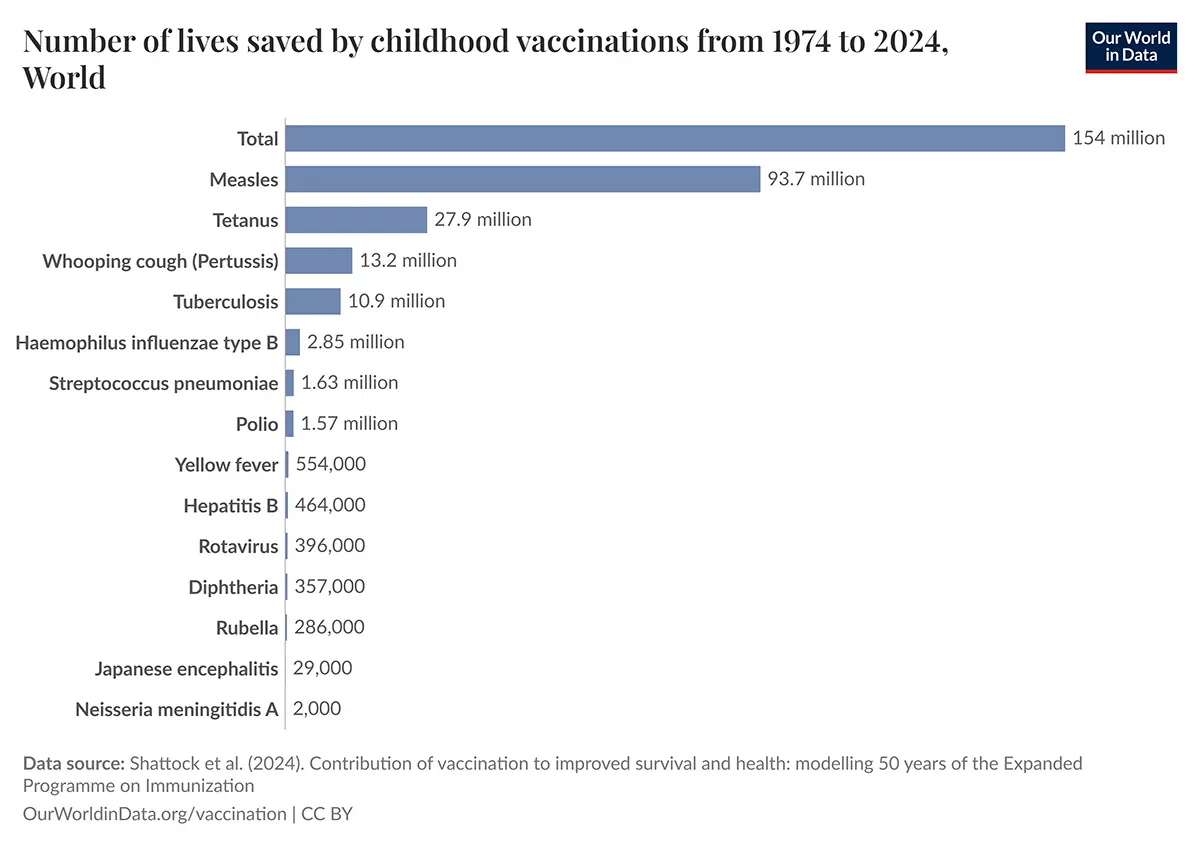
The climb to 154 million: This chart visualizes the cumulative lives saved since the launch of the Expanded Programme on Immunization. Credit: Our World in Data / WHO.
When we break this down mathematically, the constant “shielding” effect of vaccines becomes clear:
- 154 million lives divided by 50 years is 3.08 million lives per year.
- That breaks down to 8,432 lives per day.
- That equals roughly 5.86 lives saved every single minute.
This is not a theoretical estimate. It is a calculated reality based on five decades of observed health data 1 Shattock, A. et al. (2024). Contribution of vaccination to improved survival and health: modelling 50 years of the Expanded Programme on Immunization. The Lancet. https://doi.org/10.1016/S0140-6736(24)00850-X .
The Biology: How the Immune System “Reads” a Vaccine
One of the most persistent concerns regarding modern immunization is the safety of the hexavalent (6-in-1) vaccine. The question is logical. Does combining six different treatments overwhelm an infant’s developing immune system?
To answer this, we must look at how the adaptive immune system functions at the molecular level.
The “Antigen” and the “Wanted Poster”
Your immune system does not “see” a whole virus. It looks for specific proteins on the virus’s surface, known as antigens.
Think of your immune system as a highly trained security force. The vaccine is not the villain. It is a “Wanted Poster.” The antigen is the specific face on that poster.
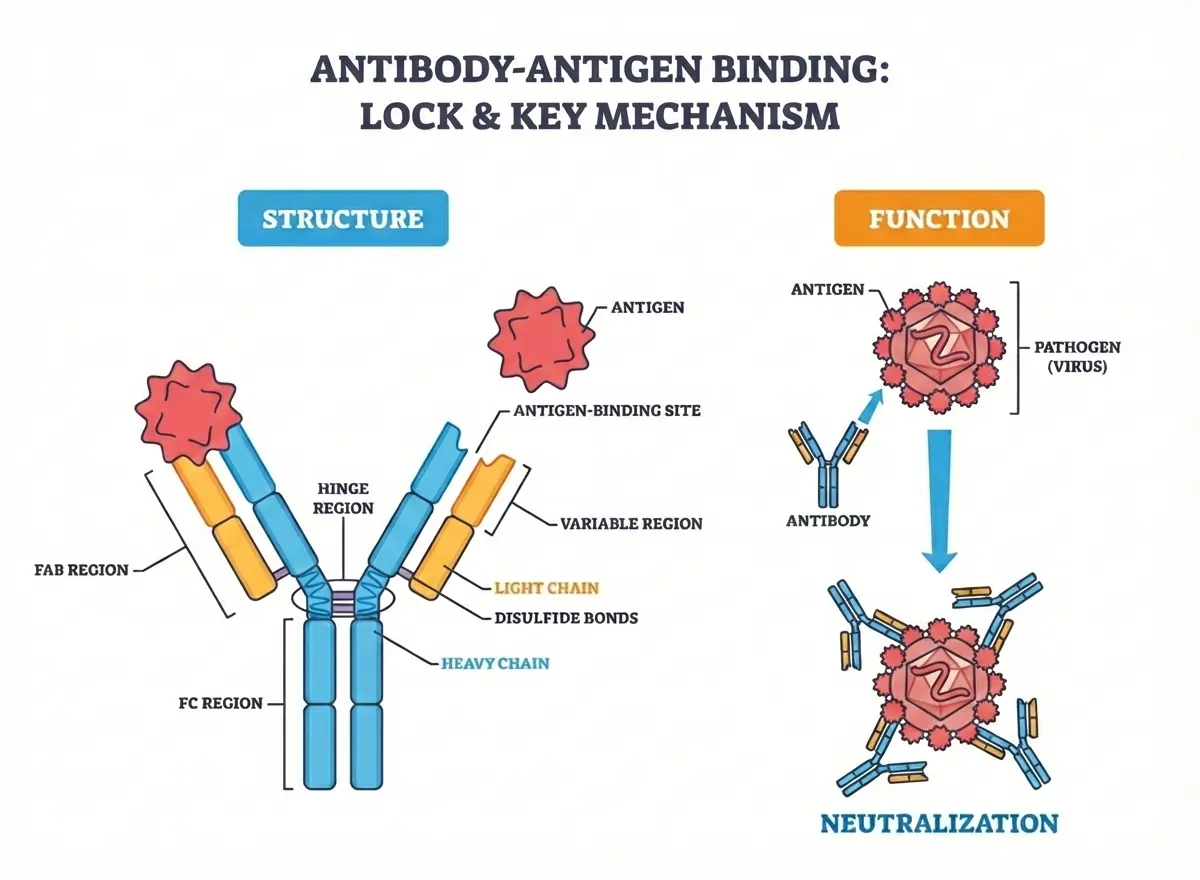
The “Lock and Key” mechanism in action: The diagram shows how the antibody’s specific shape allows it to bind to and neutralize a pathogen. Credit: Seriously Scientific.
The Old Method: In the past, doctors provided one poster at a time (e.g., a single Polio shot). The immune system would study it, memorize the antigen, and produce antibodies.The Modern Method: A hexavalent vaccine is simply a single sheet of paper with six faces on it.
The immune system is an incredibly powerful biological computer. It can process these six distinct “faces” simultaneously without difficulty. It does not get “tired” or “confused.” It simply catalogues the information and prepares its defenses.
In fact, immunologists estimate that an infant’s immune system could theoretically handle up to 10,000 vaccines at once without exhausting its capacity 2 Children’s Hospital of Philadelphia. (2025). Immune System and Vaccines. CHOP.edu. https://www.chop.edu/centers-programs/vaccine-education-center/vaccine-safety/immune-system-and-health . The biological “bandwidth” of the human body is immense.
Myth Buster: The “Antigen Overload”
A common misconception is that modern vaccines contain “more ingredients” than those in the past. While children do receive more shots today, the actual biological load (the number of antigens) has plummeted.
This is due to advances in protein purification and recombinant DNA technology.
- In 1960: Children received about 5 vaccines. However, because the science was less precise, those shots exposed the body to over 3,200 distinct antigens.
- In 2024: Children receive roughly 14 vaccines. Yet, thanks to precision engineering, these shots contain fewer than 150 antigens combined.
We are providing broader protection with a significantly lighter biological footprint. The “Wanted Posters” have become high-definition and efficient. We have removed the unnecessary noise 3 Offit, P. A. et al. (2002). Addressing Parents’ Concerns: Do Multiple Vaccines Overwhelm or Weaken the Infant’s Immune System? Pediatrics. https://doi.org/10.1542/peds.109.1.124 .
The MVP: Why Measles Matters Most
The Lancet study identified the Measles vaccine as the single most effective tool in the global arsenal. It accounts for 60% of the 154 million lives saved.
Measles is uniquely dangerous because it is not just a respiratory virus. It is an immunosuppressant. The virus attacks memory B-cells. This effectively causes “immune amnesia.” When a child survives wild Measles, their immune system may “forget” how to fight other diseases it had previously mastered.
[Image of measles virus structure]
By preventing Measles, we protect the integrity of the entire immune system. This concept, known as the “Measles Effect,” means the vaccine saves lives not just from Measles, but from other infections like pneumonia and diarrhea for years afterward 4 Mina, M. et al. (2015). Long-term measles-induced immunomodulation increases overall childhood infectious disease mortality. Science. https://www.science.org/doi/10.1126/science.aad0068 .
The Hidden Benefit: Vascular Health
Beyond preventing infection, vaccines appear to play a crucial role in cardiovascular health. When the body fights a severe infection like influenza, the resulting systemic inflammation can damage blood vessels. This increases the risk of thrombotic events.
Research indicates that influenza vaccination is associated with a significantly reduced risk of stroke in older adults 5 Johns Hopkins Bloomberg School of Public Health. (2025). The Health and Economic Benefits of Vaccines. JHSPH. https://publichealth.jhu.edu . By preventing the infection, we prevent the inflammatory cascade that stresses the heart and brain.
The Future: Technology Beyond the Needle
For those who fear injections, the next 50 years of immunization will look vastly different.
Scientists are currently developing Microarray Patches. These look like small, square bandages. They have thousands of microscopic spikes that dissolve into the skin. They are painless, easy to transport, and do not need refrigeration 6 UNICEF. (2025). Vaccine Microarray Patches (VMAPs). UNICEF Innovation. https://www.unicef.org/innovation .
We are also seeing mRNA technology, the same tech used for COVID-19, being adapted to fight cancer. Scientists are working on “vaccines” that teach the superhero to hunt down tumor cells inside the body 7 National Cancer Institute. (2025). Cancer Vaccines. Cancer.gov. https://www.cancer.gov .
The statistic of “6 lives per minute” is a powerful testament to public health. But the biological reality is even more impressive. It is a sophisticated, adaptable shield that protects us in ways we are only just beginning to fully understand.














This study shows that 6 lives have been saved every minute since 1974. Have you seen the impact of public health initiatives change over your lifetime, or do you have a family story about why vaccination matters to you? We’d love to hear your story.