For tens of thousands of years, the Arctic permafrost has acted as a giant natural freezer, locking away ancient life in icy silence. But now, our planet is warming rapidly, especially in the far north, and that vast freezer is beginning to thaw. Therefore, scientists are racing to understand what happens when its ancient, frozen inhabitants, from tiny microbes to giant 50,000-year-old viruses, wake up.
What they are finding presents us with two very different kinds of challenges. The first is a direct threat to our climate. As trillions of ancient microbes come back to life, they start eating frozen organic material. This releases powerful greenhouse gases that could speed up the very warming that set them free. The second challenge sounds like science fiction but is real. Researchers have revived viruses dormant for nearly 50,000 years, nicknamed “zombie viruses.” While the ones found so far only infect amoebas, their existence proves ancient germs can survive the deep freeze. This raises urgent questions about what else might be lurking in the ice.
What is Permafrost, Anyway?
To understand what’s waking up, we need to know where it has been sleeping. Permafrost is any ground like soil, rock, or sand that stays frozen at or below 0°C (32°F) for at least two years straight.1NASA. (n.d.). What Is Permafrost?. NASA Science. https://science.nasa.gov/kids/earth/what-is-permafrost/ Think of it like a giant underground ice block covering about 15% of the Northern Hemisphere’s land, mostly in Alaska, Canada, and Siberia.2UNEP. (n.d.). Could microbes, locked in Arctic ice for millennia, unleash a wave of deadly diseases?. https://www.unep.org/news-and-stories/story/could-microbes-locked-arctic-ice-millennia-unleash-wave-deadly-diseases
It is not solid ice all the way up. The top layer, called the “active layer,” thaws in summer and refreezes in winter. Below this, the permafrost goes deep, sometimes almost a mile down.3National Snow and Ice Data Center. (n.d.). Frozen Ground & Permafrost. https://nsidc.org/learn/parts-cryosphere/frozen-ground-permafrost This frozen state preserves things incredibly well. It holds massive amounts of organic carbon from ancient plants and animals that never decomposed.4NASA. (n.d.). What Is Permafrost?. NASA Science. https://science.nasa.gov/kids/earth/what-is-permafrost/ It also contains amazingly preserved bodies of Ice Age animals like woolly mammoths.5Kuta, S. (2025, October 15). Scientists Resurrect 40,000-Year-Old Microbes From Alaskan Permafrost. What They Found Raised Worries About the Future of a Warming Arctic. Smithsonian Magazine. https://www.smithsonianmag.com/smart-news/scientists-resurrected-40000-year-old-microbes-from-alaskan-permafrost-180987509/ Most importantly, it holds dormant microbes: bacteria, fungi, and viruses locked in time, some for 700,000 years.6Wikipedia. (n.d.). Permafrost. https://en.wikipedia.org/wiki/Permafrost
How Did Scientists Find These ‘Zombie Viruses’?
One major worry is the return of ancient germs, often called pathogens. A team led by virologist Jean-Michel Claverie investigated this. They focused on permafrost samples from remote parts of Siberia. Their big question was: can viruses frozen for millennia still infect something?
To find out safely, they used a clever trick. Instead of looking for viruses that infect humans (too risky!), they used a harmless single-celled organism called Acanthamoeba as bait.7Alempic, J.-M., Lartigue, A., Goncharov, A. E., Grosse, G., Strauss, J., Tikhonov, A. N., Fedorov, A. N., Poirot, O., Legendre, M., Santini, S., Abergel, C., & Claverie, J.-M. (2023). An Update on Eukaryotic Viruses Revived from Ancient Permafrost. Viruses, 15(2), 564. https://doi.org/10.3390/v15020564 These amoebas live in soil and water. Like humans, amoebas are eukaryotes, meaning their cells have a defined nucleus and complex internal parts.8LibreTexts Biology. (2022, November 1). Prokaryotic and Eukaryotic Cells. https://bio.libretexts.org/Bookshelves/Introductory_and_General_Biology/Introductory_Biology_(CK-12)/02%3A_Cell_Biology/2.02%3A_Prokaryotic_and_Eukaryotic_Cells They are natural prey for “giant viruses.” These aren’t like the tiny flu virus; they’re called “giant” because some are physically as large as small bacteria and have much more complex genetic material than typical viruses, blurring the lines of what we thought viruses could be.9Villarreal, L. P. (2015). Are Viruses Alive?. Scientific American. https://www.scientificamerican.com/article/are-viruses-alive-2004/ The scientists reasoned that if they could revive an ancient virus that infects these eukaryotic amoebas, it would prove viruses can stay infectious over vast timescales.10Bloomberg. (2023). Zombie Viruses Are Waking Up After 50,000 Years as Planet Warms. https://www.igs.cnrs-mrs.fr/wp-content/uploads/2023/10/Bloomberg_2023_2.pdf
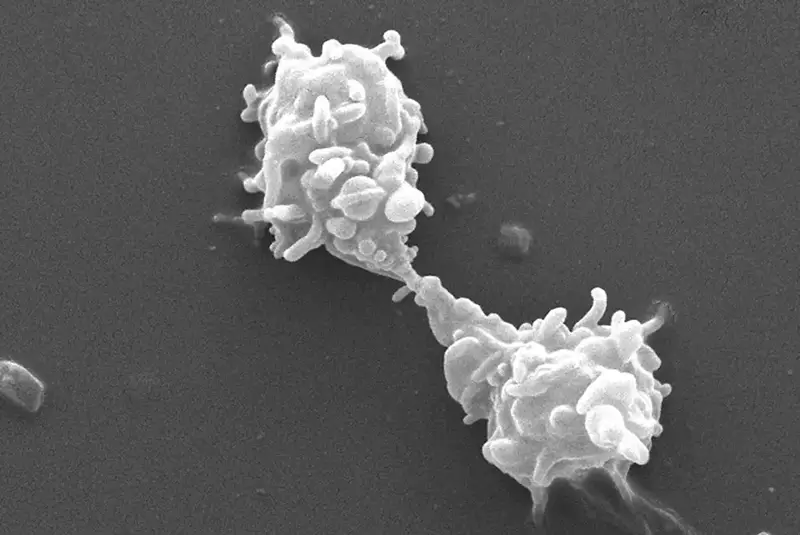
scanning electron micrograph reveals the detailed surface of two Acanthamoeba polyphaga protozoa interacting. Scientists use related amoebas as ‘bait’ to test the infectivity of ancient viruses recovered from permafrost. Image Credit: CDC/Catherine Armbruster; Margaret Williams (Public Health Image Library).
What Exactly Did the Virus Researchers Discover?
They succeeded spectacularly. In 2023, the team announced they isolated and revived 13 ancient viruses from seven Siberian samples. The oldest, a new type named Pandoravirus yedoma, came from permafrost dated to 48,500 years old. This set a world record for the oldest revived infectious virus. These viruses, asleep since Neanderthals roamed, woke up and successfully infected, copied themselves inside, and killed their modern amoeba hosts.11Science Communication Club, University of Toronto. (n.d.). Awakening Ancient Viruses with Climate Change. http://scc.sa.utoronto.ca/content/awakening-ancient-viruses-climate-change/
Why Is This Virus Discovery Such A Big Deal?
This research provides powerful “proof of principle.” It shows complex DNA viruses can survive nearly 50,000 years frozen and still cause infection. The specific viruses revived only harm amoebas. But their survival suggests other viruses, perhaps ones that infected ancient animals or even early humans, might also be preserved. The biggest worry is the “immunity gap.” If a virus unseen for millennia re-emerges, our modern immune systems would have no memory of it, leaving us potentially vulnerable.12Wikipedia. (n.d.). Pathogenic microorganisms in frozen environments. https://en.wikipedia.org/wiki/Pathogenic_microorganisms_in_frozen_environments
Have We Seen Diseases Emerge From Ice Before?
Yes. In summer 2016, a heatwave in Siberia thawed the 75-year-old carcass of a reindeer killed by anthrax. The anthrax bacteria, Bacillus anthracis, forms tough spores that survive freezing. Bacteria like anthrax are prokaryotes, simpler cells without a nucleus.13LibreTexts Biology. (2022, November 1). Prokaryotic and Eukaryotic Cells. https://bio.libretexts.org/Bookshelves/Introductory_and_General_Biology/Introductory_Biology_(CK-12)/02%3A_Cell_Biology/2.02%3A_Prokaryotic_and_Eukaryotic_Cells These spores spread, killing over 2,000 reindeer. The outbreak tragically spread to people, hospitalizing dozens and killing a boy.14Revel, M., et al. (2021). Reindeer Anthrax in the Russian Arctic, 2016: Climatic Determinants of the Outbreak and Vaccination Effectiveness. Frontiers in Veterinary Science, 8, 668420. https://doi.org/10.3389/fvets.2021.668420 This proves pathogens frozen for decades can re-emerge and cause deadly harm. Earlier work also found genetic fragments of the 1918 Spanish Flu virus in a victim buried in Alaskan permafrost.
How Do Scientists Know Microbes Are Waking Up And Affecting Climate?
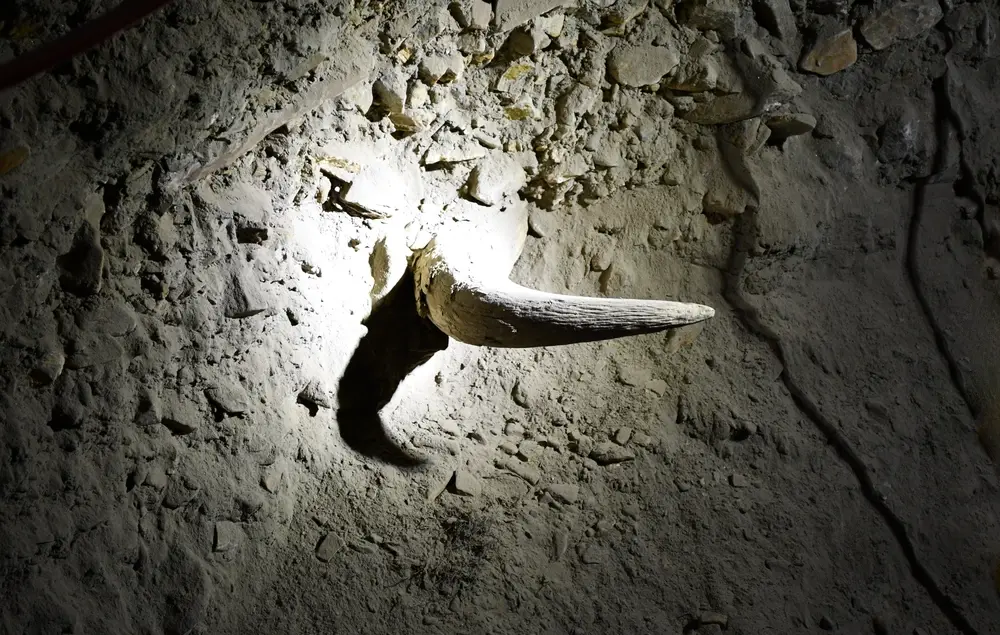
While viruses grab headlines, the more immediate threat is climate change. Scientists Tristan Caro and Sebastian Kopf studied this at a unique lab: the Permafrost Tunnel Research Facility in Alaska. It is a man-made tunnel dug deep into frozen ground.15Graham, D. (n.d.). Scientists resurrect 40,000-year-old organisms from Arctic ice now they’re worried. Discover Wildlife. https://www.discoverwildlife.com/environment/ancient-microbes-arctic-permafrost Inside, you can walk through earth frozen for up to 40,000 years.
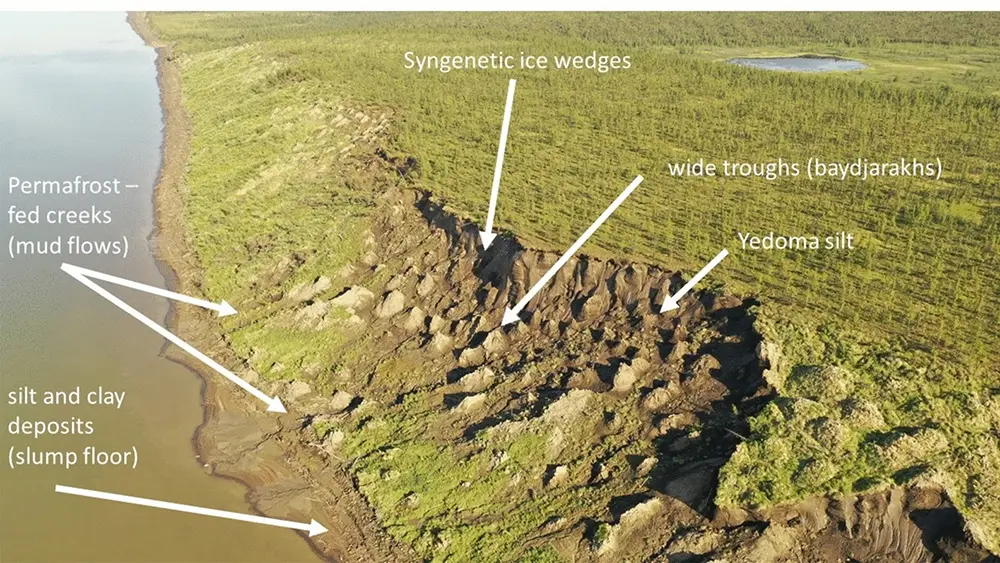
The Duvanny Yar Yedoma outcrop on the Kolyma River, Siberia. Arrows indicate thawing features like melting ice wedges, permafrost-fed creeks (mud flows), and slumped deposits. This type of ancient, ice-rich permafrost is releasing both greenhouse gases and preserved ancient microbes, including viruses. Photo by Vasily Efimov, via Chalov et al.,
The team took permafrost samples and warmed them in the lab to 4°C and 12°C. To see if microbes were growing, they gave them “heavy water” containing deuterium, a special type of hydrogen. If microbes grew, they would absorb this heavy hydrogen into their cells. This leaves a chemical fingerprint scientists can measure.16Caro, T. A., et al. (2025). Microbial Resuscitation and Growth Rates in Deep Permafrost: Lipid Stable Isotope Probing Results from the Permafrost Research Tunnel in Fox, Alaska. Journal of Geophysical Research: Biogeosciences. [Note: DOI/URL not provided in source PDF, citation based on provided info]
What Did the Climate Researchers Find?
The microbes did not wake up instantly. For months, they were sluggish, growing incredibly slowly. But after about six months of steady warmth, their activity exploded. They formed slimy colonies called biofilms and started eating the ancient carbon in the permafrost. As they ate, they released greenhouse gases: carbon dioxide (CO2) and methane (CH4).17Caro, T. A., et al. (2025). Microbial Resuscitation and Growth Rates in Deep Permafrost: Lipid Stable Isotope Probing Results from the Permafrost Research Tunnel in Fox, Alaska. Journal of Geophysical Research: Biogeosciences. [Note: DOI/URL not provided in source PDF, citation based on provided info]
Why Does This ‘Lag Phase’ Matter So Much?
This slow awakening, or “lag phase,” is crucial. It means a single short heatwave might not trigger massive gas release before the ground refreezes. However, it highlights a bigger danger. What really matters is the length of the warm season. As climate change makes Arctic summers longer, it gives these ancient microbes the sustained warmth they need to fully activate. Once active, they release greenhouse gases, warming the planet more, thawing more permafrost, releasing more microbes… a dangerous cycle called a positive climate feedback loop.18Strain, D. (2025, October 2). Researchers wake up microbes trapped in permafrost for thousands of years. CU Boulder Today. https://www.colorado.edu/today/2025/10/02/researchers-wake-microbes-trapped-permafrost-thousands-years
How Likely Is A ‘Zombie Virus’ Pandemic?
It is important to separate the risks. The climate threat from microbes releasing gas is certain and happening now. The “zombie virus” pandemic threat is more speculative. We know ancient viruses can survive and remain infectious. That possibility is real. We also know our immune systems would likely have no defense against a truly ancient virus unseen for millennia. The biggest risk might come from increased industrial digging in the Arctic, potentially exposing workers directly to deep, ancient permafrost.20Kilian, N. (2023, January 4). Bringing ancient viruses back to life. Advanced Science News. https://www.advancedsciencenews.com/bringing-ancient-viruses-back-to-life/
However, there are reasons to be skeptical. Viruses are usually very specific about what they infect. A virus adapted to an amoeba or an extinct mammoth is extremely unlikely to infect modern humans.21Reddit. (n.d.). Do “ancient glacier viruses” actually pose a threat to modern life?. https://www.reddit.com/r/biology/comments/1jkt2c3/do_ancient_glacier_viruses_actually_pose_a_threat/ Viruses are also fragile. Once thawed and exposed to oxygen, sunlight (UV radiation), and modern microbes, they would likely break down quickly.22MDedge. (2023, March 13). ‘Zombie viruses’: Fascinating and a little frightening. https://www.mdedge.com/infectiousdisease/article/261759/mixed-topics/zombie-viruses-fascinating-and-little-frightening Plus, the Arctic has very few people, making it harder for a disease to spread widely.
Scientists generally agree the climate feedback is the immediate, definite danger. The zombie virus scenario is a “low-probability, high-consequence” risk. It is unlikely, but potentially devastating, so it needs monitoring, not panic.23Houser, K. (2023, March 12). “Zombie virus” revived after 48,500 years in permafrost. Freethink. https://www.freethink.com/science/zombie-virus
What Do Scientists Want To Do Next?
More research is crucial. The Alaskan study is just a “tiny slice” of the world’s permafrost. We need to know if microbes elsewhere behave the same way. For the viral threat, scientists like Claverie propose an Arctic monitoring network. Working with local people, it could watch for unusual illnesses in humans and animals. This early warning system could catch a new pathogen at the source, preventing a local outbreak from going global.
The Arctic is no longer a distant, frozen land. It is a sensitive indicator of our planet’s health. The stories emerging from its thawing ground are urgent warnings. Watching the north is key to navigating our future on a changing planet.