









Galapagos: Origin
How did penguins end up living on the equator? How do tortoises cross 600 miles of open ocean? Discover how volcanic islands, ocean currents, and trade winds built one of the most extraordinary ecosystems on Earth.
How Did Life Reach the World's Most Isolated Islands?
They floated. Tortoises cannot swim, but they can float. About three million years ago, a large tortoise from South America was swept out to sea, perhaps by a flash flood. After weeks or even months adrift, it reached the islands. As David Attenborough explains, reptiles are extraordinarily tough. They can survive without food or water for months, something no mammal could endure on such a journey.
A cold ocean current carried them there. The Humboldt Current flows up from the Antarctic along the coast of South America. A few thousand years ago, some penguins got caught in this cold stream and were carried north, all the way to the Galapagos. They adapted by becoming much smaller than their Antarctic relatives, which helps them lose heat faster in the tropical climate. Today, most of them stay in the cool channel between the two westernmost islands.
Put Your Instincts to the Test
Think about what you already know about islands, animals, and survival. Pick an answer for each question, then see if your instincts were right.
The wings get smaller or vanish entirely. David Attenborough explains that the same large wings that carried beetles to the Galapagos could equally carry them away again. Beetles with smaller wings were more likely to stay put and survive on the island, so over generations, their descendants had ever-smaller wings. Some Galapagos beetles have lost their wings altogether.
It creates its own soil from scratch. In the documentary, David Attenborough describes how Scalesia, a plant related to dandelions, drops into a lava crevice and collects moisture with tiny leaves. It deliberately sheds dead leaves to build its own soil. After 80 to 100 years, whole forests of these giant dandelions can blanket the slopes of an island.
Reptiles are far tougher ocean travellers than mammals. As the documentary explains, reptiles can go without food or water for days, weeks, even months. No mammal can survive such hardships for as long. The only mammal that originally reached the Galapagos was a small, short-tailed rat. Birds flew there, reptiles floated there, but mammals simply could not endure the 600-mile journey.
Understanding the Science
Tap each card to reveal the explanation. These are the scientific processes that built the Galapagos.
Key Concepts
Hotspot Volcanism
Tap to learn moreThe Galapagos Islands sit above a volcanic hotspot, a gigantic column of superheated molten rock rising from deep within the Earth. David Attenborough describes it as at least 60 miles across and extending 1,800 miles downward to the very centre of the Earth. This hotspot has been building islands for four million years, pushing new volcanoes up from the ocean floor.
Tectonic Plate Movement
Tap to learn moreThe Galapagos sit on the Nazca Plate, which moves slowly over the stationary hotspot beneath it. As the plate drifts, new islands form over the hotspot while older islands are carried away. The youngest island, Fernandina, rose from the sea just 500,000 years ago and is still volcanically active. The oldest islands are crumbling into the sea. This is why the islands form a chain, from young and fiery to old and eroded.
Trade Wind Dispersal
Tap to learn moreThe Galapagos sit at the crossroads of two powerful wind systems. The southeast trade winds blow up from South America, and the northeast trades come down from Central America. These winds carried the earliest colonists: seeds, pollen, bacteria, algae, and insects were blown across hundreds of miles of ocean. Most were lost at sea, but a very few reached the islands and started new populations.
Ocean Dispersal
Tap to learn moreLarger organisms used the ocean itself as transport. Mangrove seeds float in seawater and can stay alive for a very long time, producing food like a leaf. When they drift into brackish water, the heavy end sinks and the seed plants itself in the mud. Reptiles like iguanas and tortoises floated across on rafts of vegetation swept out by tropical storms. Being cold-blooded, they could survive weeks or months without food or water.
Ballooning
Tap to learn moreSpiders were among the first animals to reach the Galapagos, using a remarkable technique called ballooning. A spiderling climbs to the tip of a leaf, produces a thread of specially adapted silk from its spinnerets, and waits for a gust of wind. The silk thread is actually two filaments stuck together, flattened like a blade to catch the wind. Once airborne, spiders can float to altitudes of several thousand metres, easily covering the 600-mile journey.
Natural Selection
Tap to learn moreOnce organisms arrived, they began to change. Natural selection favoured individuals best suited to the harsh volcanic environment. Beetles with smaller wings were more likely to stay on the island rather than being blown away, so over generations their wings shrank. Tortoises on different islands developed different shell shapes depending on the available food. David Attenborough calls this "nature's greatest experiment."
Ocean Currents
Tap to learn moreThe sea around the Galapagos is enriched by powerful ocean currents. The cold Humboldt Current flows up from Antarctica along the South American coast, and the deep Cromwell Current surges across the Pacific and hits the islands head-on, forcing cold, nutrient-rich water to the surface. These nutrients fuel vast blooms of phytoplankton, microscopic plants that form the base of the entire marine food web.
Marine Food Web
Tap to learn moreThe nutrient-rich waters create a food web of staggering abundance. Phytoplankton feed tiny zooplankton, which feed fish and jellyfish, which in turn feed larger predators. The Galapagos supports Galapagos sharks, scalloped hammerhead sharks, mola mola sunfish, sea lions, and even the 20-ton whale shark. Few parts of the world's oceans can match the Galapagos for variety and abundance of marine life.
Try It: Island Colonisation Simulator
Watch a volcanic island emerge and see how different species colonise it over time. Click each species to send it across the ocean. Herbivores will only survive if vegetation is already established.
Wildlife of the Galapagos
Meet the extraordinary animals and plants featured in this episode. Tap each card to discover their story.
Giant Tortoise
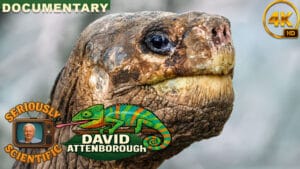
Tap to learn moreThe creatures that gave the islands their name. Galapagos means tortoise in Spanish. These extraordinary reptiles can weigh a quarter of a ton and live for over 100 years. David Attenborough describes thousands of them wallowing in the warm volcanic mud of the Alcido crater. At their peak, there were 15 different species across the islands, each adapted to its own island's conditions. They arrived about three million years ago after floating across the ocean from South America.
Marine Iguana
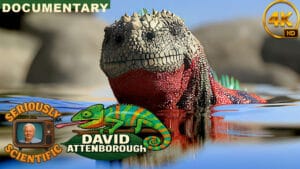
Tap to learn moreThe famous "black lizards that swim in the ocean and spit salt from their noses," as David Attenborough describes them at the start of the documentary. Iguanas arrived on floating vegetation from South and Central America millions of years ago. They are the only sea-going lizards in the world, having adapted to dive and graze on underwater algae. Special glands near their nostrils expel excess salt, which they sneeze out in a fine spray.
Galapagos Penguin
Tap to learn morePerhaps the most unlikely Galapagos resident. Their ancestors lived 5,000 miles away in the Antarctic. A few thousand years ago, some penguins got caught in the cold Humboldt Current and were carried northward to the islands. They adapted by becoming only half the height of emperor penguins, which helps them lose heat faster. They keep their easily sunburnt feet covered, and most stay in the cool channel between the two westernmost islands.
Flightless Cormorant
Tap to learn moreA superb swimmer whose wings are now mere stumps with a few tatters. David Attenborough explains that cormorants arrived by accident, probably swept out to sea by a gale. With no land predators to escape from and plenty of fish to catch by swimming, flying became unnecessary. Over generations, their wings shrank and their bodies grew heavier than any flying relative. With nothing to hassle them, some now manage to raise three broods each season.
Blue-footed Booby
Tap to learn moreFamous for their spectacular blue feet, which are the key element in their courtship display. Males strut and lift their feet to persuade a mate that their feet really are the bluest around. Boobies are superb fishermen, diving from heights of 25 metres at speeds of 60 miles per hour. Special air sacs in their heads cushion the impact of hitting the water at such force, which would kill most other birds.
Scalesia
Tap to learn moreThe giant dandelion of the Galapagos. This extraordinary plant is related to the common dandelion, but grows into a full-sized tree. David Attenborough describes how a windblown seed lands in a lava crevice, collects moisture with tiny leaves, and deliberately sheds dead leaves to create its own soil. After 80 to 100 years of this slow process, whole forests of Scalesia blanket the higher slopes of the islands.
Waved Albatross
Tap to learn moreThe king of long-distance flight, the albatross spends most of its life on the wing. But each year it must land to breed. The waved albatross lives nowhere else but the Galapagos. These huge birds were also unwitting gardeners: seeds stuck to their feet and feathers hitched rides to the islands. David Attenborough notes they may even have given seeds a head start with a nice packet of fertiliser.
Whale Shark
Tap to learn moreThe biggest fish in the ocean, weighing up to 20 tons, is drawn to the Galapagos by the incredible abundance of plankton. The nutrient-rich ocean currents create a marine food web so productive that it attracts these gentle giants alongside Galapagos sharks, scalloped hammerhead sharks, and the mola mola sunfish, which grows three metres across and eats vast quantities of jellyfish.
Apply Your Knowledge
Use what you have learned from the documentary to connect each species to the way it first reached the Galapagos.
Match the Species to Its Journey
Click a species to select it, then click the matching description to place it.
Real-World Challenge
Imagine a new volcanic island has just emerged from the ocean near the Galapagos. It is completely bare rock with no soil, no fresh water, and no living things. Based on what you learned from this documentary, describe the first five things that would need to happen before giant tortoises could survive there. Think about what needs to arrive first and why the order matters.
Protecting the Galapagos Today
The Galapagos remain one of the most carefully protected ecosystems on Earth, but they face serious threats. Tap each challenge to learn what is being done.
Response: The Galapagos National Park has conducted some of the most ambitious invasive species removal programmes in the world. Goats were successfully eradicated from several islands, and rat removal efforts have allowed native bird populations to recover. The Park uses GPS tracking, helicopter surveys, and trained detection dogs to find and remove invasive mammals before they can establish breeding populations.
Response: In 2022, Ecuador expanded the Galapagos Marine Reserve by 60,000 square kilometres, creating a protected corridor connecting the Galapagos to Cocos Island off Costa Rica. This expansion protects crucial migratory routes for sharks, sea turtles, and whale sharks. Satellite monitoring and patrol vessels help enforce fishing restrictions across the reserve.
Response: Scientists are conducting long-term monitoring programmes to track how species respond to changing ocean temperatures. Stronger El Nino events warm the water and reduce the nutrient upwelling that feeds the entire food web, from phytoplankton to whale sharks. Research teams are studying which populations are most vulnerable and developing strategies to help species survive during extreme warming events.
What Has Changed Since This Documentary Aired
This documentary was first broadcast in 2013. While David Attenborough's explanations remain scientifically accurate, some exciting new discoveries have been made since.
Updated: In 2015, genetic analysis confirmed that tortoises on the eastern slopes of the Isabela volcano Wolf are a distinct species, now named Chelonoidis donfaustoi after a beloved park ranger. This brought the number of recognised living species to 12 (of the original 15, three are extinct). DNA studies continue to reveal more about how the different species are related.
Updated: In 2018, researchers at the University of Bristol demonstrated that spiders can detect and use Earth's electric field to launch themselves into the air, not just wind. The electrostatic force on their silk threads provides additional lift, allowing spiders to balloon even on calm days. This discovery helps explain how spiders can travel such vast distances across open ocean.
Test Your Understanding
Answer these questions and get instant feedback. How many can you get right?
Results
Your score:
Reflection
David Attenborough describes the Galapagos as "nature's greatest experiment." After everything you have learned, what do you think he means by that? Can you think of any other places on Earth where similar experiments might be happening?
Episode Discussion
Share your thoughts on this David Attenborough documentary