




Tasmania: A World Apart
Imagine an island cut off from the rest of the world for 12,000 years. In the southern ocean lies a sanctuary where wombats feed in the snow, lobsters grow to the size of dogs, and trees touch the clouds. Let us explore the bizarre and beautiful world of Tasmania.
How Does Isolation Create Giants and Devils?
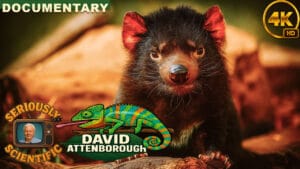
They heard sinister screaming in the night! The explorers were terrified by the loud, aggressive shrieks echoing through the dark forests. As David Attenborough explains, these sounds are actually just the devils communicating and negotiating over meals.
It can do both! In Tasmania, a lack of large predators allows freshwater lobsters to grow massive over decades. Meanwhile, the island is also home to the Little Penguin, the smallest species of penguin in the world.
Put Your Instincts to the Test
Think about what you already know about biology and environments. Pick an answer for each question, then see if your instincts were right.
It detects electrical signals from its prey's muscles. As David Attenborough reveals, the platypus has some 40,000 receptors in its bill that pick up the tiny electrical pulses made by moving prey.
They cover the nest in white stones to reflect the sun. It is an inventive solution to changing seasons. In cooler months, they use dark materials to absorb heat, but switch to white stones when temperatures soar.
Fire is so infrequent they keep growing for centuries. These eucalyptus trees actually need fire to release their seeds. But in Tasmania's damp west, fires are so rare that the trees just keep growing, becoming the tallest flowering plants on Earth.
Understanding the Science
Tap each card to uncover the geological, climatic, and evolutionary processes that shape Tasmania's unique ecology.
Key Concepts
Island Isolation
Tap to learn moreAbout 12,000 years ago, rising sea levels following the last ice age cut Tasmania off from mainland Australia. This created an isolated sanctuary free from mainland competition, allowing unique species to evolve independently.
The Gondwana Legacy
Tap to learn moreMillions of years ago, the southern continents were joined in a supercontinent called Gondwana. Tasmania is a living window into this ancient past, hosting primitive species whose ancestors roamed alongside dinosaurs.
The Rain Shadow Effect
Tap to learn morePrevailing winds carry bad weather from the west. Tasmania's mountains force the clouds to drop their rain on the western side, dividing the island into a lush, wet west and a dry, open east.
Marsupial Reproduction
Tap to learn moreUnlike placental mammals, marsupials give birth to highly undeveloped young. A Tasmanian devil baby is the size of a grain of rice and must crawl into its mother's pouch to find a teat and survive.
Island Gigantism
Tap to learn moreWhen an animal is isolated on an island without its usual predators, it can evolve to be much larger. This is why Tasmania's freshwater lobsters and platypuses grow significantly larger than their mainland counterparts.
Bioluminescence
Tap to learn moreThe ability of living organisms to produce light through a chemical reaction. In Tasmania's wet forests, fungus gnat larvae use this process to create glowing traps to ensnare other insects.
Electroreception
Tap to learn moreAn incredible biological ability to detect naturally occurring electrical fields. It is a vital adaptation for animals like the platypus hunting in murky waters where vision is useless.
Catastrophic Moult
Tap to learn moreUnlike most birds that replace feathers gradually, little penguins shed all 10,000 feathers at once. They must remain on land for three weeks, unable to swim or feed, until their waterproof coat regrows.
Try It: Devil Island
Feed the devils, then bring in the disease and try to save them. Click the ground to drop food, or switch tools and click devils to move them to Maria Island.
Devil facial tumour disease is a cancer that's passed from devil to devil when they bite each other's faces, often while squabbling over food. Since it was first seen in 1996, devil numbers have fallen by about 80 per cent. In 2012 healthy devils were moved to Maria Island, off Tasmania's east coast, to keep a disease-free population safe. Time runs fast here: a second is about a month.
Wildlife of Tasmania: A World Apart
Discover the remarkable animals and ancient plants featured in David Attenborough's journey across the island.
Tasmanian Devil
Tap to learn moreDespite their fearsome reputation and bone-crunching bite, these scavengers have complex social lives. David Attenborough notes they use their loud shrieks not to fight, but to establish a pecking order and share their meals safely.
Giant Freshwater Lobster
Tap to learn moreWeighing up to five kilos and living for 40 years, this is the largest freshwater invertebrate on the planet. Its massive size is a direct result of Tasmania's lack of large aquatic predators.
The Platypus
Tap to learn moreTasmania's platypuses are up to three times heavier than those on the mainland to survive the cold. Without large predators, they are also uniquely bold, confidently walking across dry land between rivers in broad daylight.
Jack Jumper Ant
Tap to learn moreA primitive killer from the Gondwana era. Unlike most ants that hunt by scent in groups, the jack jumper hunts alone using acute vision and a venomous sting that can be fatal even to humans.
Glow-worms
Tap to learn moreHidden in the damp western forests, these fungus gnat larvae hang sticky, mucus-laden threads from their nests. They turn their bioluminescent abdomens on and off to lure flying insects into their snares.
White Wallabies
Tap to learn moreA stunning example of isolation at work. On the mainland, a white wallaby would be quickly spotted and eaten by predators. In Tasmania's safe eastern grasslands, this genetic variation thrives and multiplies.
Eastern Quoll
Tap to learn moreA rare, solitary, nocturnal marsupial predator. While they have vanished from the Australian mainland, they thrive in Tasmania's dry eastern pastures, hunting a rich bounty of summer moths and grubs.
Southern Beech Tree
Tap to learn moreHigh in the mountains, this tree puts on a rare autumnal display. It is the only tree in Australia to drop its leaves in the cooler months, and its closest relatives are found thousands of kilometres away in South America.
Apply Your Knowledge
Connect what you have learned about Tasmania's unique species to their extraordinary survival strategies.
Match the Concepts
Click an object to select it, then click the matching description to place it.
Real-World Challenge
Imagine you are an ecologist studying the impact of climate change. If prevailing weather patterns shift, causing Tasmania's wet western forests to dry out and experience more frequent fires, how might this impact the survival of the giant mountain ash trees and the glow-worms?
Protecting This Ecosystem Today
While isolation protected Tasmania's wildlife for millennia, human impact has brought new challenges. Explore the real-world threats facing this ecosystem and how conservationists are responding.
Response: Since the late 1990s, a contagious cancer has devastated wild devil populations. In response, scientists have established healthy, isolated "insurance populations" across Australia and are making breakthroughs in developing vaccines to save the species.
Response: Habitat loss and historical overfishing caused giant freshwater lobster populations to plummet. Today, strict forestry regulations help maintain shaded buffer zones around critical river habitats, keeping the water cool and clear for these slow-growing giants.
What Has Changed Since This Documentary Aired
Science is always advancing. Here is a recent discovery that updates our understanding of Tasmania's wildlife.
Updated: Modern miniaturised GPS trackers have revealed that these penguins travel much further and dive far deeper during their pre-moult foraging than scientists previously realized. This makes them highly vulnerable to changing ocean temperatures and shifting fish populations.
Test Your Understanding
Answer these questions and get instant feedback. How many can you get right?
Results
Your score:
Reflection
The documentary shows how being isolated on an island for 12,000 years allowed bizarre adaptations to flourish in Tasmania. If you could design an animal perfectly adapted to survive in your local neighbourhood, what unique adaptations would it have?
Episode Discussion
Share your thoughts on this David Attenborough documentary