Lou is a sculptor, not a gardener. She’ll tell you so herself. She doesn’t know much about plants; she has a permanent quarrel with the slugs and snails; she likes the garden because it looks natural. Twenty-four years of that approach, in a city of nearly half a million people, has produced one of the richest small habitats in the series. Some of what lives here is thriving. One family in it starves to death on camera. That’s the part of this episode I wouldn’t skip.
What happens in this episode
A hundred gardens, one fox
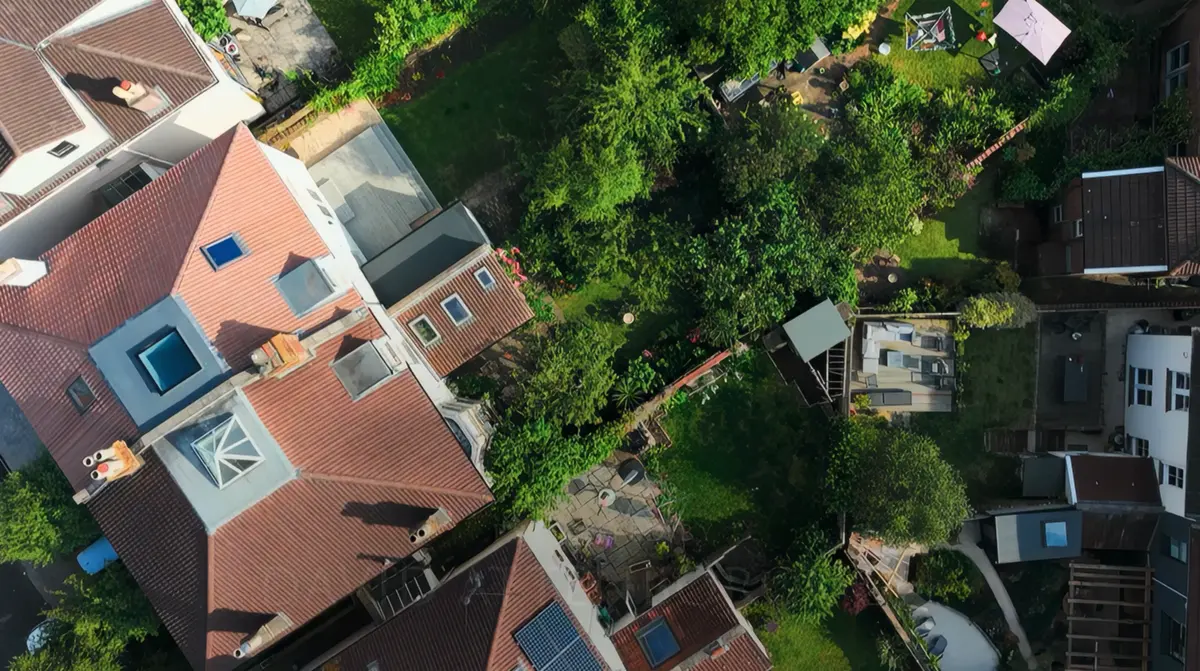
Seen from above, the back gardens of one street stop being separate and become a single habitat. Photograph: BBC / Plimsoll Productions.
A century ago there were virtually no foxes living in British cities. There are now around 2,000 in Bristol alone; nationally their urban numbers have quadrupled in the last fifty years.
The young male who sleeps in Lou’s garden holds a territory of roughly a hundred gardens, with hers near the middle. He’s noticeably bolder than a country fox: he works the patio for spilled birdseed in daylight and he’s worked out which night the bins go out.
Because so much free food is available in a city, densities reach 50 foxes to the square mile. That makes the breeding season fierce and explains a sound most of us have heard without ever seeing what makes it. The screaming that goes up in residential streets after dark is foxes, in courtship and in argument over territory. Holding his patch is what gets him a mate.
Bottom of the pecking order
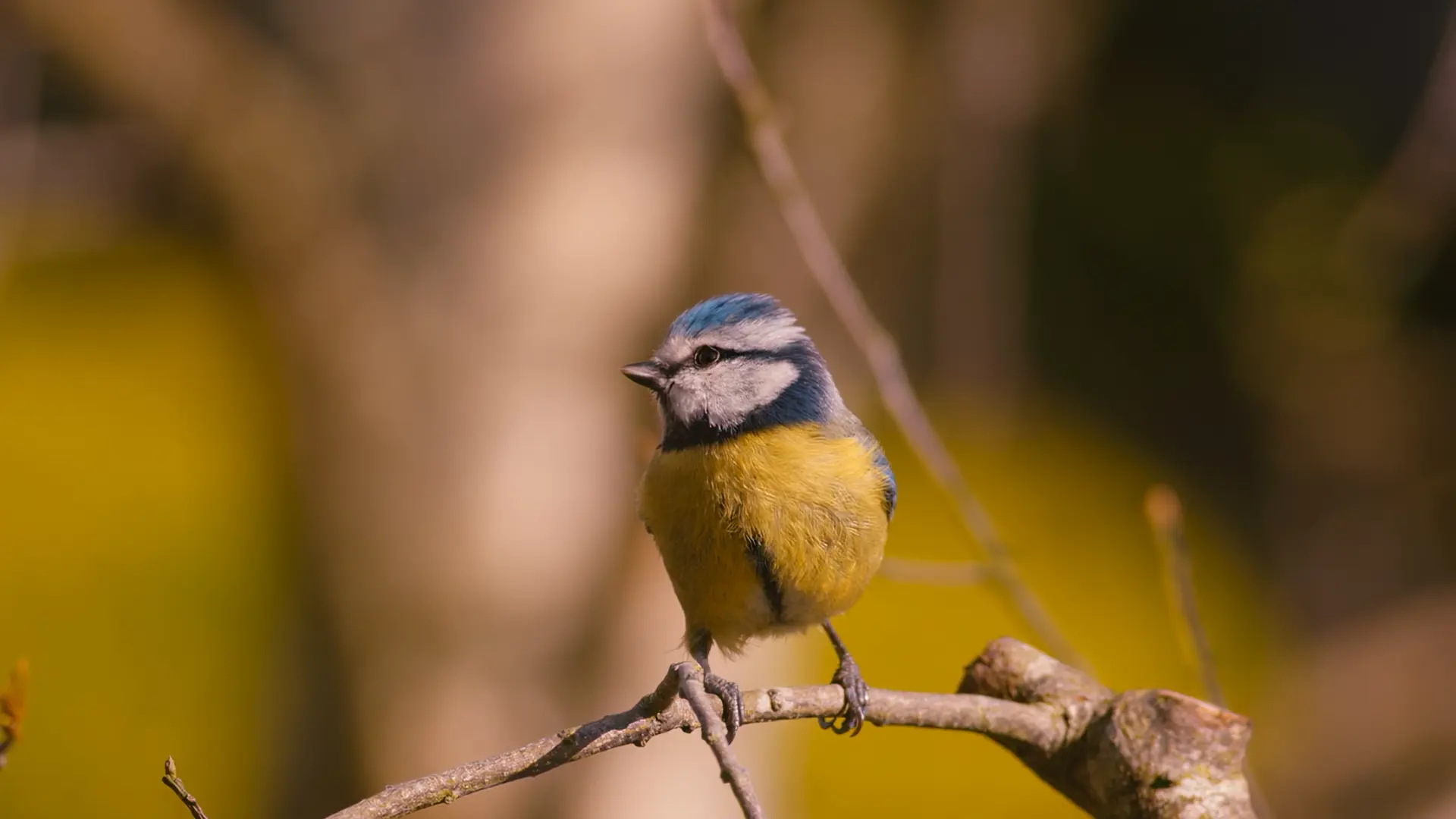
A blue tit weighs about as much as a pound coin, which settles most arguments at a feeder before they start. Photograph: BBC / Plimsoll Productions.
A young blue tit, under a year old, arrives from woodland that winter has stripped bare. Over a hundred species of bird use garden feeders in Britain in winter; there’s a strict order to it.
Goldfinches are bigger and heavier and don’t share. Feral pigeons, which are a good deal cleverer than they look, have learned that goldfinches on a feeder means spillage on the patio below, so they wait there. A blue tit weighs about the same as a pound coin. He’s last in every queue.
Then there’s Mr Fluffy, the neighbourhood cat. Britain has over ten million pet cats and they kill upwards of 50 million birds a year. Lou has hung her feeder just out of reach, so on this occasion the only casualty is Mr Fluffy’s dignity.
The blue tit survives the winter, finds a mate at the feeder and views a nest box in the front garden. He takes it: north-facing, so it won’t cook in July, and solid walls. Ten chicks hatch.
Twenty thousand caterpillars
Here’s the number that decides everything. To get one blue tit chick from hatching to fledging takes around 20,000 caterpillars; all of it inside three weeks.
Both parents work every daylight hour. When caterpillars run short they bring spiders instead. It isn’t enough, because a city garden planted for looks rather than for insects simply doesn’t carry the native plants that caterpillars feed on.
The chicks die one at a time. Ten hatch and one fledges.
Insect numbers in Britain have fallen by 60 per cent in the last twenty years. That statistic usually arrives in the abstract, as a line on a graph. This is what it looks like at the other end: two competent adult birds working themselves ragged in a garden full of flowers and nine dead chicks, because flowers aren’t the same thing as food.
The survivor makes it out of the box, lands on the ground where a fledgling should never be, and Mr Fluffy turns up wearing a new bell. A bell cuts a cat’s hunting success by over a third. The chick gets away.
Sixteen gardens and a hole in the fence

City hedgehogs appear to be learning to use the quieter streets. Hundreds of thousands still die on British roads every year. Photograph: BBC / Plimsoll Productions.
Britain had over 30 million hedgehogs once. Fewer than a million remain. The main reason is that intensive agriculture has taken their countryside homes away.
Lou’s female comes out of five months of hibernation ready to breed and immediately runs into the problem with walled gardens: she’s the only hedgehog in hers. Lou and her neighbours have solved it with a hedgehog highway, a run of small holes cut through the base of every fence on the street. It turns one garden into sixteen.
She works her way along it and finds a male in the last one. Then a second, then a third. Hedgehogs are highly promiscuous, so a single litter can have several fathers; the pay-off is genetic diversity in a population that badly needs it.
The dry summer nearly undoes her. Insects and earthworms retreat deep underground, bird-feeder leftovers don’t come close to feeding a female nursing four hoglets. She goes out onto the streets. Hundreds of thousands of hedgehogs are killed on British roads every year.
What the film catches is genuinely encouraging: city hedgehogs appear to be learning to avoid the busiest roads and to cross the slower, quieter ones instead. She raises all four hoglets. While rural hedgehogs keep declining, there are signs the urban population is going up.
Under the shed across the road

Four cubs, in a den under a neighbour’s shed, a street away from the garden their father patrols. Photograph: BBC / Plimsoll Productions.
Lou’s fox won his territory. The reward is under a shed in a garden across the road: a vixen and four cubs, secure enough that they come out and explore in daylight.
In most mammal groups the father is long gone by now. Paternal care is commoner in the dog family than in almost any other, so while she stops foraging entirely to nurse, he carries food back to her from across the whole territory. Raising a litter of urban foxes takes a postcode.
Fifty species of bee, in a small garden
The thing about Lou’s beds, which she assembled by instinct rather than by plan, is that a densely planted urban garden can carry a higher diversity of flowering plants than any wild habitat in Britain. Around 50 species of bee visit hers.
One of them is the hairy-footed flower bee, which has a long tongue for reaching into nectar and precisely the feet the name suggests. Her warm walls also host a green-fanged tube-web spider, a Mediterranean species now doing very well in Britain’s southern port cities.
Down in the pond, a male common frog warms up after a run of nights around five degrees and goes looking for a mate among perhaps fifty rivals in a garden this size. Males can outnumber females four to one, so he grabs one and holds on, fending off everything that tries to take her, until she rewards him with a clump of eggs for him to fertilise.
The tadpoles then have to get past dragonfly larvae, which hunt anything small that moves. Three months later the survivors come out of the water as froglets the size of peas. Lou has built them a makeshift staircase out of the pond. They repay her by eating the slugs.
The science underneath it
Quick facts
- One blue tit chick needs around 20,000 caterpillars to fledge, all within three weeks.
- Insect numbers in Britain have fallen by 60 per cent in the last twenty years.
- Britain’s hedgehogs have gone from over 30 million to fewer than a million.
- A century ago there were virtually no urban foxes. There are now about 2,000 in Bristol, at densities of up to 50 to the square mile.
- Over ten million pet cats kill more than 50 million British birds a year. A bell cuts a cat’s success rate by over a third.
- Around 50 species of bee visit one small Bristol garden.
- Gardens make up a third of our urban space and cover more ground than all our national nature reserves combined.
How they filmed it
Cinematographer John Waters set remote cameras around the garden, which is harder in a small space than a large one, because the camera itself ends up in the animal’s way. His verdict on the kit was blunt: the cameras are unpredictable, the animals are unpredictable and there’s a massive element of luck. His first review of the footage runs “cat, cat, cat, oh, fox”.
Producer Ewan McDonnell-Smith went out onto the streets to find the den, which turned into six months of work. He found a dead fox hit by a car and had a bad few minutes thinking it was Lou’s. In the end it was Lou’s neighbourhood WhatsApp group that gave him the lead.
There’s a nice piece of history in here too. The BBC’s Natural History Unit is based in Bristol; back in the 1970s it made the first ever film about the life of a town fox, in these same streets. The programme runs the archive.
Where this leaves us
Lou’s own reaction to seeing the footage is the right one: astonishment that this much is going on, in the centre of a city, a few feet from where she works.
I’d add one thing to it. The hedgehogs and the foxes are the good news story and they’re real; the blue tits are the warning, and that’s just as real. A garden can look green, smell wonderful and still be a desert for the thing that particular bird needs. If this episode makes you plant one native shrub that caterpillars will actually eat, it’s done more than most nature programmes manage.