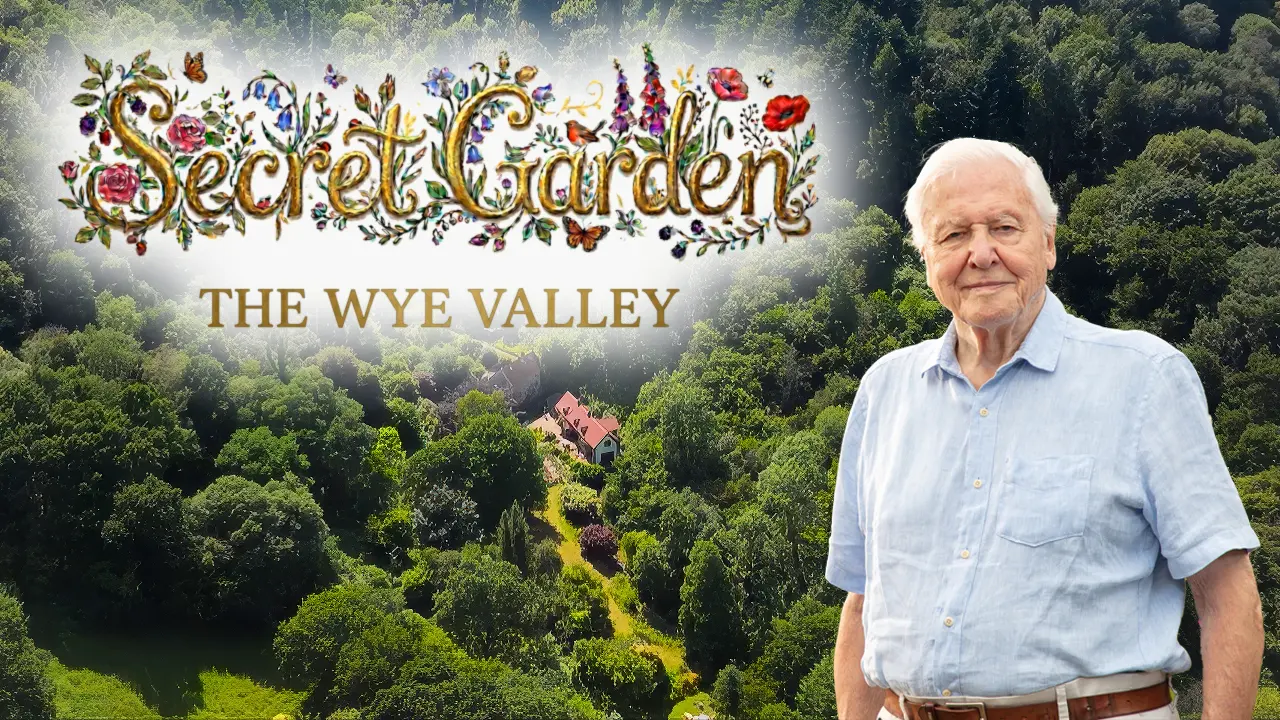
Robin Smith has been a wildlife cameraman for over twenty years and has filmed on most of the planet. His wife Laura points out the irony: he observes wildlife all over the world rather more than he does in his own back garden. So this episode hands him the cameras and asks him to turn them on his own cottage, at the bottom of a steep Welsh valley where the sun doesn’t reach the floor for four months of the year.
What happens in this episode
A garden run by the light
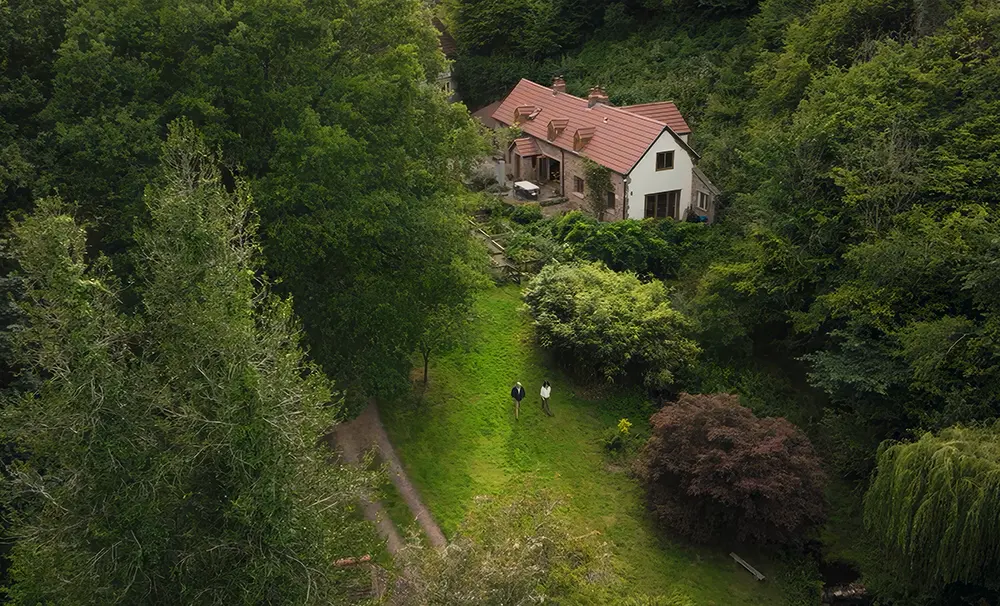
Robin and Laura’s cottage, marooned in one of the most biodiverse corners of Britain. Photograph: BBC / Plimsoll Productions.
The cottage sits in a sea of green, on a slope, with woodland pressing in on both sides and a brook that runs through the garden, under the house and down to the river. Robin and Laura found it by accident, drove into a hidden valley and stayed.
The organising fact of the place is light; this is the idea that makes the episode. The sun doesn’t come up over the trees for months at a time; it arrives late, sweeps across in summer, then goes again as the canopy thickens. Nothing living here can just get on with it. Everything has to time itself to its own window.
Seven months asleep at a tenth of the speed
Late winter, and direct sunlight hasn’t touched the valley floor in four months. Under a pile of leaves is a hazel dormouse. She’s barely running.
Her body temperature is only just above freezing. Her heart rate and her breathing have dropped to a tenth of their summer rate. She’ll stay like that until spring, because waking early means being hungry in a wood with nothing in it and being hunted by the tawny owls in the trees above.
When she finally comes out, seven months of that has cost her half her body weight. She has five months to double it again before she does the whole thing over. She does it on redcurrants from the garden, taken at night, dangerously exposed the whole time. Of everything in this series, she’s the animal I’d most like people to have heard of.
To-wit is one bird, to-woo is the other
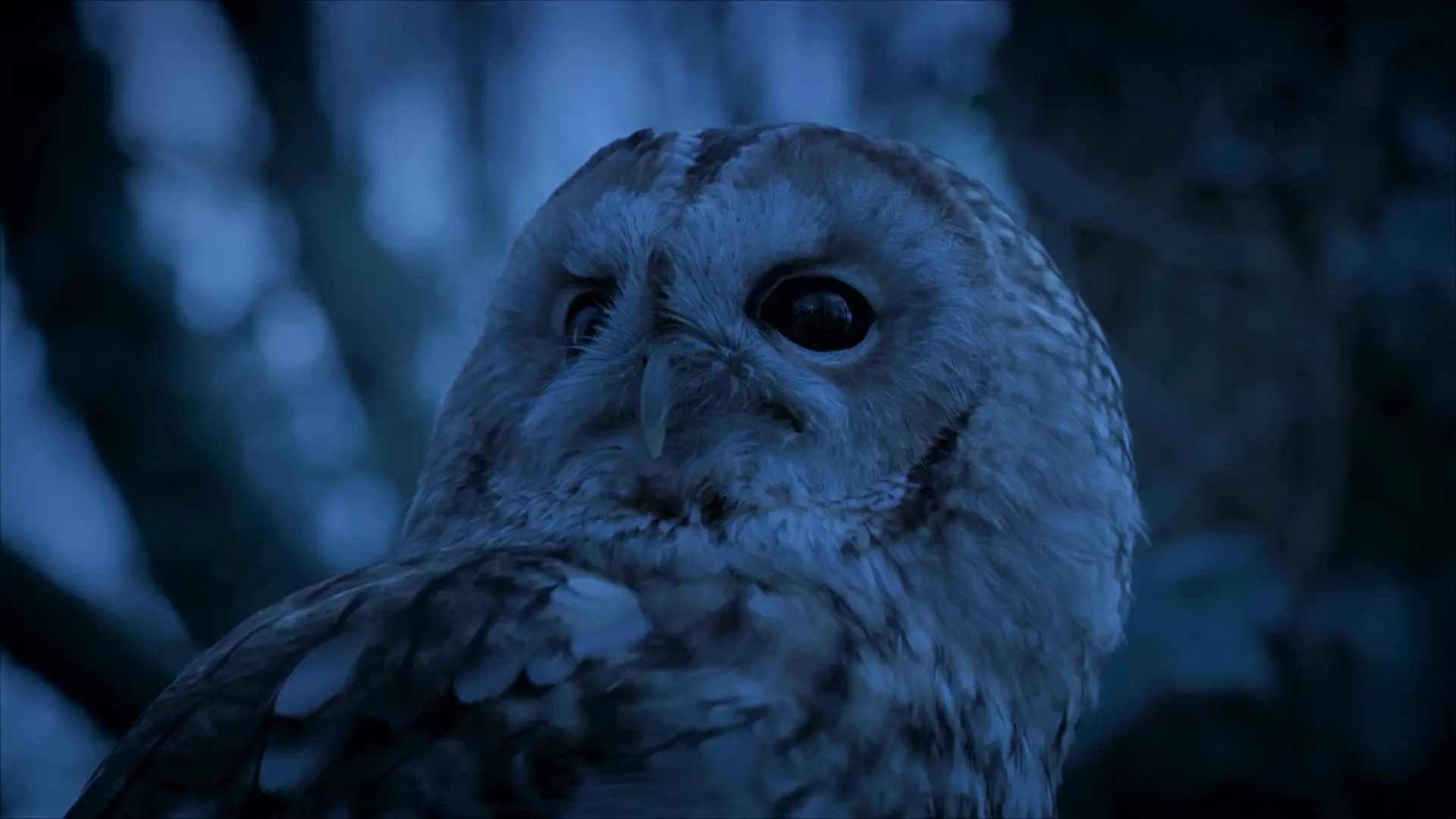
Bare winter branches make excellent observation posts; the bird feeders below bring the mice. Photograph: BBC / Plimsoll Productions.
The male tawny owl hunts the garden from the bare branches, with night vision and hearing that make him the top predator here. The bird feeders bring in wood mice. He waits.
Every rodent he catches does two jobs. One is dinner. The other is evidence, presented to his long-term mate, that he’s still worth staying with.
Here’s the bit almost nobody knows. The classic “to-wit to-woo” is not one owl. She calls to-wit; he answers to-woo. It’s a duet between two birds. Once you’ve heard it explained you can’t unhear it.
They need somewhere to nest. Even in woodland like this there aren’t enough tree hollows, so Robin and Laura have put up a large box three metres up with a camera and an infrared light already inside it.
Two owlets and only one is winning
Tawny owls breed early so their chicks hatch into the spring glut. Two owlets appear in the box. Infrared shows what’s happening in the dark.
The elder hatched a few days before his brother, which at that age is an enormous advantage. He takes most of what comes in. Earthworms at first, then, as the garden fills up, three rodents a day, all of them his. His brother gets weaker.
Tawny owlets will eat a smaller sibling if they get hungry enough, which is where this appears to be heading. Instead the little one, driven by hunger, makes a break for the entrance and shoves his older brother clean out of the box.
Big brother lands on the ground, three metres down, far too young to fly. If anything finds him there he has no chance at all. He climbs, which he’s just strong enough to do, with both parents calling above him to keep him going. He makes it back up.
Both owlets survive. The gamble of breeding early pays off.
The bird that walks underwater
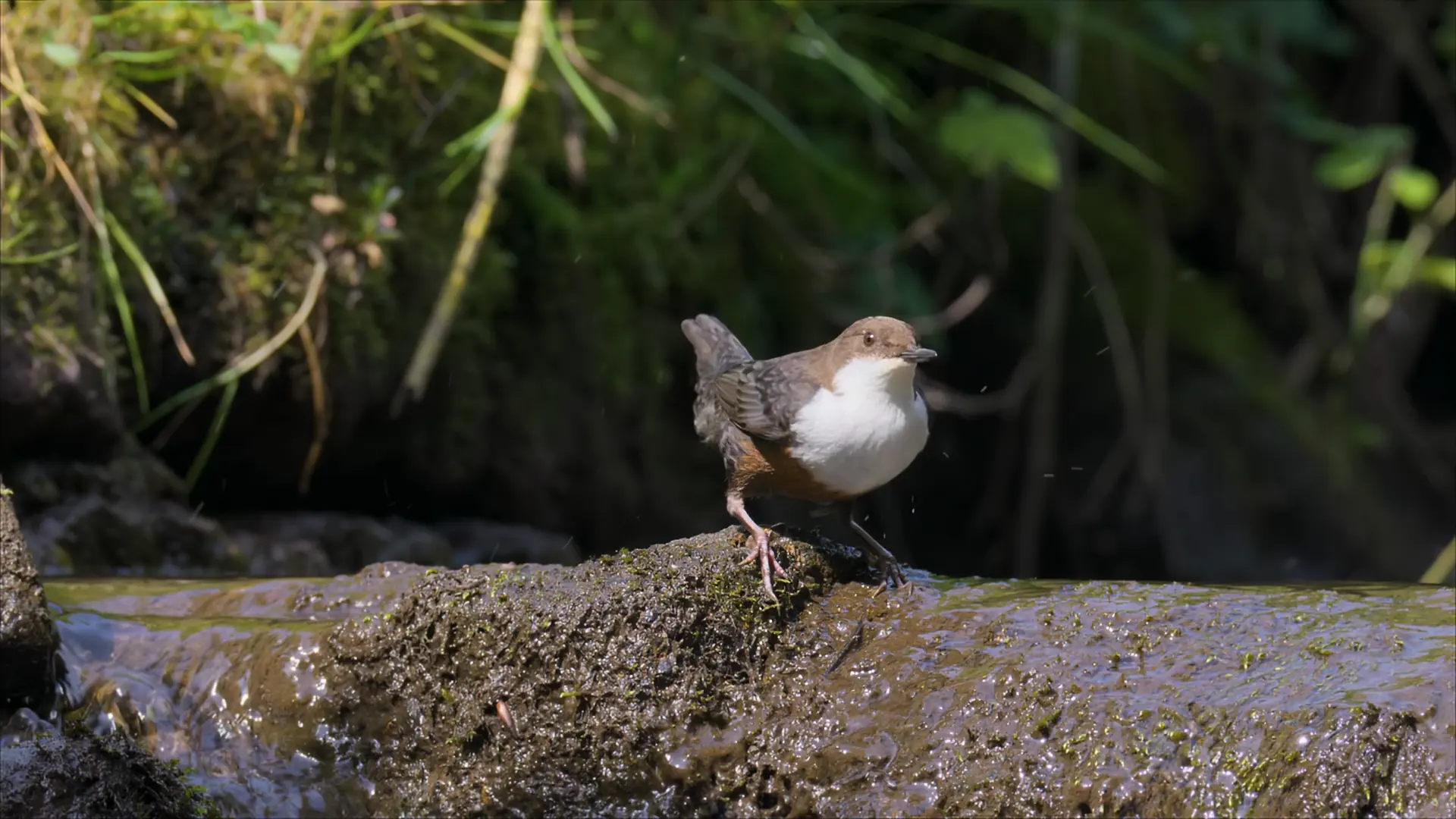
Dippers only nest on clean water, so having a pair is a verdict on the brook. Photograph: BBC / Plimsoll Productions.
A pair of dippers nest under the cottage itself, out of sight, right where the brook runs beneath the building.
She dives into fast water and works along the bottom against the current, taking aquatic insects that no other bird can reach. She can stay under for up to thirty seconds, with transparent third eyelids that act as goggles so she can see what she’s doing. Her main competition down there is fish.
Feeding the chicks takes hundreds of insects a day. The waterways here aren’t as clean as they used to be, so it’s a struggle. Robin starts putting out mealworms, dense in protein and fat. It makes a measurable difference.
One chick then slips out of the nest early, far too young to look after itself and calls from the rocks. Its voice is barely audible over the water; its mother is tuned to exactly that frequency and finds it. The parents keep feeding it until it can hunt.
Three chicks come through. Nationally, dipper numbers have fallen by almost 40 per cent. This pair’s brook feeds down into the Wye, which has serious, well-documented pollution problems. A dipper on your water is a verdict on the water.
Britain’s largest land predator, eating worms
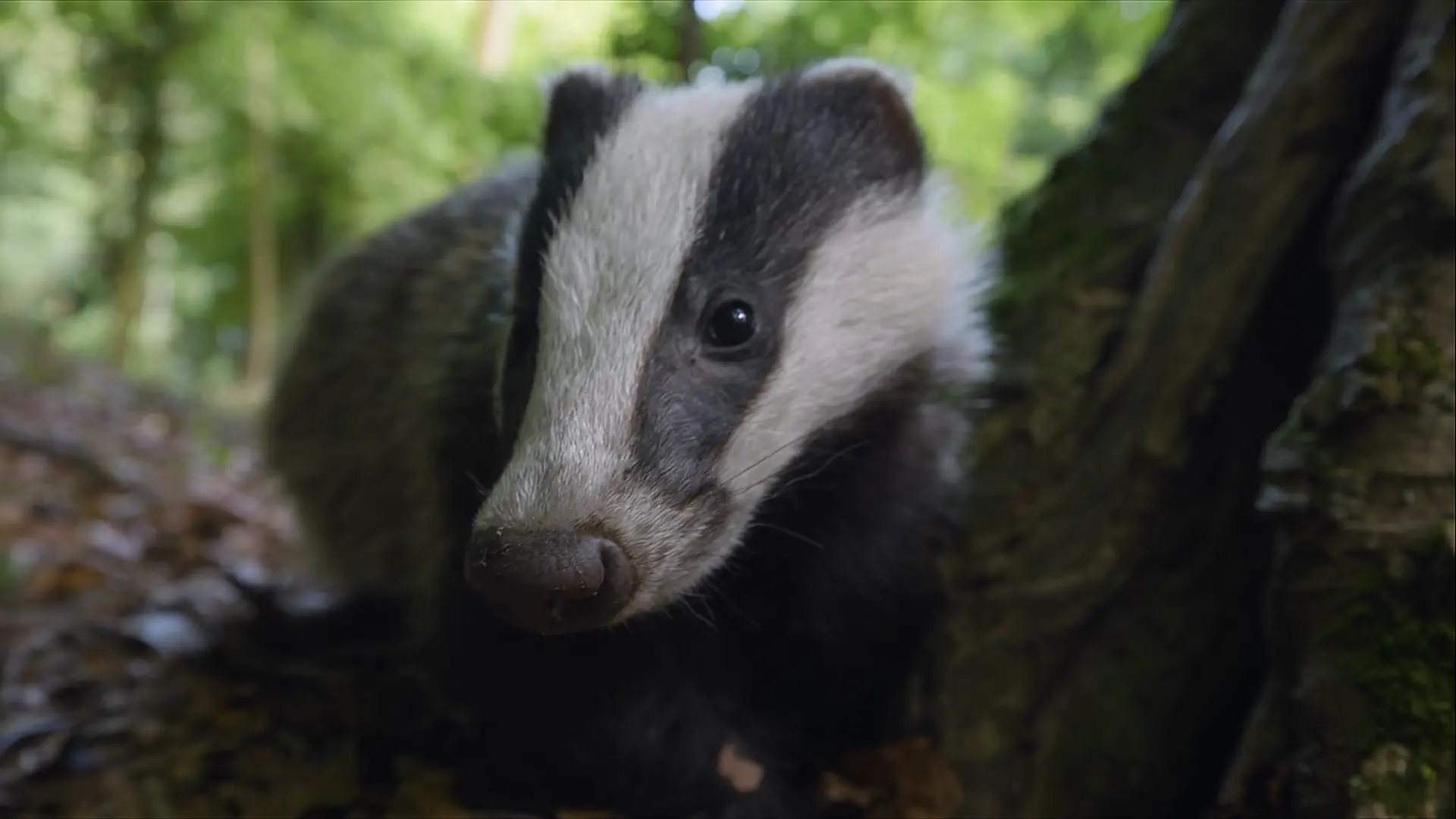
Sixty per cent of a badger’s diet is earthworms, which explains what it is doing to the lawn. Photograph: BBC / Plimsoll Productions.
There may be 400,000 badgers in Britain and hardly any of us have seen a live one. A sow brings her three-month-old cubs above ground for the first time, in daylight, which they’ll only do somewhere undisturbed.
Badgers are our largest land predator and they live mostly on invertebrates. Earthworms make up around 60 per cent of the diet, so a dry spell is genuinely dangerous: the worms go deep; two thirds of badger cubs can die in a drought.
This is where Laura’s watering does something she probably didn’t intend. It brings the worms back up within reach. A yearling badger works the lawn over thoroughly, after starting on the peanuts on the patio. He makes a mess of the grass. Robin and Laura take the view that it comes with the territory.
He also finds the bumblebee nest, which his claws would open without difficulty. He doesn’t, because badgers are wary of people and the nest is too close to the house.
One queen, one colony, one year
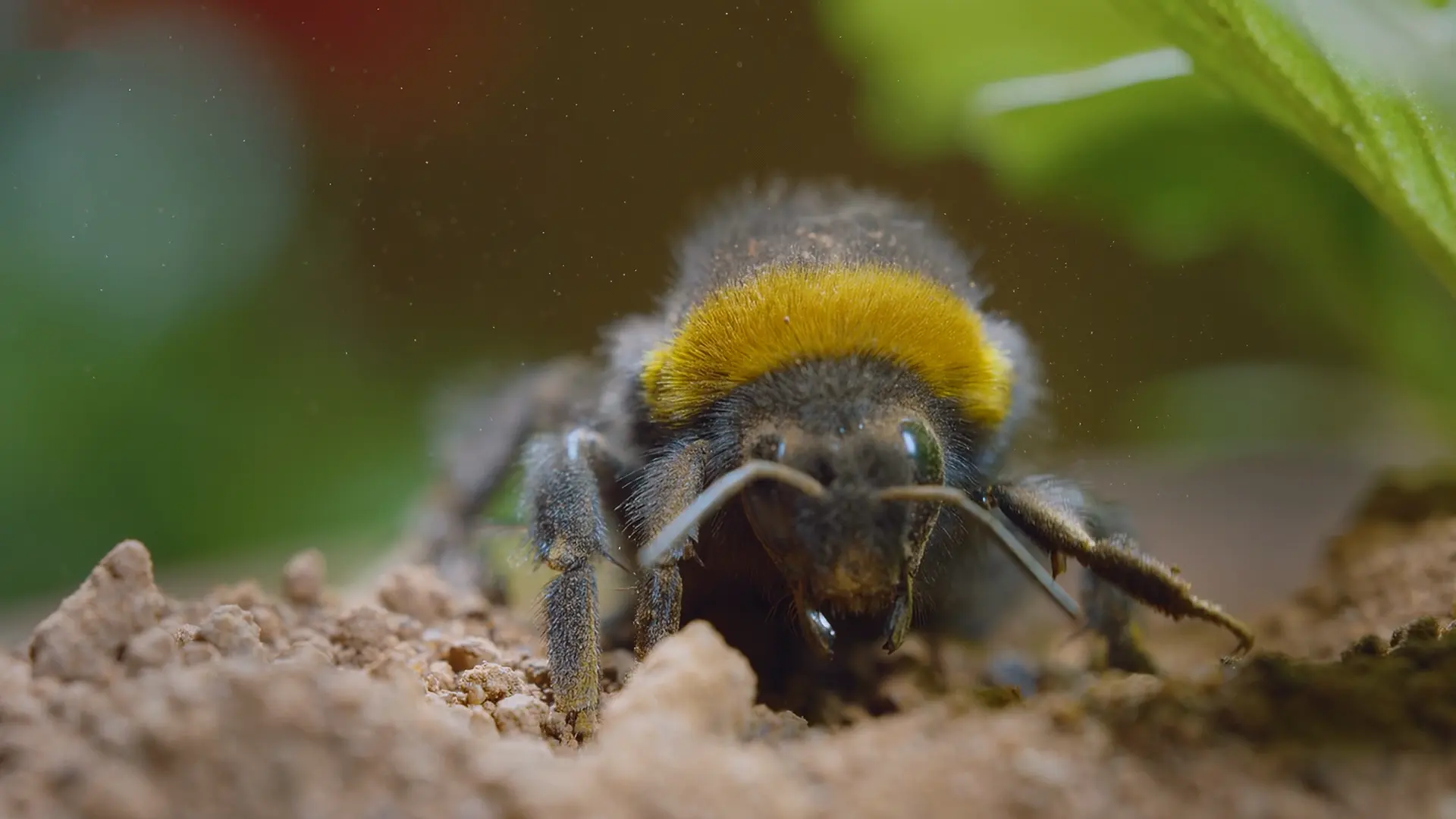
A buff-tailed queen shivering her flight muscles up to 30 degrees before she can fly. Photograph: BBC / Plimsoll Productions.
Britain has 270 native species of bee. One of them has spent six months underground on her fat reserves. A buff-tailed bumblebee queen comes up, and everything that happens next is on her alone.
She can’t fly cold. She vibrates her flight muscles to warm herself, sometimes for fifteen minutes, until she hits about 30 degrees. Then she forages for a week, thousands of flowers a day, and finds an old mouse hole to nest in.
What she does inside it is remarkable to watch. She secretes wax from her own abdomen, moulds it into brood cells, lays a single fertilised egg in each, then sits and shivers to keep them warm.
Those eggs become her workers. She keeps them in line chemically: a pheromone she releases suppresses their urge to breed. Smaller workers stay in and tend the larvae; the bigger ones go out for food. When a badger threatens them, they warn him off; unlike a honeybee, a bumblebee can sting again and again.
At the end of the season she’s spent. She can no longer produce enough pheromone, so the workers start laying eggs of their own and the last larvae are raised into next year’s queens. The old queen dies. Her workers die with her. If a single new queen survives the winter, the whole thing runs again.
What else the cameras found
The oaks come into leaf and fill with invertebrates; a single oak hosts over a thousand species, which is why pied flycatchers fly thousands of miles from West Africa to breed here, among 70 species of woodland bird.
Then autumn brings the part of the episode that quietly does the most work. Trees pull the nutrients back out of their leaves before dropping them. One tree sheds hundreds of thousands. Slugs and woodlice start returning the carbon to the soil while centipedes patrol underneath hunting them. Earthworms, at hundreds per cubic metre, drag tonnes of leaf litter down and turn it into next year’s plant food within months.
Robin’s remote cameras also pick up two things he wasn’t expecting: wild boar, wiped out here by hunting centuries ago and now spreading back through British woodland from farm escapees, and a pine marten, which is rare enough that its presence is a straight verdict on the health of the wood.
The science underneath it
Quick facts
- A hibernating hazel dormouse runs her heart and breathing at 10 per cent of the summer rate, with a body temperature barely above freezing.
- She loses half her body weight over seven months and has to double it again in five.
- “To-wit to-woo” is two birds. The female calls to-wit; the male answers to-woo.
- A dipper can stay submerged for up to 30 seconds and has transparent third eyelids that work as goggles.
- Dipper numbers have fallen by almost 40 per cent nationally.
- Earthworms are about 60 per cent of a badger’s diet. Two thirds of cubs can die in a dry spell.
- Britain has 270 native bee species. A buff-tailed queen shivers her flight muscles to 30 degrees before she can take off.
- A single oak tree hosts over a thousand species of invertebrate.
- There may be hundreds of earthworms in every cubic metre of this garden’s soil.
How they filmed it
Robin’s view is that filming British wildlife is harder than filming in the Amazon, because we’re a small, crowded island and our animals have become very good at avoiding people. He would know.
His solution was to repurpose domestic kit. The garden is rigged with adapted security cameras running on the house wireless network, each with a small solar panel on top so nobody has to change batteries. The owl box had a camera and an infrared light fitted before the owls ever looked at it. His summary of the method is worth stealing: try to think like the animal.
For the dippers he went back to a proper camera and a hide, then waited. The birds can be gone for an hour at a time, with stretches of hours where nothing happens at all. As he says, it puts a new slant on working from home.
Where this leaves us
Robin describes the year as having been handed a cast of characters playing out a wildlife soap opera on his own patch, which is about right.
The thing to take from this one is the light. A garden isn’t a single habitat with a single season; it’s a set of overlapping windows. The dormouse, the owls, the bumblebee queen and the dippers are each solving the same puzzle of when to be awake and when to be somewhere else. Laura describes the garden as a clock. Having watched the episode, I’d say she’s understating it.