



Rain and Volcanoes
Where do puddles go after it rains? And what is the deal with volcanoes, anyway? In this lesson you follow a puddle up into the sky and back down again, drop an eggplant with Galileo Galilei, and find out why a cherry pie is a lot like a volcano.
Where Do Puddles Go After It Rains?
Nothing disappears. The sun warms the puddle until the water turns into an invisible gas called water vapour, and it floats up into the sky. Beakman says it on the show: everything goes somewhere. The puddle is still there. It is just too small to see and too high up to reach.
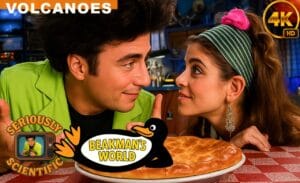
Colleen from Vermont wants to know what the deal is with volcanoes. A volcano is the Earth letting off pressure. Deep under your feet is hot melted rock called magma, and when the pressure gets too big it bursts out through a weak spot in the ground. Beakman shows it with a cherry pie. Keep going.
Have a Guess
Have a guess for each one before you tap. Trust your gut.
It turned into water vapour and rose into the air. Warm water evaporates: it becomes a gas you cannot see. Higher up it gets cold again, squeezes back into tiny drops and makes a cloud. The water is never lost.
The eggplant, but not because it is heavier. Gravity pulls both of them down at exactly the same rate. The flat paper is slowed by the air pushing against its wide shape, which is called air resistance. Galileo scrunched the paper into a ball, dropped them again, and they hit the floor together.
Only as deep as the apple's skin. The Earth is too big and too hard to drill through. That is why we know so little about the inside, and why people used to think volcanoes started at the core. They start much closer to the surface, in the crust and the top of the mantle.
Fast, Fun, Furious Facts
Eight fast facts from the show and the science. True or false? Tap fast, think faster.
Score:
Best streak:
Let's Find Out
Tap each card to find out more. Four cards for rain, four for volcanoes.
Key Ideas
Evaporation
Tap to learn moreWhen the sun warms a puddle, the water turns into an invisible gas called water vapour. That is evaporation. Beakman used a lamp for the sun and a sheet of plastic wrap for the vapour floating up.
Condensation and Clouds
Tap to learn moreThe higher up you go, the colder it gets. Cold water vapour squeezes back into tiny drops, which is called condensation. Millions of tiny drops bunched together make a cloud.
The Water Cycle
Tap to learn moreDrops grow too heavy for the cloud and fall as rain. Rain makes puddles, the sun warms the puddles, and round it goes again. This loop is the water cycle, and the water you drink has been round it more times than anyone can count.
The Same Old Water
Tap to learn moreThe water in your glass has been round the water cycle more times than anyone could count. The Earth has had about the same amount of water for billions of years. It never gets used up; it just keeps changing between liquid, gas and ice. A dinosaur may once have drunk some of it.
The Earth's Layers
Tap to learn moreThink of the Earth as Beakman's apple. The thin skin is the crust, about 30 kilometres thick under the land. Under that is the mantle, nearly 3,000 kilometres of hot rock, and right in the middle is the core.
Magma and Lava
Tap to learn moreIn the crust and the top of the mantle there are pockets of hot melted rock called magma. Heat and gas build up pressure, and the magma pushes out through a weak spot. Once it is out in the open air we call it lava.
The Cherry Pie Volcano
Tap to learn moreA pie crust is like the Earth's crust, and the hot cherry filling is like magma. As the pie cooks, steam and pressure build up until the filling bursts out, which is just what an eruption is. Some eruptions ooze and some explode, but it is the same idea.
Volcanoes Make New Land
Tap to learn moreWhen lava cools it hardens into new rock. Eruption after eruption, layer on layer, volcanoes can build whole mountains and even islands. The islands of Hawaii are the tops of volcanoes that grew up from the sea floor, and Mauna Loa, the biggest volcano on land, is still growing.
A Visitor From History
Every Beakman episode gets a visit from a famous scientist of the past. This time a very cheerful Italian turned up with a telescope under his arm.
Galileo Galilei, who lived in Italy about 400 years ago. He built one of the first telescopes in 1609 (on the show he calls it his dynamoscope) and pointed it at the sky. Most of all he loved testing ideas by trying them out instead of just arguing about them.
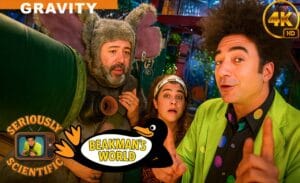
He dropped an eggplant and a sheet of paper. Things fall at the same rate no matter how heavy they are. Only the air pushing on the flat paper made it lag behind. Scrunch the paper into a ball and they land together. Gravity, as Beakman says, is the law.
Try It: Nothing Disappears
Turn the sun up and down and follow every drop of water from the puddle to the cloud and back.
Watch the total. Puddle, air and cloud go up and down, but the total never changes: the water only moves. Nothing disappears.
Use What You Know
Time to use what you know. Match the four things to their descriptions, then take on the challenge.
Match Them Up
Tap an item to pick it, then tap the box it belongs to.
Real World Challenge
Put a saucer of water on a sunny windowsill and mark the level with a pen. Check it every day. Where is the water going, and where will it end up? Then think about the pie: next time a grown-up bakes one with a filling, watch the top as it cooks. Where does the steam escape, and why there and not somewhere else?
What Has Changed Since This Episode
This episode first aired in September 1992. The water cycle and the cherry pie are as right as ever, but here are three things we know now that Beakman did not.
Now we know: Mauna Loa erupted again in November 2022, after 38 quiet years. Scientists at the United States Geological Survey watched the whole thing with instruments on the mountain and satellites overhead, something the show could only dream of. It is still the biggest active volcano on land.
Now we know: In 2013 scientists described Tamu Massif, a volcano on the floor of the Pacific Ocean about the size of New Mexico, as the largest single volcano on Earth. A 2019 study then found it formed by the sea floor spreading apart, so scientists still argue about the title. Either way, the biggest volcano on Earth is under the sea.
Now we know: A satellite called MICROSCOPE let two different metals fall around the Earth together for two years. In 2022 the team reported that they fell at exactly the same rate, to better than one part in a thousand trillion. Galileo was right, more precisely than he could ever have measured.
Show What You Know
Answer these and get an instant tick or a nudge. How many can you get?
Results
Your score:
Think About It
Next time it rains, find the biggest puddle you can. Can you work out where that water was a week ago, and where it will be a week from now?
Episode Discussion
Share your thoughts on this Beakman's World episode