
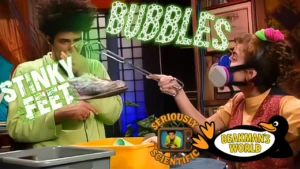
Beakman’s World Season 1 Episode 12 zooms in on two ordinary things that turn out to be quite strange when you look closely: a soap bubble and a stinky sneaker. In this episode of Beakman’s World, Beakman explains why surface tension pulls every soap bubble into a perfect sphere, then flips the same close focus onto the human foot to show why bacteria and sweat combine to make sneakers smell so gloriously awful. A Beakmania quiz round with the classic sneeze with eyes open challenge sits between the two topics.
In this episode you will discover:
- How to mix a homemade bubble solution with water, dishwashing liquid and glycerin
- What surface tension is, and why it pulls a bubble into a sphere
- Why adhesion makes soap film stick to a rubber band and stretch into any shape
- Why your feet sweat about half a pint (roughly 280 millilitres) every single day
- How bacteria on your skin turn sweat and body oils into the unmistakable sneaker smell
- Why you cannot sneeze with your eyes open, no matter how hard you try
Two everyday surfaces science makes strange
Beakman keeps circling back to the same idea across the episode: a great deal of what makes everyday objects behave the way they do happens at surfaces, where one thing meets another. A soap bubble owes its perfect round shape to surface tension, the force pulling the water film inward at the exact place where soap meets air. A smelly sneaker owes its stink to bacteria feeding on oils at the exact place where skin meets shoe. In both cases the interesting physics and biology is happening in the thinnest possible layer, invisible to the naked eye but easy to see once you know what to look for.
Surface tension
The force that pulls a soap film inward at its surface and squeezes it into the smallest shape it can find.
Sphere
The shape with the smallest possible surface area for a given volume, which is why every free bubble ends up round.
Bacteria
Single celled organisms living on your skin that feed on sweat and body oils, producing the compounds that make feet smell.
Beakman’s demonstrations
Beakman opens the bubble segment in his La Bubble laboratory, mixing a homemade solution of water, dishwashing liquid and glycerin, then stretches a soap film across a rubber band held by Josie to show that no matter what shape the rubber band takes, surface tension pulls the soap film to fill it. Guest scientist Louis Pearl, billed as Captain Bubbles, blows an actual square bubble on the frame of a wire cube, and Beakman climbs inside a giant bubble to show its shimmering rainbow interior. Later, in the feet segment, he uses microscope views of little rod shaped bacteria to reveal what really lives on skin, then grows a genuine bacteria farm from a swab between Lester’s toes to prove exactly what a shoe worn on a sweaty foot has been culturing all day.
Try this at home
The homemade bubble solution. Into a bucket, pour about half a gallon (roughly 2 litres) of water. Add one third of a cup of clear dishwashing liquid (avoid the opaque hand friendly stuff, which does not make good bubbles) and one tablespoon of glycerin, sold at most pharmacies. Stir gently and, if you can wait, leave the solution to settle for 24 hours before you use it, as the bubbles will hold together far better once the mixture has rested. Any wire loop will do to blow with.
The stinky sneaker bacteria farm. With an adult, boil half a cup of water, then stir in four envelopes of unflavoured gelatine and a teaspoon of sugar until they dissolve. Pour the mixture into a clean jar, cap it, and lay the jar on its side so the gelatine sets in a broad layer. Now take off one sock, put the shoe back on, and go and run around for a few hours until your foot is properly sweaty. Come back, swab between your toes with a cotton bud, then wipe the swab across the set gelatine. Close the jar tightly and put it somewhere warm and dark for four days. When you open it, the coloured patches on the gelatine are colonies of bacteria that were happily living on your foot. Do not open the jar indoors, do not touch the bacteria, and put the whole sealed jar in the bin when you have finished looking.
- Chewing gum is made from chicle, the milky sap of the sapodilla tree that grows in Mexico and Central America.
- It takes about 8,000 folds to wear out a dollar bill.
- A starfish cut into pieces can grow a whole new starfish from each piece.
- You cannot sneeze with your eyes open, because the same muscles that make you sneeze force your eyelids shut at the same time.
- Beakman’s home recipe uses glycerin, and glycerin turned out to be the key ingredient behind a much bigger discovery. In 2022 physicists at the University of Lille in France created bubbles that survived for a record 465 days without popping, by replacing the soap with plastic microparticles and using a water and glycerol mix; the glycerol absorbs moisture from the air to cancel out evaporation, and the particles stop the liquid draining down the shell. University of Lille, Physical Review Fluids, 2022
- The general story of bacteria plus sweat is right, but researchers have since narrowed the culprit down to specific bugs and a specific chemical. A microbiome study in Oxford’s FEMS Microbiology Ecology mapped the bacterial communities across different regions of the foot and found that Staphylococcus species dominate the sole, breaking down the amino acid leucine in sweat into isovaleric acid, the sour cheesy compound behind the classic sneaker smell. FEMS Microbiology Ecology, Oxford Academic, 2015
- The episode counts 26 bones in a human foot, and in 2020 researchers pinned down which arch does most of the work of holding it stiff. A team led at Yale, publishing in Nature, showed that the transverse arch, curving across the width of the foot, is responsible for more than 40 per cent of the foot’s stiffness, working like a floppy banknote that becomes rigid the moment you curl it along its length. Nature, 2020
Curriculum focus
NGSS MS-LS1
KS2 science
KS3 physics
Surface tension
Microorganisms
Beakman's World
02 // EPISODE_INDEX13 episodes remastered for modern science education
Uncategorised (1 episodes)
Season 1 (12 episodes)
Beakman's World | Volcanoes & Rain

Beakman's World | Gravity & Inertia
Molecules & Snot

Beakmans World | Blood & Circulation
Photosynthesis & Paper Making

Soap and Engines

Electricity & Light Bulbs

Beakman's World | Sound, Vibrations & Explosions

Refraction & Magnetism

Displacement & Lift
Levers & Television

Microscopes & Healing
Episode Discussion
Share your thoughts on this Beakman's World episode