
Beakman's World: Sound, Vibrations & Explosions
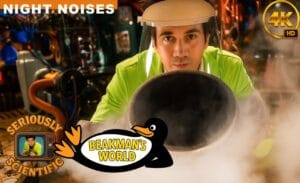
Beakman’s World turns the volume up this episode as Beakman takes on a viewer’s question about noise and turns it into a hands on tour of sound, before Lester gets dragged into a countdown of things that get bigger, faster. A balloon stretched over a can reveals the hidden shake of a human voice, and a bottle of liquid nitrogen proves that explosions are simply matter changing size in a hurry.
In this episode you will discover:
- Why sound is really just vibrations moving through the air
- How a homemade sound viewer can make your own voice visible
- How a tin can telephone carries a voice along a taut string
- Why air pressure alone can hold water inside an upside down glass
- What actually happens inside an explosion, from popcorn to liquid nitrogen
- How controlled explosions are sometimes used to help rather than harm
The Same Push, Two Speeds
Sound and explosions turn out to be two speeds of the same basic idea. Both are about something pushing on the air, or the water, around it. Sound is a gentle, repeating push, a vibration that travels outward as a wave until it reaches an eardrum and gets read as noise or music. An explosion is the same kind of push taken to an extreme, a substance suddenly getting far bigger than it was a moment before, whether that is steam bursting out of a popcorn kernel or nitrogen gas escaping a warming bottle. Sitting quietly behind both ideas is air pressure itself, the constant, usually invisible push of the atmosphere that Beakman reveals with nothing more than a playing card and a glass of water.
Beakman’s demonstrations
Beakman builds a sound viewer out of nothing fancier than a balloon, a can and a tiny mirror, shining a flashlight off the stretched balloon so the audience can watch his own voice dance across the studio as a moving beam of light. He shows how the same shaking travels through a tightly stretched string in a homemade tin can telephone, then hands things over to Colonel Corn and a squad of safety obsessed helpers for the main event, popping a kernel of corn to show a small explosion before building up to a full sized one, a bottle of liquid nitrogen dropped into a bin of water that sends a geyser of spray flying as the gas inside suddenly expands.
Try this at home
The tin can telephone test. Ask an adult to help remove one end from each of two clean cans and punch a small hole in the closed end of each. Thread a long piece of string through both holes and knot each end so it cannot slip out. Pull the string tight between two people and take turns talking into one can while the other person listens. The voice makes the air in the can vibrate, which vibrates the can, which vibrates the string, which carries the shaking all the way to the other end.
The playing card test. Fill a glass right to the brim with water and cover the top with a playing card, pressing gently so no air is trapped underneath. Holding the card firmly in place, turn the glass upside down over a sink and let go of the card. Air pressure pushing up on the card is stronger than the weight of the water pushing down, so the card, and the water, stay exactly where they are.
The film canister test. With an adult, drop a quarter of a fizzy tablet and a spoonful of water into a small snap lid canister, seal the lid, set it down and step well back. Carbon dioxide builds up inside faster than the sealed canister can hold it, and the lid pops off with a bang, a small, safe version of exactly the same idea behind Beakman’s much bigger liquid nitrogen blast.
- Light from the Sun takes just over eight minutes to reach Earth.
- A bristlecone pine tree in northern California is more than 4,600 years old, one of the oldest living things on the planet.
- Humans shed their outer layer of skin every month, adding up to about 40 pounds a year.
- The average caveman lived to just 18 years old.
- At University Medical Center Göttingen in Germany, researchers used a super resolution technique called MINFLUX nanoscopy to map the molecular synapses inside the inner ear for the first time, showing exactly how hair cells convert vibrations into the nerve signals the brain reads as sound. https://analyticalscience.wiley.com/content/news-do/molecular-symphony-behind-hearing-s-precision
- At Tohoku University in Japan, physicists discovered that sound waves travelling across a magnetic material can diffract unevenly depending on their direction, a completely new behaviour for acoustic waves that could help build more precise communication devices. https://www.sciencedaily.com/releases/2025/01/250129121353.htm
- The United States Geological Survey confirmed that a new monitoring station at Yellowstone National Park recorded the seismic and infrasound signature of a small hydrothermal explosion in April 2024, the first time such a blast had ever been caught by instruments rather than witnesses. https://www.usgs.gov/observatories/yvo/news/a-small-hydrothermal-explosion-norris-geyser-basin
Curriculum focus
Built on NGSS 4-PS3-2 and MS-PS1-4 (sound as a form of energy transfer, and how heat changes a substance’s state and particle motion). Complementing that, it is pitched at KS2 and KS3 physics and sound and works as a gentle introduction to GCSE and IGCSE physics topics such as wave properties, pressure and states of matter, across boards such as AQA, Edexcel, OCR and Cambridge IGCSE. The worksheet and critical thinking questions take these ideas further than the episode alone.
KS3 physics
sound waves
air pressure
states of matter
energy transfer
Beakman's World
02 // EPISODE_INDEX13 episodes remastered for modern science education
Season 1 (12 episodes)

Beakman's World | Volcanoes & Rain

Beakman's World | Gravity & Inertia
Molecules & Snot

Beakmans World | Blood & Circulation

Photosynthesis & Paper Making

Soap and Engines

Electricity & Light Bulbs

Beakman's World | Sound, Vibrations & Explosions

Refraction & Magnetism

Levers & Television

Displacement & Lift

Microscopes & Healing

Episode Discussion
Share your thoughts on this Beakman's World episode