
Beakman's World: Levers & Television
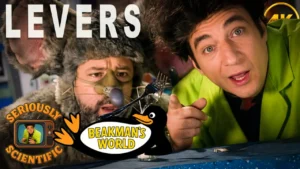
Beakman’s World, Season 01 Episode 10 explores two great human inventions separated by hundreds of thousands of years: the lever, the ancient simple machine that lets a small push move a huge weight and the television, a twentieth century wonder that sends pictures across a continent on radio waves. In this episode of Beakman’s World, Paul Zaloom as Beakman uses a fallen boulder, a wheelbarrow, a bottle opener and a walkie talkie relay to show how machines extend what people can do, with a Beakmania quiz round and a fork balance challenge sitting between the two topics.
In this episode you will discover:
- The three parts of every lever: the fulcrum, the resistance and the effort
- Why a teeter totter, a wheelbarrow and a baseball bat are all levers but of three different classes
- Who Philo Farnsworth was and how he built the first all electronic television picture at the age of 21
- How a TV camera turns a picture into a stream of instructions and sends them on radio waves
- Why the moving pictures on a screen are really a rapid sequence of still frames
- How to build a flipbook that turns still drawings into a tiny cartoon
Two machines that extend what people can do
Beakman ties the episode together with a simple idea. A lever extends the human body: it takes the strength we already have in our arms and legs and trades a longer push at one end for a stronger push at the other, so two people can shift a boulder. A television extends the human senses: it takes a scene from one place and translates it into a set of instructions that a machine in your living room can use to rebuild the picture. Both are machines that break a hard job (lifting a rock, seeing across a continent) into something easier by turning it into something else first.
Fulcrum
The fixed pivot every lever turns on; move it and you change how much effort is needed to shift the load.
Lever class
Where you put the fulcrum, the resistance and the effort defines a first, second or third class lever.
Persistence of vision
The effect that lets a rapid sequence of still pictures look like smooth motion on a screen.
Beakman’s demonstrations
A boulder crashes through the ceiling and lands on a plank, giving Beakman an instant first class lever: Josie and Lester push down one end and the rock lifts at the other. Beakman then walks through second class levers with a wheelbarrow and a bottle opener on a cream soda, and third class levers with a hammer, a baseball bat and even the human arm. For the television segment he becomes Philo T. Farnsworth, sends Josie behind a screen with a walkie talkie, and rebuilds a picture in her hand one line at a time, saying “black, black, white, white” until the pattern spells out the letters TV, exactly the way a real broadcast rebuilds a scene from a stream of instructions.
Try this at home
The fork and toothpick balance. With an adult, thread two dinner forks together at the teeth so they hinge like a jaw, then push a round toothpick between them until the whole arrangement balances on your finger. Now stand a second toothpick upright in the hole of a salt shaker, and rest the first toothpick on its tip. It looks impossible, but the forks hang below the point of support, so the centre of gravity sits directly under the pivot and the whole thing balances.
The flipbook. Take a small pad of paper or an old telephone book, and on the corner of each page draw a simple stick figure. Change the position of the arms and legs a little on each page, then flip the pages fast with your thumb. The stick figure looks like it is dancing. That is exactly how animation and television work: a rapid sequence of still pictures reads as motion.
- A housefly lives for an average of two weeks.
- Tapeworms can grow up to 10 metres long inside their host.
- Your brain runs on about the same amount of electricity as a small light bulb.
- A snail’s tongue can carry up to 25,000 tiny teeth.
- Engineers are now building wearable levers you can put on like a jacket. In 2022 a team at ETH Zurich in Switzerland unveiled the Myoshirt, a soft textile exomuscle with a motorised cable that runs alongside the arm like an artificial tendon, boosting shoulder endurance by about a third in healthy wearers and by roughly 60 per cent in a participant with muscular dystrophy. ETH Zurich, 2022
- The neat idea that moving pictures work because still images “persist” on the retina has since been reframed. Vision scientists now treat persistence of vision as a discredited theory of motion perception; the apparent movement on a screen is explained instead by flicker fusion together with two brain effects called the phi phenomenon and beta movement. Oxford Reference
- Philo Farnsworth built a TV picture out of a few hundred lines. On 1 December 2018 Japan’s public broadcaster NHK launched BS8K, the world’s first 8K television channel, with pictures made from 7,680 by 4,320 pixels arranged in 4,320 progressive lines, sixteen times the detail of high definition. NHK BS8K, launched December 2018
Curriculum focus
NGSS 4-PS4
KS2 science
KS3 physics
Simple machines
Signals and information
Beakman's World
02 // EPISODE_INDEX13 episodes remastered for modern science education
Uncategorised (1 episodes)

Season 1 (12 episodes)
Beakman's World | Volcanoes & Rain
Beakman's World | Gravity & Inertia
Molecules & Snot
Beakmans World | Blood & Circulation
Photosynthesis & Paper Making

Soap and Engines

Electricity & Light Bulbs

Beakman's World | Sound, Vibrations & Explosions

Refraction & Magnetism

Displacement & Lift
Levers & Television
Microscopes & Healing
Episode Discussion
Share your thoughts on this Beakman's World episode