Ten years ago Chris and Liz left the city for somewhere rural. It was the garden rather than the house they fell for. They now think of it as an ark. Every spring they carry the tools out of their shed so the swallows can have it back, which tells you most of what you need to know about how the place is run. What they don’t know, and what this episode shows them, is what happens in it while they’re indoors.
What happens in this episode
The mouse that leaves herself signposts

Four months old and already looking for a mate, with a tawny owl in the trees above her. Photograph: BBC / Plimsoll Productions.
A four-month-old female field mouse comes out of the dry stone wall looking for a mate. The tawny owl in the trees above her has hearing ten times more sensitive than ours and can pick up the slightest sound she makes.
Her way round this is genuinely clever. Male field mice sing at frequencies far above anything an owl can hear, so she navigates towards a serenade that’s effectively private. Slowed right down, it’s a proper song.
Getting to him means crossing a wide, featureless lawn, which raises the harder problem of finding her way home again. So she builds herself a trail, deliberately placing objects as she goes to mark the route back. Field mice are the only mammals apart from us known to position objects as landmarks. She’s doing it with a brain the size of a pea.
She gets there, likes what she hears and gets home again on her own signposts.
Six thousand miles to one shed

Those tail streamers evolved to impress a female. They also make the male almost impossible to film. Photograph: BBC / Plimsoll Productions.
A male barn swallow finishes a 6,000 mile flight from southern Africa. Out of 25 million gardens in Britain he comes back to the one he was raised in and lands in Chris and Liz’s tool shed.
Barn swallows pair for life but spend most of the year apart, coming together only to breed. Other pairs around him are already reunited after seven months. His female doesn’t arrive. Swallows live three or four years, so a wasted season is a serious loss. Fewer are making the journey each year as the weather along the route becomes less predictable.
She turns up eventually, very late, and they get straight to work. Five chicks hatch. Each one needs a thousand insects a day.
That should be impossible. Flying insect numbers have crashed nationally under pesticides, pollution and habitat loss; swallow numbers have almost halved in a decade. What saves this pair is where they happen to live: a well-managed sheep farm next door and Chris and Liz’s own uncut meadow, which is crowded with the kind of miniature life that a small patch of untrimmed grass supports in the hundreds of species.
Then it rains. Cumbria is the wettest county in England and has been getting wetter. Rain grounds flying insects, making them roughly three times harder to find. The parents have to work three times as hard or the chicks die. Cameraman Lindsay McRae, who lives locally, put it plainly: the thought of chicks sitting in a nest begging with nothing coming is heartbreaking.
All five fledge.
The smallest male wins
Down in the pond, a female palmate newt comes out of five months in the compost heap. She’s barely the length of your little finger, heading for water at a time when Britain has lost half of its rural ponds in fifty years, drained for farmland. Garden ponds have never mattered more.
What she swims into is one of the strangest sequences in the series. Male palmate newts display underwater, flexing oversized back feet and wafting scent towards her. The big, boldly marked males look like the obvious winners. One by one they have to break off and go up for air.
The one still dancing at the end is the smallest, because he’s small enough to take all the oxygen he needs straight through his skin. Size is a disadvantage here; the underdog wins on physiology rather than on display.
She then folds a leaf around each of her hundred eggs, individually, one at a time. Newts spend most of the year out of water, incidentally, with their skin going rough and dry to hold moisture in. On land they eat slugs, which makes them one of the better things a vegetable grower can have.
Twenty metres a day, in the dark
The molehills drive Liz mad. Underneath them is a young male tunnelling for a mate at up to twenty metres a day, eating half his own body weight in worms to fuel it.
He can barely see past the end of his nose, but that nose smells in stereo, so he can pinpoint a female’s burrow from a long way off. His reception when he gets there is hostile: female moles carry unusually high testosterone, which makes them seriously aggressive. He persists and eventually wins her over.
British gardeners kill thousands of moles a year over the state of their lawns. Liz knows the molehills are also free, beautifully worked topsoil for her planting, so she puts up with them.
A spider with eight eyes and no web
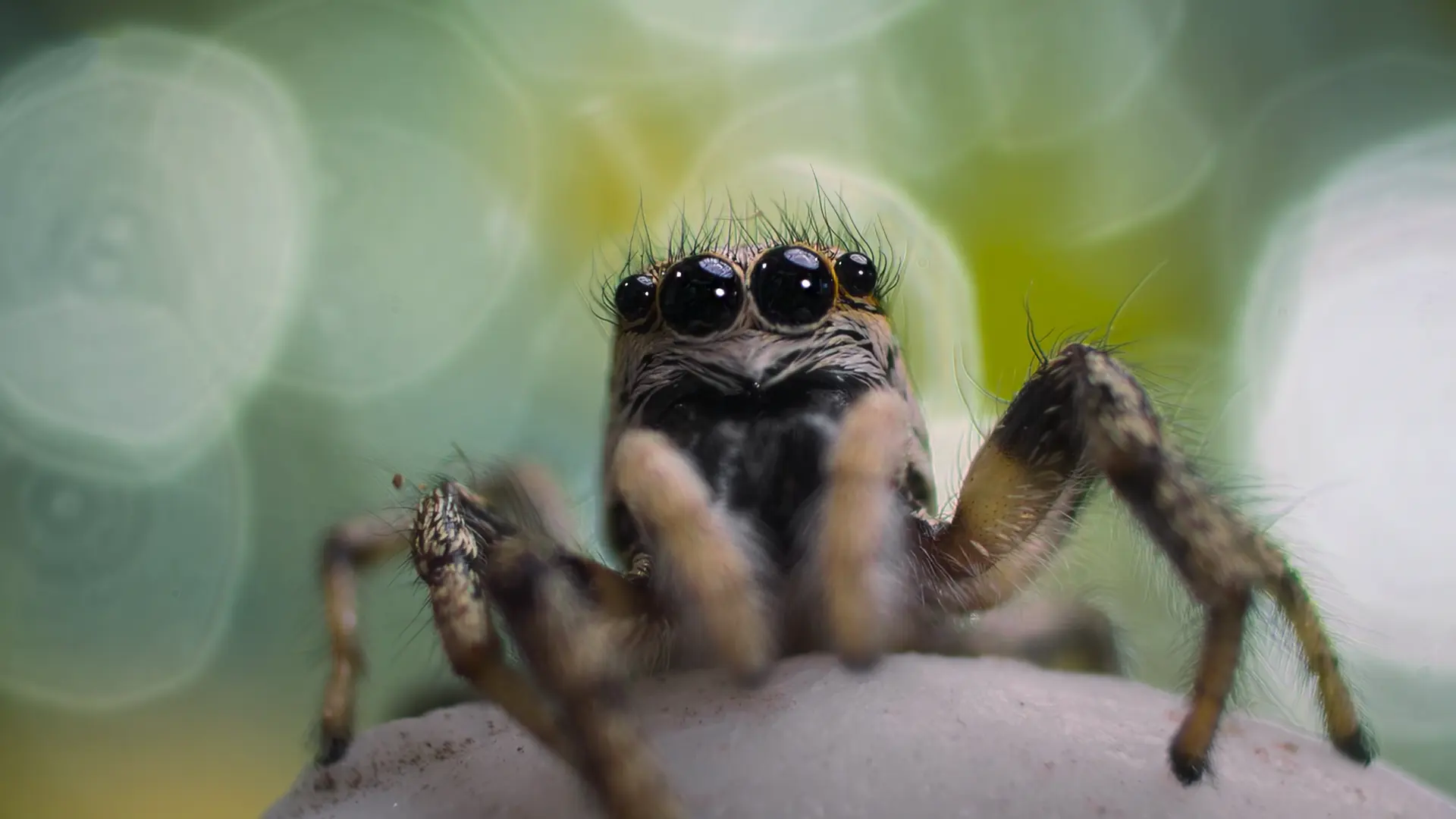
Six eyes for spotting movement, two for identifying what it is. Photograph: BBC / Plimsoll Productions.
Among the greenhouse seedlings there’s a zebra jumping spider, one of over a hundred spider species you’d find in British gardens. He builds no web at all; he stalks.
The eyes are the interesting part. Six of them detect movement across a wide field, while the two large forward-facing ones bring the target into focus and identify it. It’s the same division of labour your own peripheral and central vision uses, packed into an animal a few millimetres across.
He eats the pests that would otherwise take Liz’s seedlings, which makes him staff.
The fastest backflip in the insect world

She’s waiting for a display. He has two moves and about one second to land them. Photograph: BBC / Plimsoll Productions.
Britain has around 7,000 species of fly; the semaphore fly has the most elaborate courtship of any of them. He waves his paddle-shaped white front feet like signal flags, four bursts a second.
She isn’t impressed, so he goes to his other move: a complete backflip in a twenty-fifth of a second, the fastest in the insect world.
A predatory dungfly roughly twice his size arrives while he’s mid-display. He’s too fixated on the female to notice. There are, as the narration observes, plenty more flies in the pond.
Thirty million pheasants
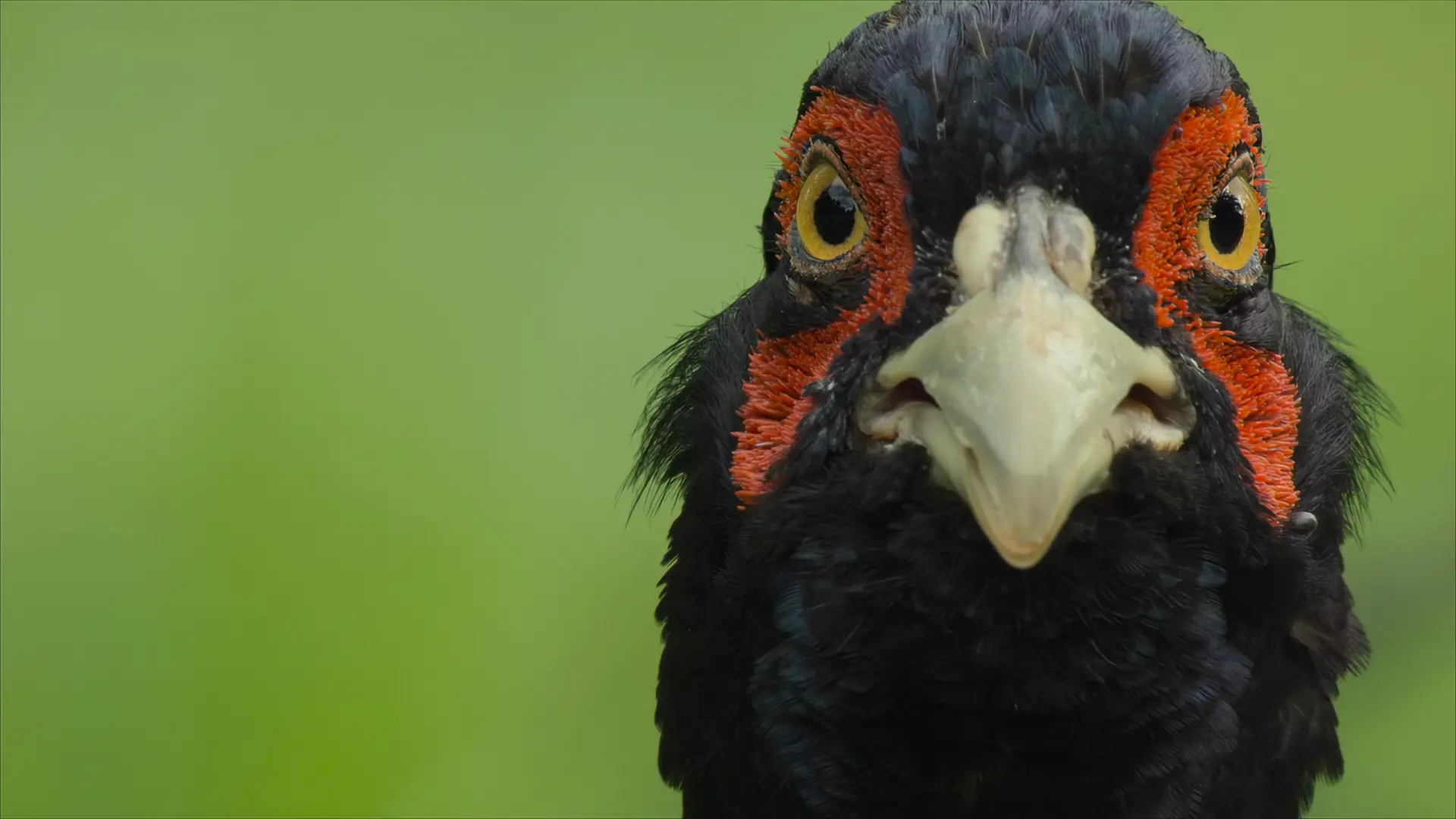
Beautiful, non-native and released into the British countryside at a scale that is hard to picture. Photograph: BBC / Plimsoll Productions.
Chris cuts the meadow with a scythe rather than a mower, which leaves amphibians like the palmate newt room to get out of the way. It’s slower and it’s the reason the newt survives the cut.
The moment he stops, the pheasants walk in. They’re native to Asia and over 30 million of them are released into the British countryside every year for shooting, where they eat vast quantities of insects, reptiles and amphibians. A gardener can scythe as carefully as he likes; he can’t do much about that.
The science underneath it
Quick facts
- A barn swallow flies 6,000 miles from southern Africa and returns to the exact garden it was raised in, out of 25 million in Britain.
- Each swallow chick needs about 1,000 insects a day. Swallow numbers have almost halved in a decade.
- Field mice are the only mammals other than humans known to place objects as navigational landmarks.
- A male semaphore fly performs a complete backflip in one twenty-fifth of a second.
- A mole can tunnel over 20 metres a day and eat half its body weight in worms.
- Kestrels can take up to eight rodents a day and can spot a mouse from over 40 metres.
- Britain has lost half its rural ponds in fifty years, which is why garden ponds now matter so much.
- Over 30 million pheasants are released into the British countryside every year.
How they filmed it
Lindsay McRae has filmed on every continent and grew up just over the hill from this garden, in a valley full of small farms and swallows’ nests. He’s been obsessed with them since he was a boy and says the decline in his own lifetime has been huge.
Swallows fly at around 11 metres per second and almost never in a straight line. He found the female easier to film than the male, which sounds like a joke until you learn why: the male’s longer tail streamers evolved to look good to a female; they also give him extreme manoeuvrability. Filming at ten times slow motion is the only way to see what he’s actually doing.
Camerawoman Katie Mayhew worked the night shift on the small stuff and rigged a camera to shoot below the surface of the pond. Her check before lowering it in was, in her own words, the idiot’s check: is the camera going to fall in the water? It didn’t. The newt courtship is the result.
Where this leaves us
Chris and Liz do a small number of specific things: they leave a meadow uncut, they keep the dry stone walls, they tolerate weeds like nettle and bramble, they cut with a scythe and they hand over the shed every April. Ecologists now recommend more or less exactly that list.
Liz’s own conclusion after a year of filming is the one worth repeating. She hopes anyone with a garden, a small one, a big one or a balcony, falls for it a bit more, because the difference it would make if everyone carved out a bit of space for the bugs and the birds is enormous. Given that her swallows raised five chicks in a summer that should have killed them, she has a point.