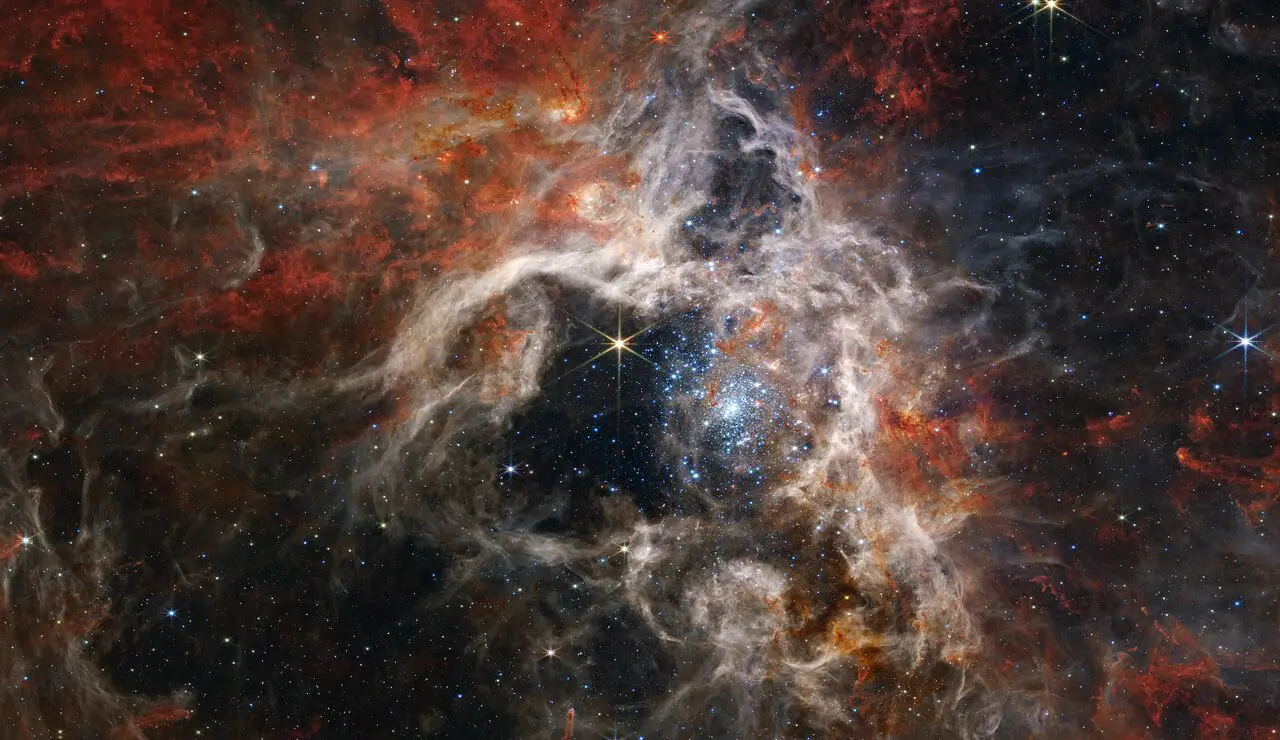
What did we think we knew about early galaxies?
For generations astronomers looked up at the night sky and made a very logical assumption. They assumed bright things are heavy and dark things are not. If you want to know how much a distant galaxy weighs you simply measure how much light it pumps out into space. We built our entire map of the cosmos on this basic idea; we counted the brilliant giant stars and used a standard mathematical recipe to guess how many smaller stars were hiding in their glare.
This standard recipe is known as the Initial Mass Function. You can think of the Initial Mass Function as the starting mix of star sizes for any given region of space. In our own Milky Way this mix is fairly predictable. For every massive giant star born in a nebula there is a highly specific number of medium and small stars born right alongside it. Scientists assumed this exact same recipe applied to the early universe and they built all their cosmological models around it.
They thought they had a pretty good handle on how heavy the oldest galaxies were. But the maths stopped working when astronomers looked at the very edge of the observable universe. The oldest star clusters seemed to be breaking the rules of physics; they behaved as if they were much heavier than their light suggested. Therefore a team of researchers from Leiden University pointed the James Webb Space Telescope at these ancient targets to figure out what was wrong. They found something that completely rewrites our understanding of the early cosmos.
Why did the standard maths stop working?
We relied entirely on the light we could easily see. Bright stars dominate the night sky and produce the vast majority of the visible light in any galaxy. If you look at a distant cluster you naturally assume the brightest objects represent most of the physical matter there. Astronomers used this assumption to estimate the total weight of early galaxies. They measured the bright light, calculated how many massive stars were required to produce it and then applied the standard Initial Mass Function to fill in the blanks.
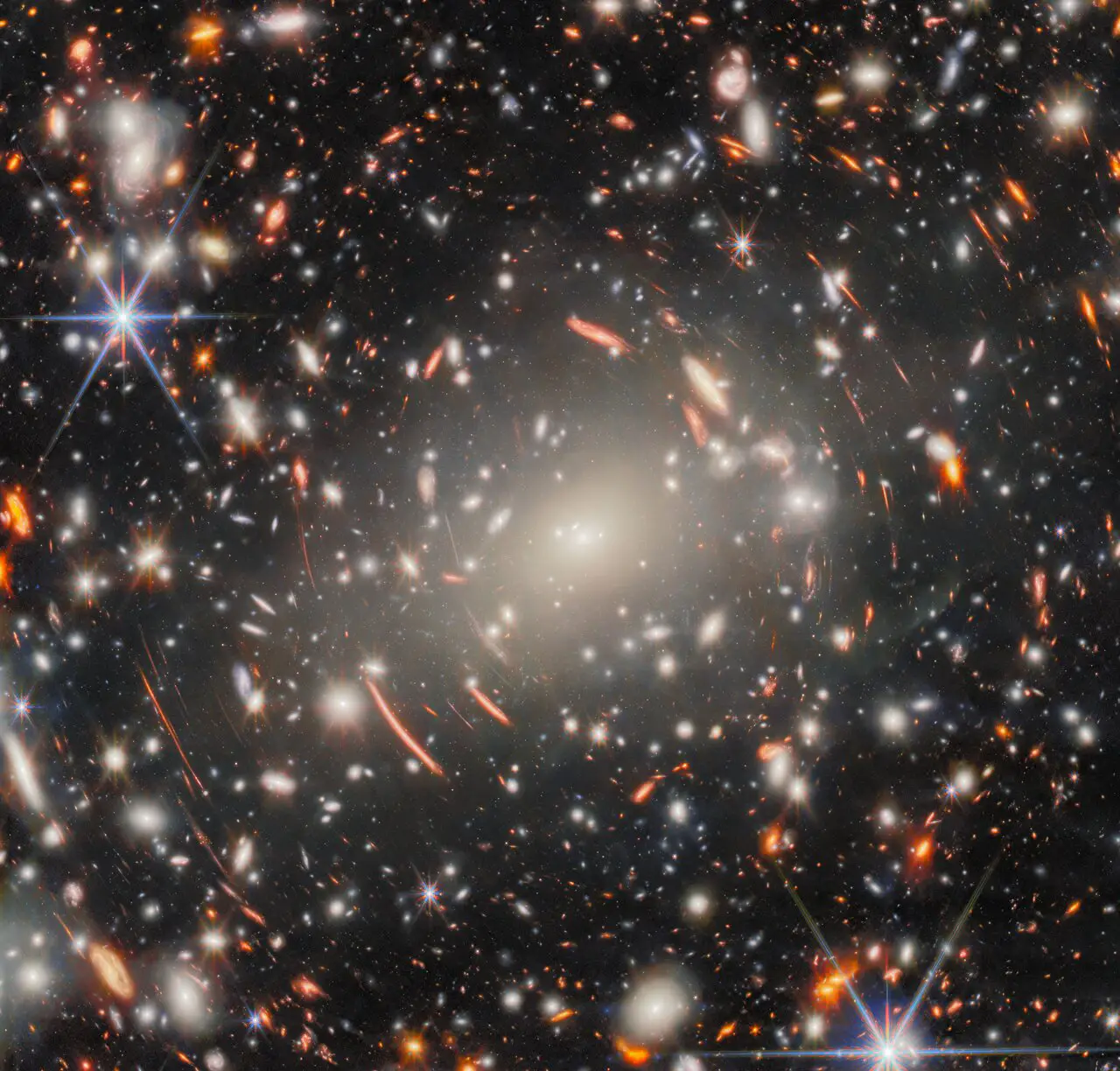
Like a colossal cosmic magnifying glass, the gravitational might of the Abell S1063 cluster warps and bends the light of ancient galaxies hiding directly behind it. Credit: ESA/Webb, NASA & CSA, J. Diego
The problem arises because the James Webb Space Telescope allows us to see further back in time than ever before. Astronomers recently found ancient galaxies that seemed completely impossible; they were fully grown just a few hundred million years after the Big Bang 1Glazebrook, K., et al. (2024). A massive galaxy that formed its stars at z ~ 11. Nature. https://doi.org/10.1038/s41586-024-07191-9. When we look at galaxies that formed just a few hundred million years after the Big Bang we are looking at environments completely alien to our modern Milky Way. The gas clouds were denser; the chemical makeup was different; the ambient temperature of space was warmer. Applying our local stellar recipe to these ancient galaxies was a fundamental mistake.
Dr Chloe M. Cheng and Professor Mariska Kriek led the research team that uncovered this error 2Leiden University. (2026). Bottom-heavy stellar populations reveal hidden mass in early galaxies. ScienceDaily. https://www.sciencedaily.com/releases/2026/08/260822015141.htm. They realised our standard maths vastly underestimated the number of small stars in the early cosmos. The mix in these ancient galaxies is “bottom-heavy”, meaning the balance is massively tilted towards the little guys 3Astrobites. (2026). Too Massive, Too Early… and Still Not Massive Enough? Astrobites. https://astrobites.org/2026/04/07/too-massive-too-early/.
Where was the missing mass hiding?
It turns out early galaxies are much heavier than we ever realised. Researchers discovered these ancient collections of stars are packed with countless low-mass faint stars. We have suspected for years that modern giant elliptical galaxies might hide huge populations of red dwarfs 4van Dokkum, P. G., & Conroy, C. (2010). A substantial population of low-mass stars in luminous elliptical galaxies. Nature. https://doi.org/10.1038/nature09578. Now we know the ancient universe did the exact same thing. This discovery means some early galaxies might be up to four times heavier than previous estimates suggested. We spent decades wondering where all the missing matter in the early universe was hiding.
The missing mass wasn’t hiding in some mysterious exotic particle or invisible dark matter halo. It was hiding in plain sight as trillions of perfectly ordinary tiny stars. These specific early galaxies are what astronomers call quiescent galaxies. A quiescent galaxy has completely stopped making new stars. Because they stopped forming new stars billions of years ago all of their massive bright stars have already burned through their nuclear fuel and died.
Massive stars live incredibly short lives. They burn incredibly hot, exhaust their fuel in just a few million years and explode as supernovae. All that remains in a quiescent galaxy are the smaller cooler stars that burn their fuel very slowly. These tiny red dwarf stars can live for trillions of years. If a galaxy is entirely populated by these small faint stars its overall mass is going to be incredibly high even if it doesn’t shine very brightly.
How do you count invisible stars?
Counting stars you cannot actually see sounds impossible. You cannot just zoom in and count them one by one because they are billions of light-years away and incredibly dim. Even the mighty gold mirrors of the James Webb Space Telescope cannot resolve individual small stars at that distance. Instead the team relied on incredibly deep spectral data that broke the ancient light apart 5Astronomy Now. (2026). JWST’s ‘impossible’ early galaxies may be even more massive than we thought. Astronomy Now. https://astronomynow.com/2026/08/24/jwsts-impossible-early-galaxies-may-be-even-more-massive-than-we-thought/. The team had to use a brilliant technique called full-spectrum modelling to solve the mystery.
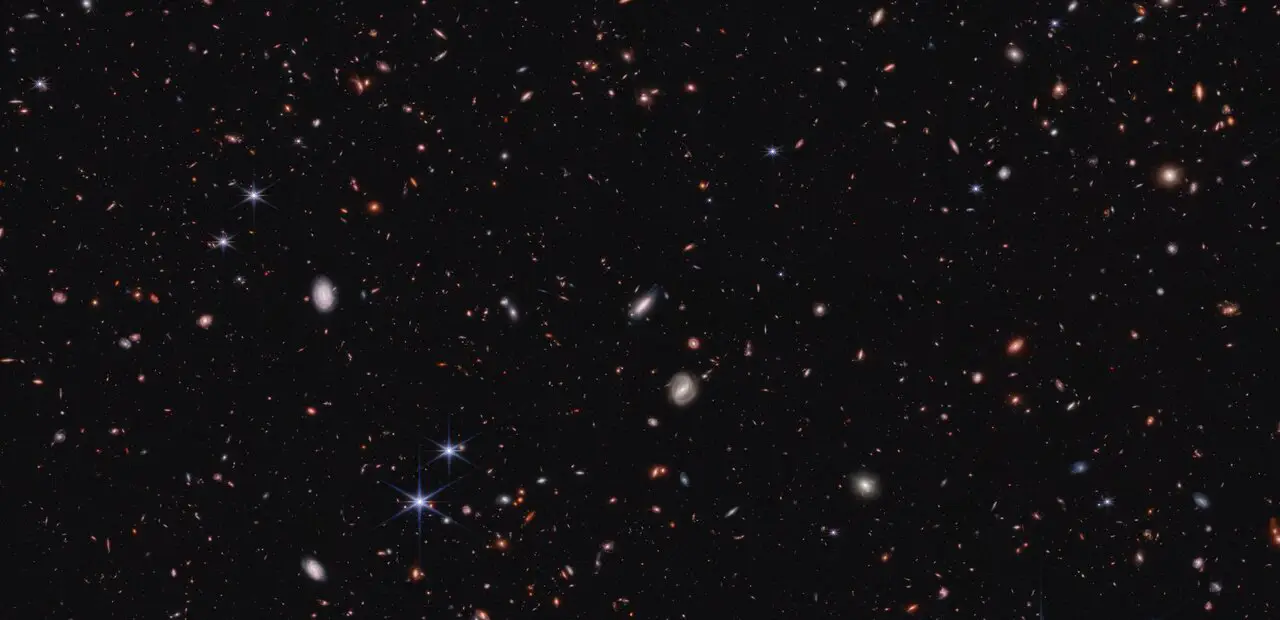
Scattered like glittering crimson rubies against the black canvas of space, these tiny red dots represent some of the most ancient galaxies ever observed. Credit: ESA/Webb, NASA & CSA, CEERS Team
Full-spectrum modelling means looking at the whole rainbow of light instead of just one colour. When starlight passes through the atmosphere of a star the chemical elements in that atmosphere absorb very specific colours of light. This creates a spectrum with dark lines in it. You can read these dark lines exactly like a barcode at a supermarket checkout. Every single type of star leaves a unique chemical fingerprint in the light it emits.
Massive hot stars leave one type of fingerprint; small cool stars leave a completely different one. By capturing the complete spectrum of light from these distant galaxies the telescope can detect the faint chemical signatures of millions of small stars all mixed together. The infrared instruments on Webb are so unbelievably sensitive they can pick up the collective hum of these tiny stars even when other cosmic noise threatens to drown them out.
What exactly is full-spectrum modelling?
Dr Cheng used this incredibly detailed spectral data to build advanced computer models. These models tested thousands of different combinations of large and small stars to see which specific recipe perfectly matched the real light captured by the telescope. They tried the standard Milky Way recipe first, and the resulting light profile looked completely wrong. The simulated spectrum simply didn’t match the real barcode Webb recorded.
The researchers kept tweaking the digital mixture. They added more giant stars; they removed medium stars; they shifted the age of the galaxy. Nothing worked until they dramatically increased the number of low-mass stars. The only computer models that accurately recreated the real telescope data were the ones absolutely stuffed with faint red dwarfs.
This was the smoking gun. You cannot see the individual faint stars, but you can see their collective chemical barcode printed right across the galaxy’s light. The Webb telescope didn’t just take a pretty picture; it broke the light apart and weighed the hidden ingredients.
Why does the coin jar analogy make sense?
Imagine you have a large glass jar full of coins on a table across the room. You want to know how much the jar weighs but you are only allowed to look through the glass from a distance. If you look at the top you might see a gleaming layer of shiny £2 coins. If you assume the entire jar is filled with those exact same £2 coins you will calculate one specific weight.
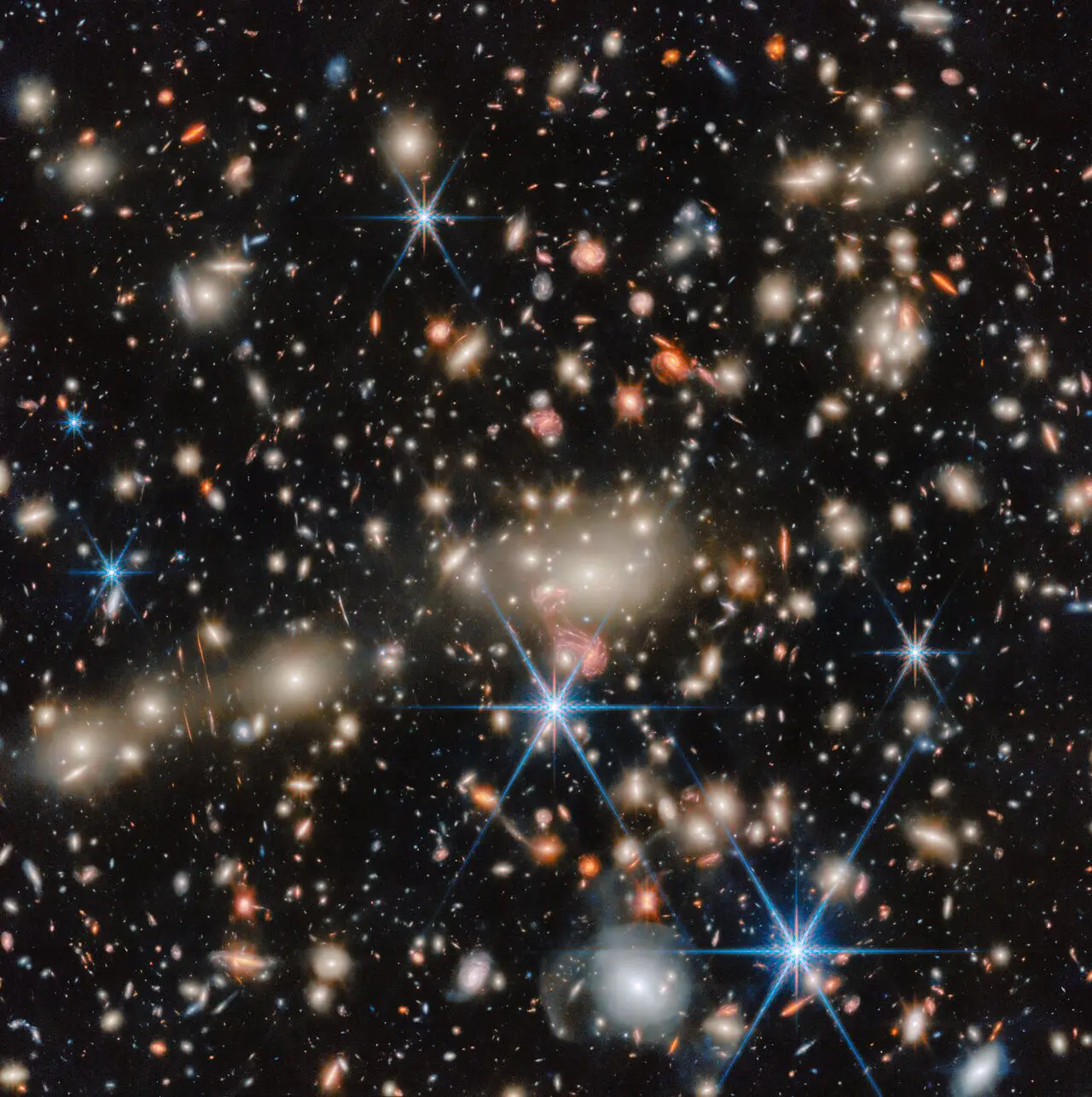
Blindingly brilliant giant stars dominate the foreground of MACS J1149, perfectly illustrating how billions of smaller, fainter stars can be completely drowned out by their shiny neighbours. Credit: ESA/Webb, NASA & CSA
But what if you are completely wrong? What if underneath that top layer of large coins the jar is actually packed solidly with thousands and thousands of tiny 1p and 2p coins? The small coins do not add much shine and they certainly do not look impressive from a distance. They do add massive amounts of physical weight to the jar. By only counting the bright £2 coins you have vastly underestimated how heavy the jar really is.
This is exactly what happened with the early galaxies. Astronomers were distracted by the £2 coins and they were entirely ignoring the pennies. The small stars were always there, silently adding massive amounts of gravitational pull to the galaxy, but they were too faint to register on our older telescopes. The James Webb Space Telescope finally gave us the tools to weigh the pennies.
What does this mean for the early universe?
Finding this hidden mass completely changes how we understand the first few billion years after the Big Bang. If these early galaxies are four times heavier than we thought they must have formed much faster and much more efficiently than our current physics models predict. We used to think building a massive galaxy took a very long time; we assumed gravity slowly pulled gas together over billions of years.
Now it seems the early universe was a highly efficient star factory. The dense gas clouds present shortly after the Big Bang collapsed into stars at a blistering pace. This forces theoretical physicists to go back to their blackboards and rewrite the timelines of how the very first structures in the universe assembled themselves.
This discovery also solves a major headache for cosmologists. For years there has been a glaring tension between how much mass we could see in galaxies and how much dark matter we knew had to be there to hold them together. Galaxies rotate so fast they should tear themselves apart; dark matter provides the extra gravity to keep them intact. By quadrupling the mass of the visible stars themselves that mathematical tension starts to ease.
Are we sure about this hidden mass?
Science is about constant testing, and rigorous researchers are always the first to admit when their work needs more confirmation. The international team selected specific massive galaxies that had completely stopped making new stars 6Cid, M. (2026). JWST found ancient galaxies hiding four times their measured mass in small stars. Martin Cid Magazine. https://www.martincid.com/science/jwst-hidden-stars-early-galaxies-4x-massive/. That quiescence matters because the glowing gas of active star formation can drown out the quiet spectral details. The sample size of this initial study is relatively small. The team only looked at nine specific quiescent galaxies. We cannot say with absolute certainty that every single early galaxy in the universe is this bottom-heavy just yet.
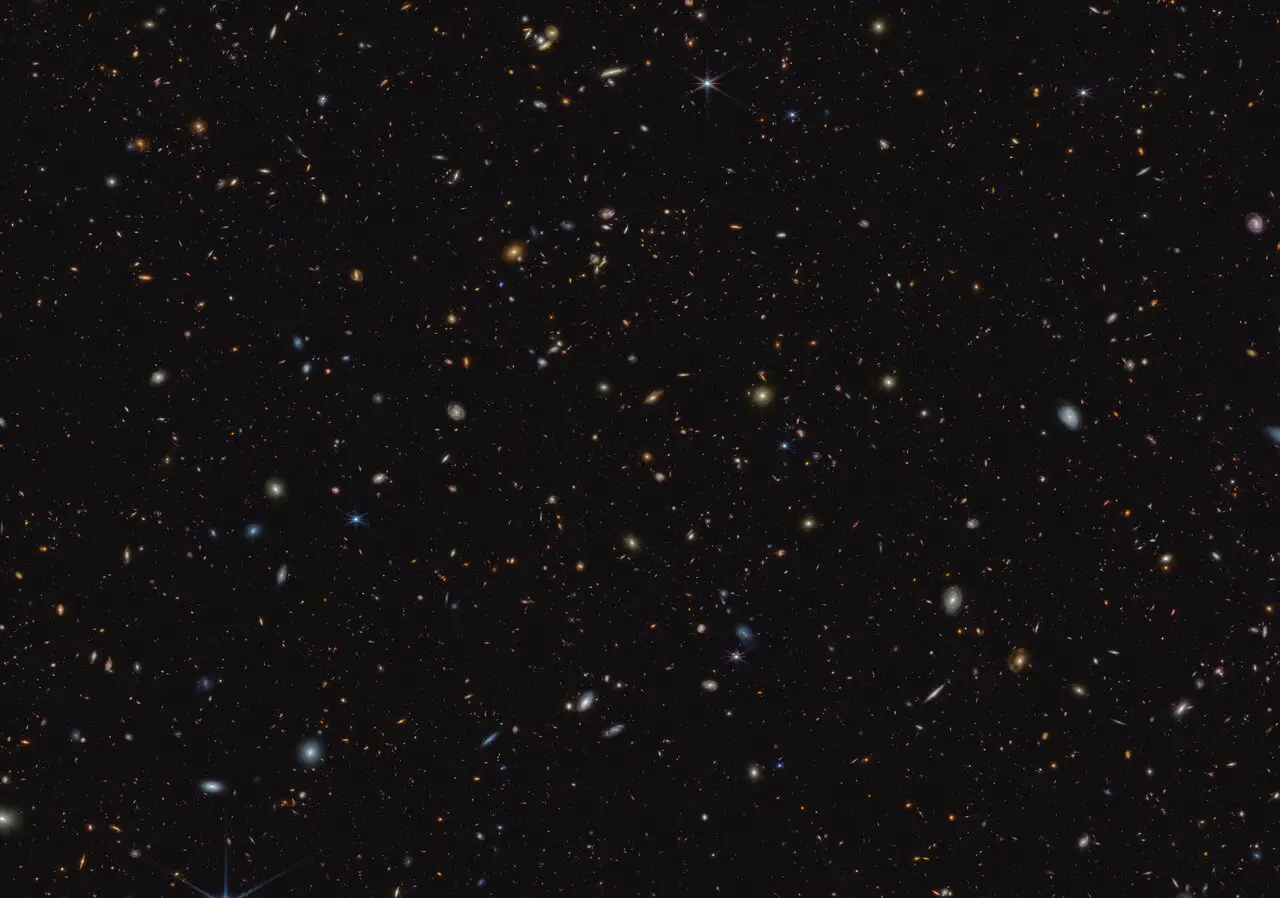
A breathtaking mosaic of more than 45,000 distant galaxies, captured in astonishing detail to help astronomers solve the mystery of the early universe’s true weight. Credit: ESA/Webb, NASA & CSA, JADES Collaboration
There are also alternative explanations we have to rule out. Some sceptics in the astronomical community might argue the unusual light signatures could be caused by active black holes hiding in the centre of these galaxies. Other scientists might suggest strange types of cosmic dust are filtering the light in unexpected ways, making the galaxy look artificially red and faint. The research team controlled for these factors beautifully in their mathematical models, but in astronomy you always want more data to be absolutely certain.
Where do astronomers look next?
The next logical step is to point the telescope at a much larger group of galaxies across different regions of the sky. Researchers need to see if this bottom-heavy mix of stars is a universal rule for all ancient star clusters, or if they just happened to pick three unusual oddballs for this first study. The James Webb Space Telescope is already scheduled to conduct wider surveys of the deep universe to gather exactly this kind of expansive spectral data.
We also need to figure out exactly why the early universe preferred to make small stars in the first place. Was the primordial gas denser? Was the ambient cosmic microwave background radiation hotter? Answering those questions will require a whole new generation of supercomputer simulations. The universe is incredibly good at keeping its secrets, but we are finally building the right tools to pry them open.