















































The Moon
Every night, the moon looks a little bit different. Sometimes it is a giant, glowing circle, and other times it completely disappears into the dark! Does the moon actually change shape, or is it playing a trick on our eyes? Let us explore the glowing secrets of our closest neighbour in space.
Why Does the Moon Change Its Shape?
Not at all! The moon is always a giant, solid sphere of rock. It just looks like it changes shape because of how the sun's light hits it as it orbits around the Earth.
From the sun! The moon does not make its own light. It acts like a massive mirror in space, bouncing the sun's bright light down to us here on Earth.
Put Your Instincts to the Test
Think about what you already know about the moon and the night sky. Pick an answer for each question, then see if your instincts were right.
The moon's gravity pulls the water! Even though the moon is far away, its gravity is strong enough to grab onto our oceans and create a giant bulge of water.
Millions of years! Because the moon has no air, there is absolutely no wind and no weather to wash or blow the footprints away. They are frozen in time.
Much lighter! The moon is much smaller than Earth, so its gravity is only one-sixth as strong. You could jump incredibly high without any effort!
Understanding the Science
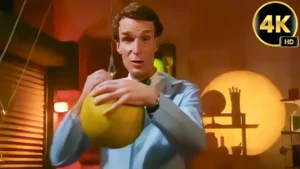
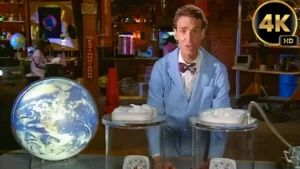
Let us break down the phases, the gravity, and the brilliant science of the lunar surface with Bill Nye the Science Guy.
Key Concepts
Reflection
Tap to learn moreThe moon does not make its own light. It glows simply because of reflection. It acts like a giant mirror, bouncing the bright light from the sun down to our eyes.
Orbit
Tap to learn moreAn orbit is the circular path the moon takes as it travels around the Earth. It takes the moon about 28 days (which Bill Nye calls a "moonth") to complete one full orbit.
Lunar Phases
Tap to learn moreLunar phases are the different shapes the moon appears to have from Earth. These shapes change based on how much of the moon's sunlit side we can see from our angle.
Gravity
Tap to learn moreGravity is the invisible pulling force of an object. Because the moon is much smaller and has less mass than Earth, its gravity is only one-sixth as strong as ours.
Tides
Tap to learn moreTides are the regular rise and fall of the Earth's oceans. This is caused directly by the moon's gravity reaching out and pulling on the water as it orbits our planet.
Lunar Eclipse
Tap to learn moreA lunar eclipse happens when the Earth moves directly between the sun and the moon. The Earth blocks the sunlight, casting a dark red or black shadow over the moon's surface.
Solar Eclipse
Tap to learn moreA solar eclipse happens when the moon moves directly between the Earth and the sun. Even though the moon is small, it is close enough to temporarily block out the sun's light during the day.
Vacuum
Tap to learn moreSpace is a vacuum, meaning there is no atmosphere, no air, and no weather at all. Because the moon is in a vacuum, the sky there looks completely black, even during the bright daytime!
Try It: Interactive Moon Phases & Tides
Take control of the moon's 28-day orbit! Use the slider to move the moon around the Earth. Watch how the moon's phase changes depending on the sunlight (coming from the right), and notice how the ocean's tidal bulge follows the moon's gravity!
Apply Your Knowledge
Let us see if you can identify the different physical features of the lunar surface.
Match the Concepts
Click an object to select it, then click the matching description to place it.
Real-World Challenge
Imagine you are an aerospace engineer helping to design the new Artemis lunar base. Because the moon has no atmosphere to protect it, what are three major environmental hazards your base must protect the astronauts from?
What Has Changed Since This Episode Aired
This episode aired back in the 1990s. While the moon's orbit remains exactly the same, humanity's drive to explore it has exploded with incredible new discoveries!
Updated: Yes, we are going back! The historic Artemis II mission recently completed the first crewed flyby of the moon in over 50 years. This incredible milestone has paved the way for astronauts to finally land, explore, and build a permanent lunar base for humanity.
Updated: Not entirely! Space probes have discovered actual water ice hidden deep inside permanently shadowed craters at the moon's south pole. This ice is a massive game-changer because future astronauts can melt it for drinking water and even split it apart to make rocket fuel.
Updated: By analysing old Apollo sensor data with modern computers, scientists discovered the moon is actually shrinking slightly as its core cools down! This shrinking causes the crust to wrinkle and crack, creating real "moonquakes" that actively shake the surface today.
Test Your Understanding
Answer these questions and get instant feedback. How many can you get right?
Results
Your score:
Reflection
Have you ever looked up and noticed the moon during the daytime? Write about why you think we can sometimes see the moon while the sun is out, and describe how looking at the moon makes you feel about our place in the universe.
Episode Discussion
Share your thoughts on this Bill Nye The Science Guy episode