





























































Planets and Moons
We see diagrams of the solar system showing planets lined up nicely next to each other. But outer space is mostly just empty space! How far apart are these worlds?
How Big is Space, Really?
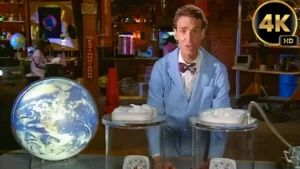
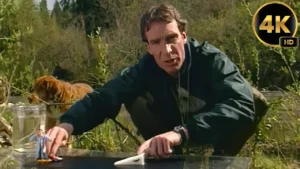
100 metres away! It would be roughly the length of an entire football pitch away. Bill Nye the Science Guy demonstrates that the solar system is mostly just empty space.
Almost 450 years! The outer edge of our solar system is unbelievably far away. Even traveling at incredible speeds, crossing the solar system takes lifetimes.
Put Your Instincts to the Test
Think about what you already know about space. Pick an answer for each question, then see if your instincts were right.
No, they are squashed circles called ellipses. Because of this oval shape, a planet's distance to the sun changes throughout its orbit. This also means its speed changes as it travels!
They reflect light from the sun. Planets and moons do not produce their own visible light. Without the sun acting like a giant searchlight, the entire solar system would be pitch black.
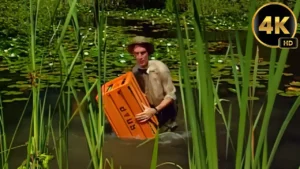
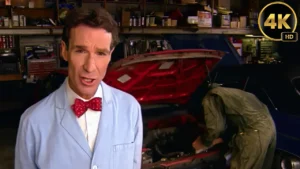
Its surface is covered in iron oxide, also known as rust. Bill Nye the Science Guy demonstrates this chemical reaction by mixing steel wool, sand, and water. When the metal oxidises over time, it turns the surrounding soil a deep, rusty red.
Understanding the Science
Tap each card to reveal the secrets of our solar system's orbits, gravity, and the different types of worlds out there.
Key Concepts
Gravity
Tap to learn moreThis invisible pulling force is the glue holding the entire solar system together. It keeps planets, moons, and dust particles from flying off in a straight line into deep space.
Anti-Clockwise Motion
Tap to learn moreIf you were floating deep in space looking down at Earth's North Pole, you would see every planet revolving around the sun in the exact same direction: anti-clockwise.
Changing Speeds
Tap to learn moreBecause orbits are elliptical, planets do not travel at a constant speed. When a planet swings closer to the sun, the stronger gravitational pull whips it around much faster.
Inner Rocky Planets
Tap to learn moreThe planets closest to the sun (Mercury, Venus, Earth, and Mars) are much warmer. They are terrestrial planets, meaning they are primarily made of solid rock and metal.
Outer Gas Giants
Tap to learn moreThe planets further out (like Jupiter and Saturn) are incredibly cold, massive balls of swirling gas. They feature spectacular planetary rings and are orbited by dozens of moons.
Asteroids
Tap to learn moreThese are irregular chunks of rock and metal floating in space. Astronomers use powerful telescopes to study what they are made of and to predict if their orbits will ever collide with Earth.
Moons
Tap to learn moreAlso known as natural satellites, these are rocky bodies that orbit planets instead of orbiting the sun directly. Earth has one, but some of the outer planets have hundreds!
Exoplanets
Tap to learn moreWhile this episode focuses on our local neighbourhood, modern astronomers have discovered thousands of other planets, known as exoplanets, orbiting completely different stars throughout our galaxy.
Try It: Gravity and Orbits
Move the sun, Earth, moon, and space station to see how their masses and distances affect their gravitational forces and orbital paths.
Apply Your Knowledge
Now let us see if you can connect what you have learned to the real world.
Match the Concepts
Click an object to select it, then click the matching description to place it.
Real-World Challenge
You are designing a robotic space probe to travel to the outer planets. Because orbits are ellipses, planets travel at different speeds depending on how close they are to the sun. Furthermore, they are moving across distances of millions of kilometres. How would you plan your trip to make sure the target planet is actually there when your space probe finally arrives?
What Has Changed Since This Episode Aired
This episode of Bill Nye the Science Guy first aired in the mid-1990s. While the core science of orbits and gravity remains perfectly accurate, modern astronomy has made some incredible discoveries since then!
Updated: In 2006, astronomers reclassified Pluto as a "dwarf planet." We discovered many other similar icy worlds out in the Kuiper Belt, so scientists had to strictly define what makes a true planet. We now officially have 8 major planets!
Updated: With better telescopes and modern space probes, we have found dozens more! As of early 2026, Jupiter has 101 known moons, and Saturn currently holds the record with an incredible 285 moons!
Updated: While we are always learning more, scientists now largely agree on the "Giant Impact Hypothesis." Evidence heavily suggests a Mars-sized object smashed into the early Earth, blasting debris into space that eventually clumped together to form our Moon.
Updated: Astronomers have now discovered over 6,000 "exoplanets" orbiting other stars in our galaxy! While we have not found life yet, we now know our solar system is just one of billions of planetary systems in the universe.
Test Your Understanding
Answer these questions and get instant feedback. How many can you get right?
Results
Your score:
Reflection
Think about how massive the distances in space are compared to the sizes of the planets. How does knowing the true scale of the solar system change the way you look up at the stars and planets in the night sky?
Episode Discussion
Share your thoughts on this Bill Nye The Science Guy episode