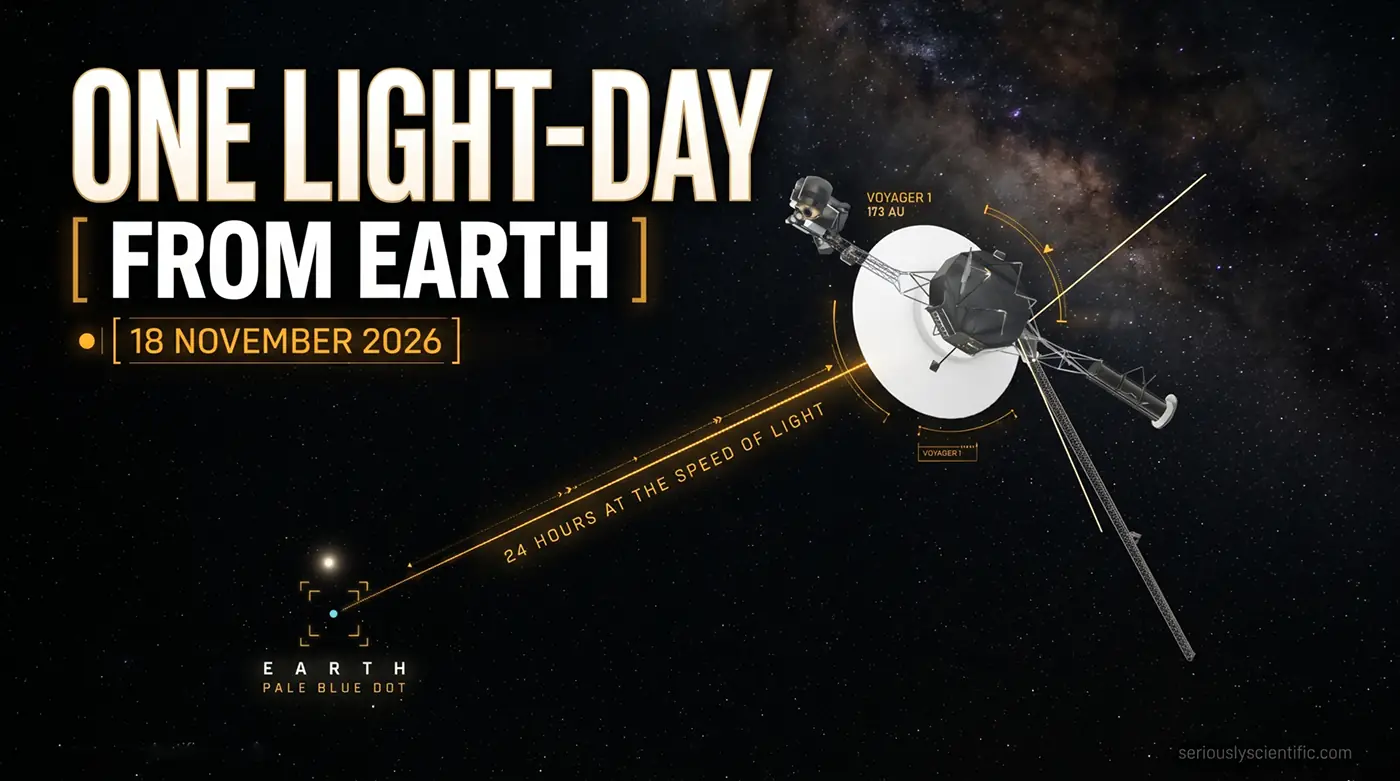
At 10:16:07 UTC on Wednesday 18 November 2026, NASA puts Voyager 1 one light-day from Earth. A radio signal, the fastest message we can send, now needs a whole day to reach a spacecraft launched in 1977. Nothing humans have built has ever been this far from home. It’s about 25.9 billion km (16.1 billion miles) away. It’s still sending us data, and every day it moves about 1.5 million km further out.
You can watch it happen on our live Voyager 1 tracker. It counts down to that exact second and then keeps counting as Voyager 1 pulls further beyond the light-day.
Voyager 1 won’t feel a thing. NASA says the spacecraft won’t detect any change around it as it passes the mark.1NASA. (2026, October 29). NASA’s Voyager 1 Conserves Power, Resolves Brief Communications Pause. NASA Science, Voyager blog. https://science.nasa.gov/blogs/voyager/2026/10/29/nasas-voyager-1-conserves-power-resolves-brief-communications-pause/ The milestone is ours, a round number we can picture. I think it’s the right moment to look back at what this small machine has done and at what it’s still carrying.
What does one light-day actually mean?
Light is the fastest thing there is. It covers 299,792 km every second, enough to go round the Earth seven and a half times. A light-year is how far it gets in a year. Astronomers use it for the distances to stars. A light-day is the same idea cut down to a single day: 299,792 km a second, multiplied by the 86,400 seconds in a day.
Do the sum and you get 25,902,068,371 km. Call it 25.9 billion km (16.1 billion miles), or 173 times the distance from the Earth to the Sun.
Some yardsticks help. Light from the Moon reaches us in about 1.3 seconds. Sunlight takes a little over 8 minutes. Even Neptune, the farthest planet, is only about 4 hours away at the speed of light. Voyager 1 is now 24 hours away.
Here’s what having Voyager 1 one light-day away does to a conversation. When the team at NASA’s Jet Propulsion Laboratory in California sends Voyager 1 a command, the message takes a day to get there. The reply takes another day to come back. Suzanne Dodd, the Voyager project manager at JPL, put it simply: “If you want to say ‘hello’ to Voyager, you send your message and then you go home and you wait two days before you finally get a response.”
That’s why nothing is done on the fly. Every command is written, checked and tested on the ground long before it’s sent, because a mistake can’t be corrected for another two days.
Out there the Sun is a different thing too. By our own sum, its light is about 30,000 times fainter than it is on Earth. It’s still brighter than a full Moon seen from here; it’s just squeezed into a single dazzling point.
How did a spacecraft from 1977 get this far?
Voyager 1 left Cape Canaveral on 5 September 1977. Its twin, Voyager 2, had gone 16 days earlier; the numbers follow the order they reached Jupiter rather than the order they left. The launch came close to going wrong. A booster underperformed on the way up. By the time the Centaur upper stage had made up the difference, it had about three seconds of burn time left in its tanks.2NASA. (n.d.). Charley Kohlhase. NASA Science. https://science.nasa.gov/people/charley-kohlhase
Then came the planets. Voyager 1 flew past Jupiter on 5 March 1979 and Saturn on 12 November 1980.3NASA. (n.d.). Voyager 1. NASA Science. https://science.nasa.gov/mission/voyager/voyager-1/ At Jupiter it caught volcanoes erupting on the moon Io, the first active volcanoes anyone had seen beyond Earth. The day before its closest pass, the camera team got one long exposure to hunt for a ring that nobody had ever seen. It was there.
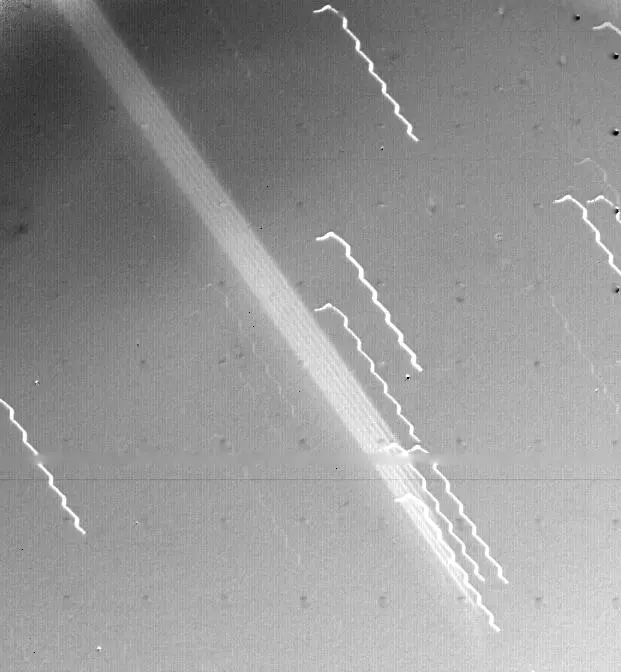
Jupiter’s ring, the faint diagonal band, seen for the first time in a single long exposure by Voyager 1 on 4 March 1979. Image: NASA/JPL.
At Saturn the team made a choice. They sent Voyager 1 close past Titan, Saturn’s biggest moon, because its thick orange haze was too interesting to skip. That pass bent the spacecraft’s path up and out of the flat plane the planets orbit in. It has been climbing away ever since. There’d be no more planets for Voyager 1. Voyager 2 carried the grand tour on to Uranus and Neptune.
On 17 February 1998 Voyager 1 overtook Pioneer 10 to become the most distant human-made object in existence. Pioneer 10 had left Earth five years earlier. Nothing has caught Voyager 1 since. It’s now heading out at about 61,000 km/h (38,000 mph).
Why did Voyager 1 switch its cameras off?
On 14 February 1990, with the planets well behind it, Voyager 1 turned round and took one last set of pictures. Carl Sagan, who was on the imaging team, had pushed for years for a portrait of the solar system seen from outside. The spacecraft took 60 frames and caught six planets. Mercury was too close to the Sun to show, Mars was lost in the glare and Pluto was too small and dim. In one of the frames, from about 6 billion km (3.7 billion miles) away, Earth is a speck just 0.12 of a pixel across.
It sits inside a pale streak, which isn’t a beam of light in space. The camera was pointing so close to the Sun that sunlight scattered across the picture and left those rays behind.
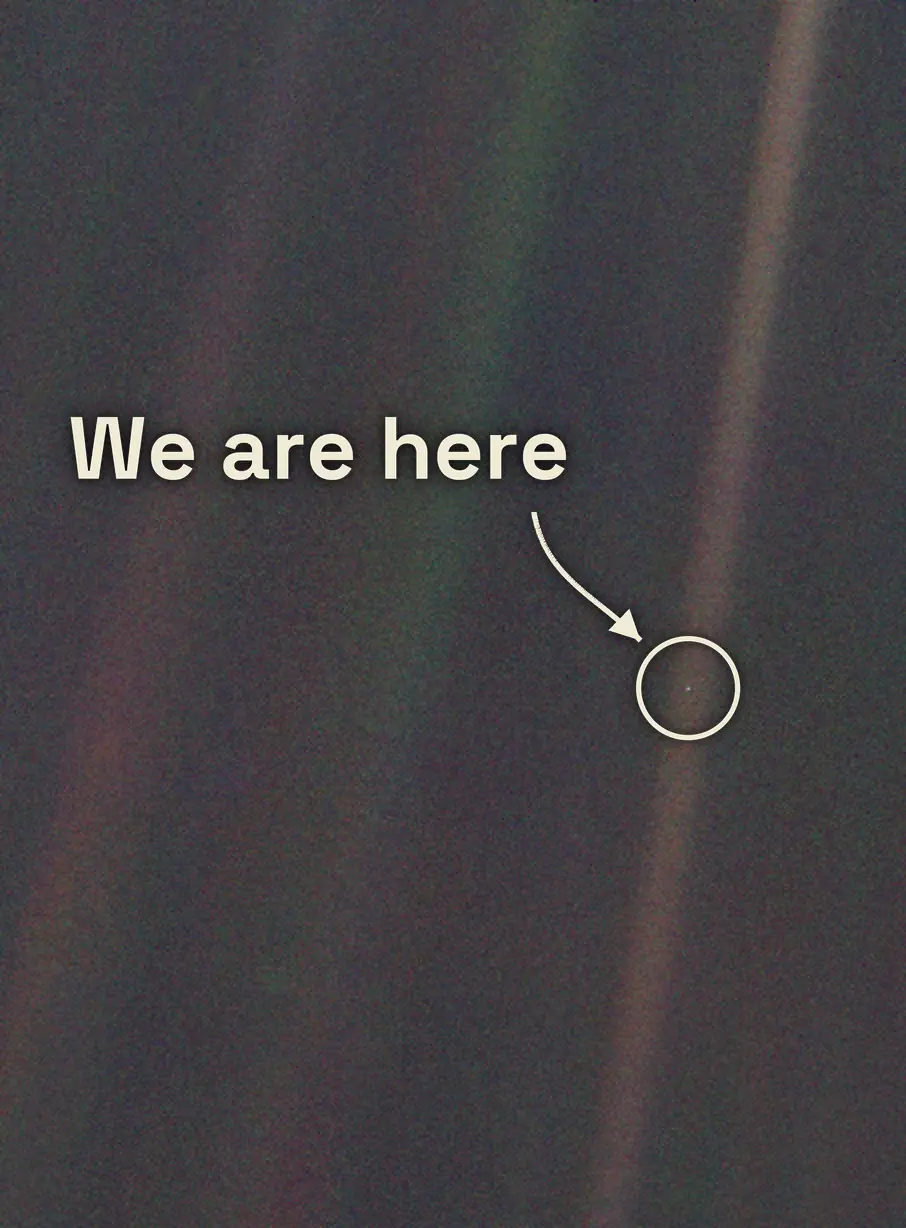
Earth from about 6 billion km (3.7 billion miles), in NASA’s original 1990 frame. The circle, arrow and words were added by Seriously Scientific. Image: NASA/JPL.
What happened next is the part most people don’t know. Those pictures were taken at 04:48 GMT. Thirty-four minutes later, Voyager 1 switched its cameras off for good.4NASA/JPL. (2020). Pale Blue Dot Revisited (PIA23645). NASA Photojournal. https://science.nasa.gov/photojournal/pale-blue-dot-revisited/ There was nothing ahead near enough to photograph, and the power and memory were needed for the instruments that would study the space between the stars. So the most famous picture Voyager 1 ever took is also one of its very last.
Sagan’s 1994 book, Pale Blue Dot, takes its title from this picture. Ours above is NASA’s original 1990 frame, grain and all, rather than a modern clean-up, because that’s what Voyager 1 actually sent home.
What’s on the Golden Record?
Voyager 1 is still carrying something it was always meant to keep. Fixed to its side is a 30 cm (12 inch) gold-plated copper record. It’s packed in an aluminium jacket with a cartridge and a needle, so whoever finds it has the means to play it. Voyager 2 carries an identical copy, so two of these records are now heading out in different directions.5NASA. (n.d.). Golden Record Contents. NASA Science. https://science.nasa.gov/mission/voyager/golden-record-contents/
A committee chaired by Carl Sagan chose what went on it, working with Frank Drake, Ann Druyan, Timothy Ferris, Jon Lomberg and Linda Salzman Sagan. There are spoken greetings in 55 languages, plus a message from Kurt Waldheim, then the Secretary-General of the United Nations. There are the sounds of Earth: surf, wind, thunder, birds and whale song. There are 90 minutes of music, from Bach and Beethoven to Chuck Berry and the blues of Blind Willie Johnson.
There are pictures too, stored as sound in the grooves. We count 116 of them, starting with a circle that shows a listener how to set the picture up; NASA’s page counts 115, leaving that circle out.
Our first Voyager video is about those pictures. Using Brandon Moore’s voyager-decoder, we turned every one back into an image straight from the record’s sound and drew them line by line, the way a finder would have to. This is Decoding the Voyager Golden Record:
How would anyone know how to play it?
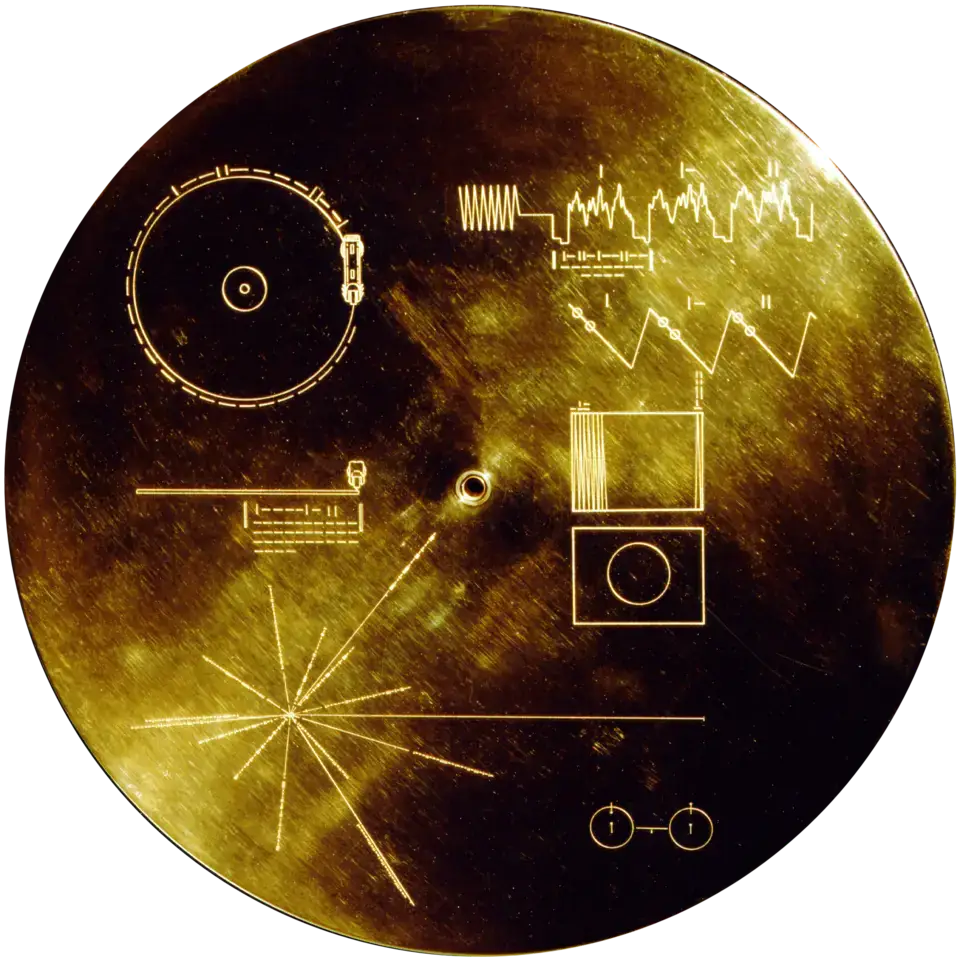
The cover that travels with each Golden Record, etched with instructions for playing it and a map to find the Sun. Image: NASA/JPL.
The cover is the instruction manual. It’s etched with a drawing of the record and its stylus. Beside them are the wave shapes a finder would need to turn the signal into pictures. A starburst of lines maps 14 pulsars, spinning stars that each flash at their own steady rate; together they pin down the Sun’s place in the galaxy. Two small circles at the bottom show a hydrogen atom flipping from one state to another. That flip is the clock that sets every time and length on the cover.
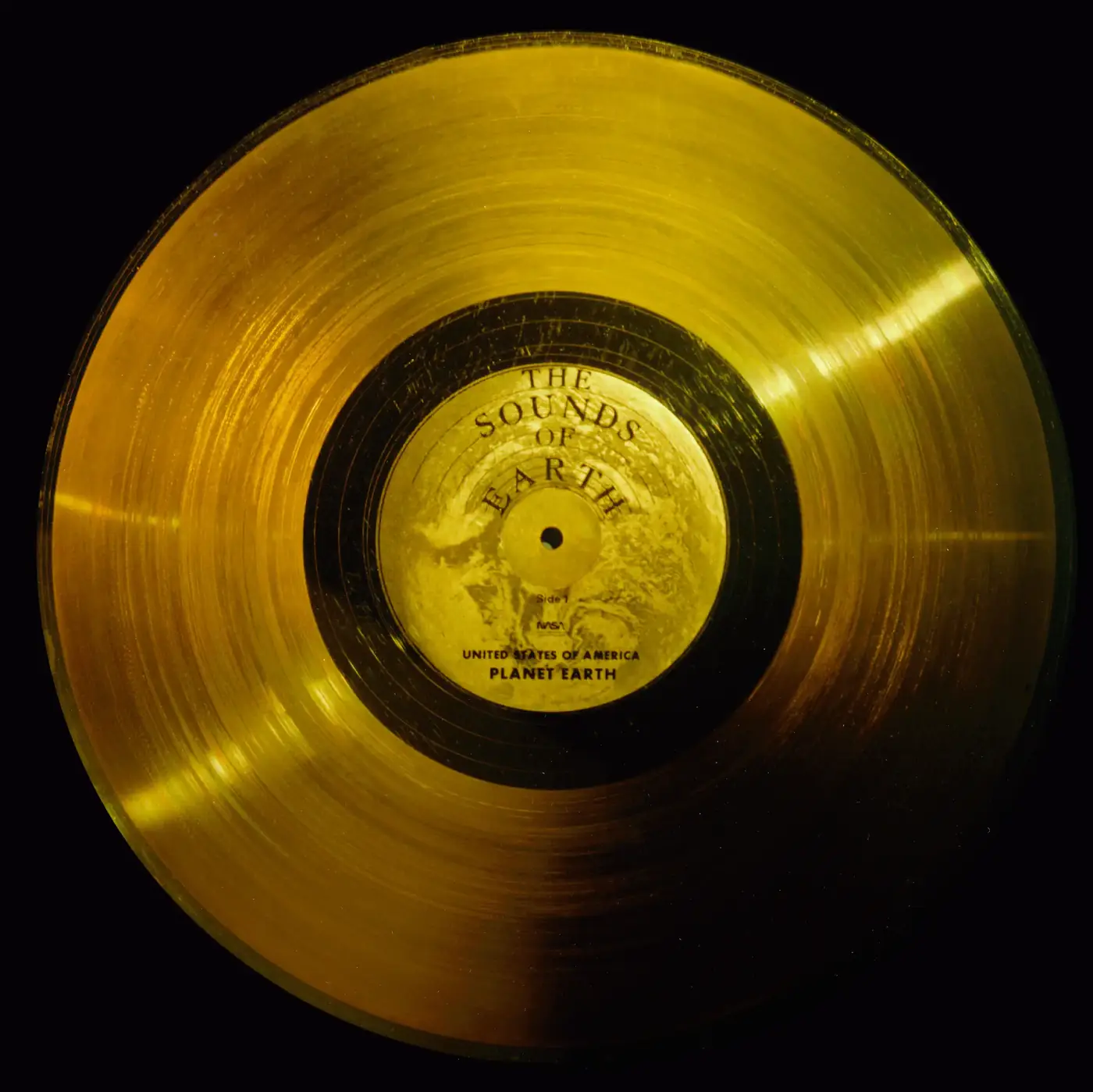
The record itself: side one of The Sounds of Earth, gold-plated copper. Image: NASA/JPL.
Nobody expects a reply. Voyager 1 is one small object in a very big dark, and the chance that anyone finds it is tiny. I’ve always read the record as a message to ourselves as much as to anyone else: a list, made in 1977, of what we thought was worth keeping.
Is Voyager 1 still working?
Yes, though it’s running on very little. Its power comes from three generators that turn the heat of decaying plutonium into electricity. At launch each one made about 158 watts. Every year they give about 4 watts less.6NASA. (n.d.). Frequently Asked Questions. NASA Science, Voyager. https://science.nasa.gov/mission/voyager/frequently-asked-questions/ So for years the team has been switching things off one at a time: heaters first, then whole instruments.
Two science instruments are still running. One is a magnetometer, which measures magnetic fields. The other is a plasma wave instrument, which picks up the faint electric hum of the gas between the stars. That instrument is how scientists proved Voyager 1 had left the Sun’s bubble. A burst of gas thrown out by the Sun caught up with the spacecraft and set the gas around it ringing. The pitch of the ringing showed the gas was far denser than anything inside the bubble. In early September 2026 engineers switched off three devices that help keep the spacecraft warm and turned on three lower-power ones in their place, to keep those two going longer.
It does all this with six computers that share 69,632 bytes of memory between them. That’s smaller than the last selfie you took.
In October it gave the team a fright. On 18 and 19 October NASA’s Deep Space Network listened for Voyager 1 twice, 24 hours apart. Both times it heard nothing. On 20 October the signal came back. One group of thrusters had gone offline and its backups had switched on by themselves. Kareem Badaruddin, the mission manager, said it was the first time they’d seen the spacecraft do anything like it, adding that “we are also at a point in the mission where we have to expect the unexpected.” By mid November NASA still hadn’t said what caused it. At this distance even asking the spacecraft a question takes two days.
Has Voyager 1 left the solar system?
Not yet, whatever the headlines say. On 25 August 2012 Voyager 1 crossed the edge of the heliosphere and became the first spacecraft in interstellar space. The heliosphere is the bubble of charged gas that the Sun blows around itself. That’s a real boundary, but it isn’t the edge of the solar system.
Far beyond the bubble lies the Oort Cloud, a vast shell of icy bodies that still belongs to the Sun. NASA says Voyager 1 will need about 300 years to reach its inner edge and possibly about 30,000 years to fly beyond it.7NASA/JPL-Caltech. (2018). Oort Cloud and Scale of the Solar System Infographic. NASA Science. https://science.nasa.gov/resource/oort-cloud-and-scale-of-the-solar-system-infographic/ Nobody has measured where the Oort Cloud ends, which is why the second number comes with a “possibly”.
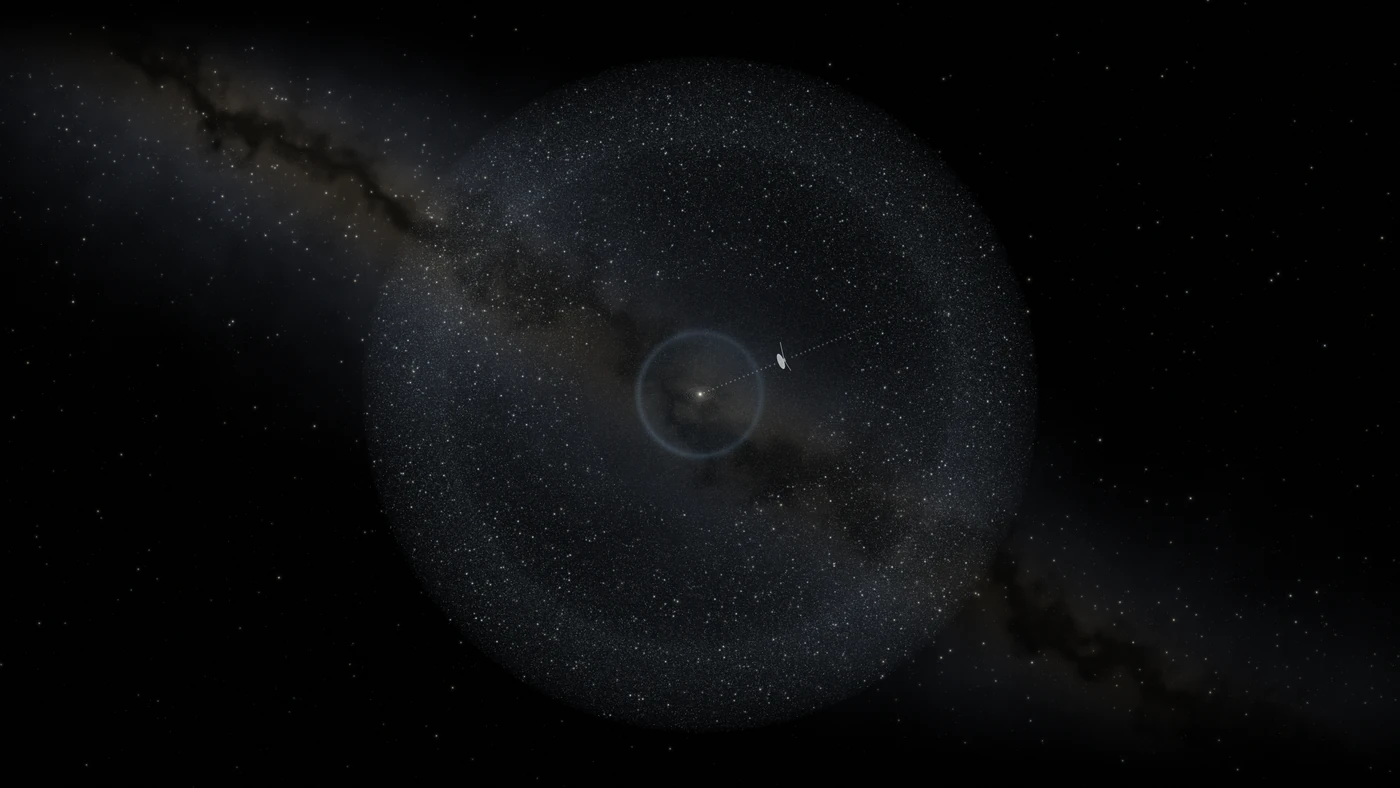
Voyager 1 has left the Sun’s bubble, but the Oort Cloud’s icy shell is still far ahead. NASA says reaching its inner edge will take about 300 years, and crossing it possibly 30,000. Not to scale. Graphic: Seriously Scientific.
The light-day it passes this week is a small step on that road. At about 61,000 km/h, Voyager 1 needs roughly 48 years to add one more.
How can you follow Voyager 1 from here?
Our Voyager page tracks it live. It shows the distance growing by the second and how long a signal now takes to get there. It also maps the routes both spacecraft took past the planets. Its record player holds all 55 greetings and the record’s 21 sounds of Earth, so you can hear for yourself what Voyager 1 is carrying out of the solar system.
The player covers the greetings and sounds. For the music as well, all 27 pieces, our full soundtrack video plays the whole record from start to finish, with every musician credited:
Voyager 1 was built for a trip to Jupiter and Saturn. Forty-nine years later, it’s still sending back readings from a place nobody has ever been, a full day away at the speed of light. It still has a gold record on its side, in case anyone out there wants to know who sent it.