Something is holding the galaxies together, and it isn’t the stars. Add up everything we can see in a spiral galaxy, every star and every cloud of gas, then work out how much gravity it all makes. The sum comes up short. The outer edges whirl so fast they should have flung themselves apart billions of years ago. They’re still there. Something invisible has hold of them, and physics has spent ninety years hunting a dark matter signal that would finally say what it is.

Messier 61, over 50 million light years away in the Virgo Cluster. Galaxies like this one spin too fast for the matter we can see to hold them together. Credit: ESO.
Astronomers named that something dark matter early on. The evidence has piled up from every direction since, from the way galaxies spin to the way whole clusters of them bend the light passing through. All of it says the same thing. Roughly five sixths of the matter in the universe is stuff we cannot see.
In all that time, nobody has ever caught a single particle of it.
That’s what makes one flash of light, recorded on a Friday evening in June 2023 in a tank of liquid xenon nearly a mile beneath South Dakota, worth a careful look. It has the shape of a dark matter signal. The team that found it has spent two years trying to explain it away, and they can’t.
What exactly did the detector see?
On 16 June 2023, at 21:22:39 in the evening, the LUX-ZEPLIN detector recorded a single event that looks like a xenon nucleus being knocked sideways by something that left no other trace.
The energy of that knock was about 248 thousand electronvolts. If you’d like a sense of scale, that’s roughly the energy a single mosquito uses to flap its wings once, delivered to one atom. The number matters because of where it sits. The team had opened up a window of energies they’d never searched in this data before, running up to about 270 thousand electronvolts, and in that window almost nothing should ever appear. The detector is built to be the quietest place on Earth. One event turned up anyway, in the part of the plot where a dark matter particle ought to leave its mark.
The collaboration is 250 scientists and engineers across 39 institutions, and their own spokesperson, Professor Rick Gaitskell of Brown University, put it plainly: “We are not claiming to have seen dark matter.”1Berkeley Lab. (2026). LZ Sees Surprising Result in Search for Dark Matter. Lawrence Berkeley National Laboratory. https://newscenter.lbl.gov/2026/09/01/lz-sees-surprising-result-in-search-for-dark-matter/ They’ve shared it because they’d like the rest of physics to pick it apart.
Why build a dark matter trap a mile underground?
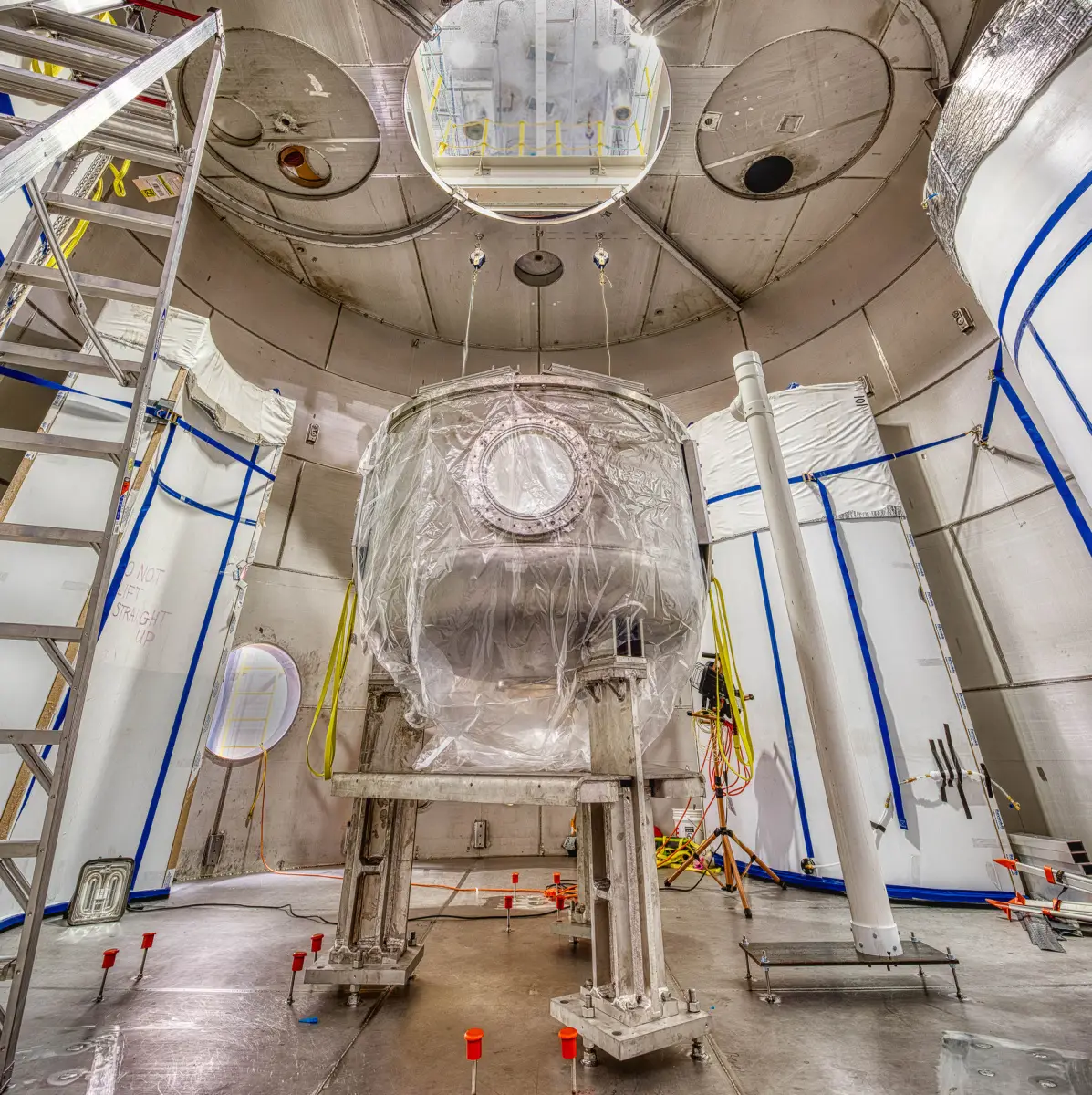
Inside the water tank in the Davis Cavern, nearly a mile below the surface. The wrapped cryostat stands at the centre, ringed by the white veto tanks that watch for stray neutrons. Photo courtesy of the LZ Collaboration, Sanford Underground Research Facility.
Space is full of things that look like dark matter if you aren’t careful. Cosmic rays rain down constantly; the rocks around you are faintly radioactive; so, slightly, are you. Any of it can nudge an atom and leave a signal that a hopeful physicist might misread.
So you go down. The experiment sits in an old gold mine at the Sanford Underground Research Facility in Lead, South Dakota, with about 1,500 metres of rock overhead.2Sanford Underground Research Facility. (2026). About SURF. South Dakota Science and Technology Authority. https://sanfordlab.org/ That rock is a filter. It stops nearly everything raining in from the sky while leaving dark matter, which barely notices solid rock, to sail straight through.
Then you keep going. The xenon sits inside a vessel, which sits inside a tank holding 17 tonnes of special liquid that lights up when a neutron passes, which sits inside 228 tonnes of ultra-pure water. Each layer is there to catch the things the layer outside it missed. The British science agency that helps fund the experiment describes the whole arrangement as a search for the rarest events in the universe, which is about right.3Science and Technology Facilities Council. (2026). New Result from the LUX-ZEPLIN Experiment. UK Research and Innovation. https://www.ppd.stfc.ac.uk/news/new-result-from-the-lux-zeplin-experiment/
How do you see something invisible?
Picture a snooker table in a completely dark room. You can’t see the cue ball at all. You can see the reds, just about. If a red suddenly rolls across the baize for no visible reason, you know something came through and clipped it. From the direction the red takes and the speed it carries, you can work out a surprising amount about the thing you never saw.
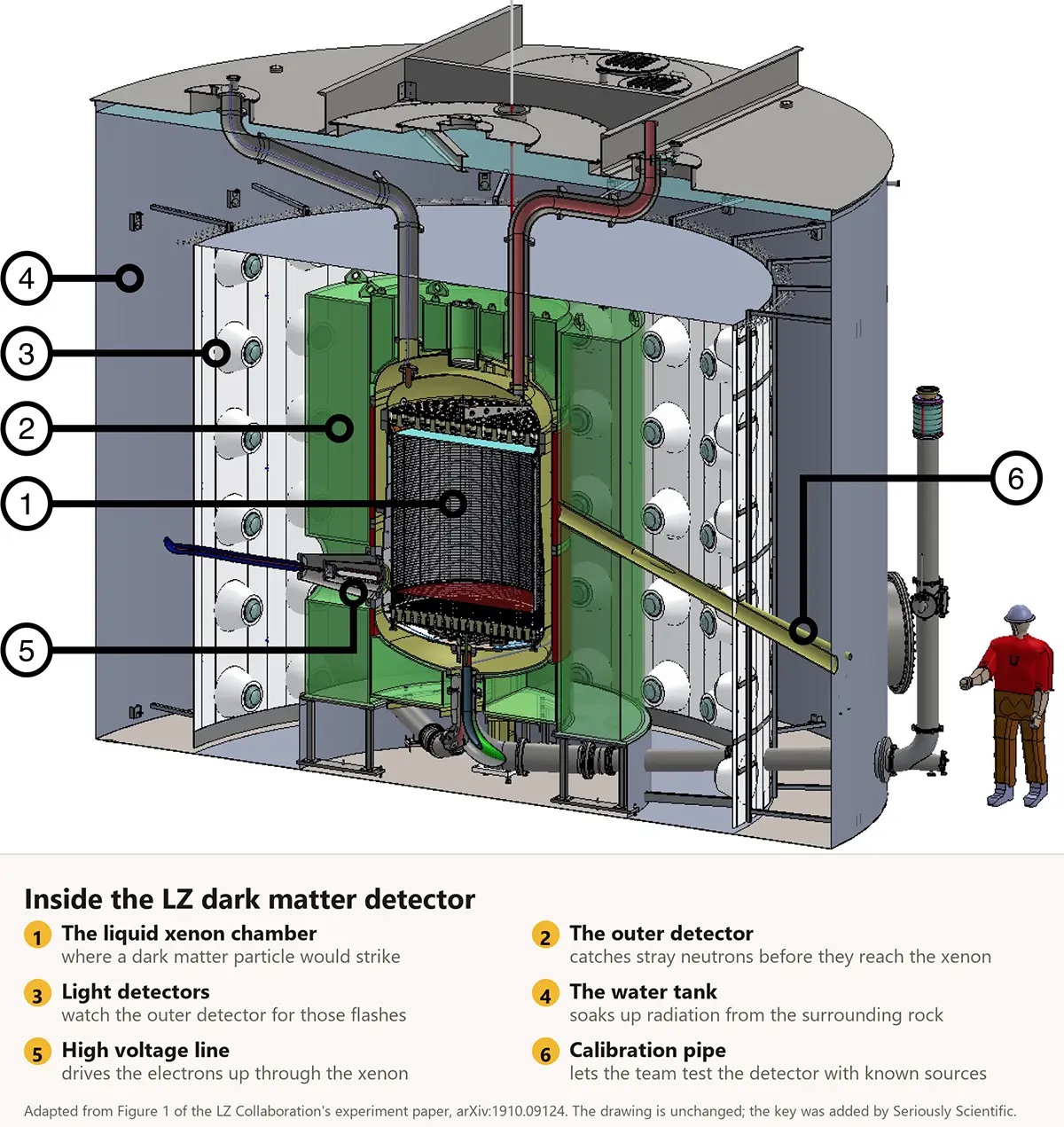
The nested layers of the LZ experiment, with the xenon chamber at the centre. The figure on the right is a person, for scale. Adapted from Figure 1 of the LZ Collaboration’s experiment paper; the drawing is unchanged and the key was added by Seriously Scientific.
The xenon nucleus is the red. A dark matter particle is the cue ball. Xenon is a good choice for this because its nucleus is heavy, so a glancing blow still shifts it, and because liquid xenon does something obliging when any of its atoms gets disturbed: it gives off a flash of light.
That flash is the first signal. The knock also tears a few electrons loose, and those are pulled upwards through the liquid by an electric field until they reach the gas at the top, where they make a second, brighter flash. Seven tonnes of xenon sit between two arrays of light detectors, top and bottom, waiting for both.
How does the tank know where the flash happened?
The gap between the two flashes is the clever part. Electrons take time to drift, so a long gap means the event happened deep in the tank and a short gap means it happened near the top. You already know this trick: count the seconds between a lightning flash and the thunder, and you know how far away the storm is. The team can place an event inside the tank to within a few centimetres, which is how they can throw away anything that happened near the walls where the radioactive dirt lives.
The two flashes do one more job. Their relative brightness tells you what kind of particle you’re dealing with. An electron knocked loose gives a different ratio than a whole nucleus shoved sideways, and only the second one looks like dark matter. The June event looked like a nucleus.
How do you know it wasn’t just a stray neutron?
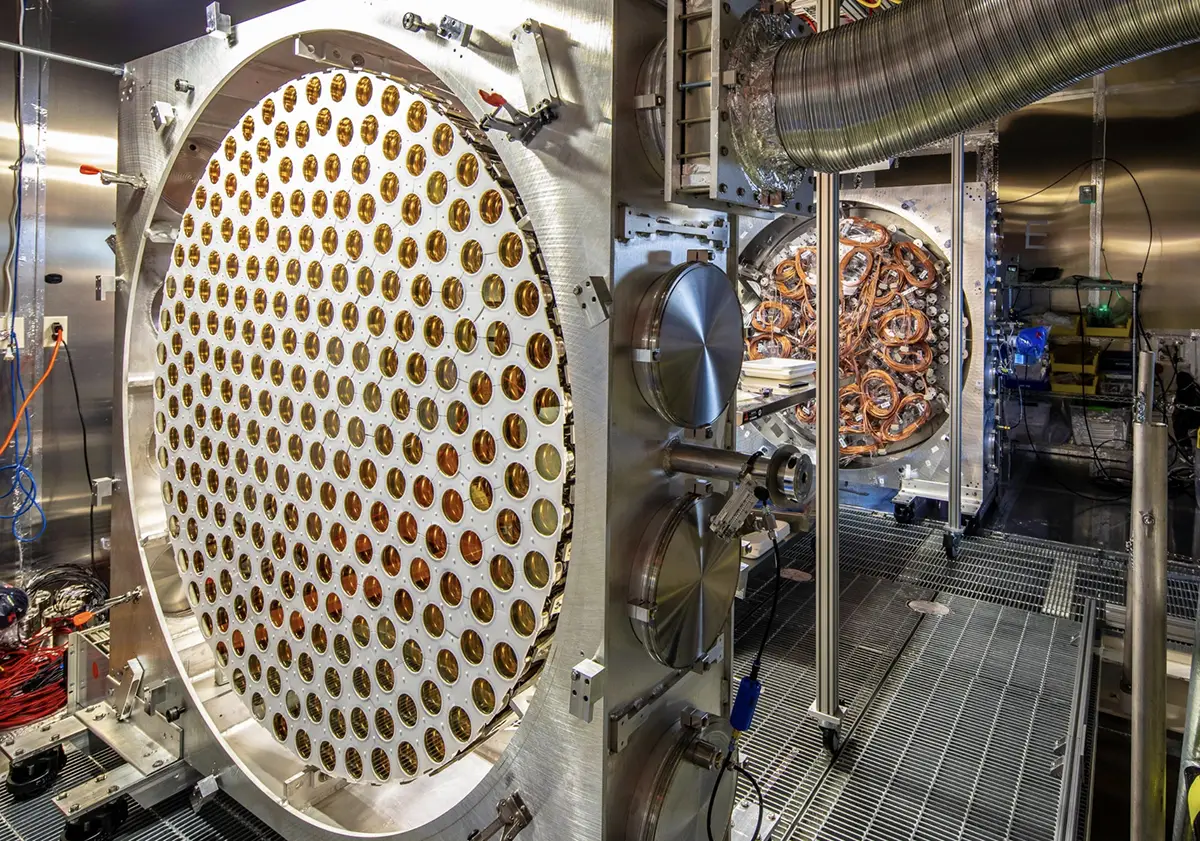
Hundreds of photomultiplier tubes face the xenon, ready to catch a single flash of light. Photo by Matthew Kapust, Sanford Underground Research Facility.
This is the right question, and it’s the one the team spent most of their two years on. A neutron is the obvious impostor, because a neutron shoves a nucleus in exactly the way a dark matter particle would, leaving behind what reads as a dark matter signal.
They went through the possibilities one at a time. Neutrons from radioactive decay in the detector’s own materials: the outer tank catches 92 per cent of those, and the ones it misses tend to hit more than one atom, leaving a tell-tale double track. Neutrons from cosmic ray muons: the nearest muon passed 41 minutes before the event, which is far too long. Neutrons from spontaneous fission. Neutrinos from the atmosphere, which do scatter off nuclei, but produce a spectrum that falls away sharply with energy and wouldn’t put an event out at 248. Two accidental flashes landing close enough together to look like one event. Rare decay routes of xenon isotopes that mimic the signature.
None of them fits. The detector was behaving normally that evening, and a calibration source that had been in the detector earlier in the day had been removed 25 minutes before, on the opposite side of the tank.
There’s one honest gap in the list. The team has a trick for tagging decays of a particular lead isotope, and on that evening the detector was in a state where the trick couldn’t be applied. They say so in the paper rather than leaving it out.
What does 2.6 sigma actually mean?
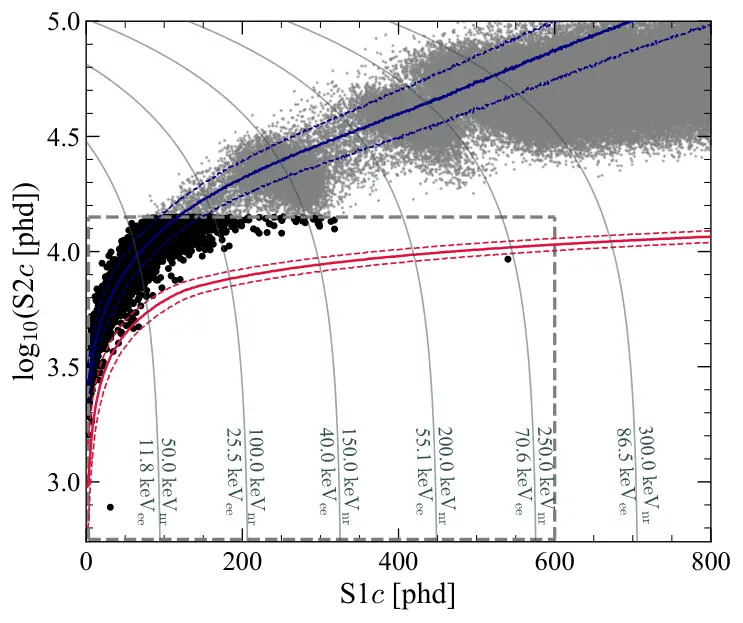
Every dot is an event the detector recorded. The one sitting on its own, away from the crowd, is the candidate. Figure 4 from the LZ Collaboration’s paper, used under CC BY-NC-SA 4.0.
Physicists measure surprise in sigma. One event in a quiet region is worth about 2.6 of them, which works out at roughly a one in two hundred chance that the known backgrounds produced it by themselves.
One in two hundred sounds convincing. For a dark matter signal, in particle physics, it isn’t close. The bar for announcing a discovery is five sigma, about one in three and a half million, and the reason the bar sits that high is a lesson the field learned painfully. Promising bumps at three sigma have a long history of melting away when more data arrives.
There’s a subtlety here worth understanding, because it’s where a lot of science goes wrong and this paper gets it right. The team tested their single event against a long list of possible dark matter models. Against the best-matching one it scores 3.4 sigma, which is more impressive. Try enough different descriptions of anything and one of them will fit well by luck alone; it’s the same reason a fortune teller who makes forty guesses will land one. So the team corrected for how many models they’d tried, and the corrected figure, the one they lead with, is the smaller 2.6.
Reporting the smaller number when the bigger one was available tells you something about how this collaboration works.
Why did the team admit their own test failed?
Before any of the analysis began, the team salted their own data. Fake signals, generated by a computer, were slipped into the real dataset so that nobody doing the analysis could know which events were genuine. You decide all your rules while you’re blindfolded, then take the blindfold off. It’s one of the best defences science has against seeing what you want to see.
Theirs didn’t work properly. The fake signals had been generated from a model built before one of the calibrations was finished, and they clustered at the wrong energies, leaving the high-energy region where the real event turned up effectively uncovered.
The team could have glossed over this. Instead the paper states that the analysis should be considered non-blind, which is the most damaging sentence in it, written by the people it damages. They also point out that their selection rules and statistical model were locked down before the fakes were revealed, so the central protection held even though the blindfold slipped.
What would it be, if it’s real?
The favourite candidate for dark matter has long been a WIMP, a weakly interacting massive particle. Heavy, slow and almost completely antisocial, passing through the Earth without noticing.
If the June event was a WIMP, it was a hefty one: at least 200 times the mass of a proton. It would also have to interact with ordinary matter in a way the simplest versions of the theory don’t predict, which is partly why this search went looking at higher energies in the first place.
Physicists responded the way physicists do. More than thirty papers appeared on the preprint server within a month, each offering a different theory that could produce exactly this event. That’s a measure of appetite rather than evidence.
So has dark matter been found?
No. One event isn’t a discovery, and everyone involved says so first and loudest.
What makes this worth your attention isn’t the strength of the signal; it’s the quality of the work around it. The team published their full dataset so that anyone can check the arithmetic.4LZ Collaboration. (2026). Data release for the extended nuclear recoil energy window search. HEPData. https://doi.org/10.17182/hepdata.182472.v1 They reported the unflattering number rather than the exciting one, and they documented their own failed safeguard. The same collaboration published a much larger search in December 2025 covering 417 days of data and found nothing at all, and they published that too.5LZ Collaboration. (2025). Searches for Light Dark Matter and Evidence of Coherent Elastic Neutrino-Nucleus Scattering. arXiv. https://arxiv.org/abs/2512.08065 A group hunting for headlines doesn’t behave like that.
The detector has been running under the same conditions since April 2024, so the answer is already being collected. If a real dark matter signal is behind this, more events will turn up and it will grow. If it was a fluke, it’ll stay stubbornly at one and quietly fade. Other experiments using different materials will look in the same place, which is the only kind of confirmation that really counts.
For now there’s one flash in a xenon tank under a mountain of South Dakota rock, and a group of physicists refusing to call it what they hope it is.