
Over the past five years, the landscape of obesity and diabetes treatment has undergone a complete transformation. Medications sold under the brand names Ozempic, Wegovy, Mounjaro, and Zepbound have dominated health news and clinical discussions alike. These drugs belong to a class of medications known as GLP-1 receptor agonists; they’ve proven remarkably effective at helping patients manage their blood sugar levels and achieve substantial weight loss.
The medical community is beginning to highlight a significant and silent catch. These medications work primarily by mimicking a naturally occurring hormone that signals to the brain that the stomach is full, thereby drastically suppressing a patient’s appetite. When you consume significantly fewer calories, your body is forced to tap into its internal reserves to find the energy it needs to function daily. The human body isn’t particularly selective about where it sources this backup energy from. Alongside breaking down fat stores, the body often begins breaking down muscle tissue to harvest amino acids for fuel.
This loss of lean muscle mass, clinically related to a condition called sarcopenia, can be highly detrimental. Muscle is completely essential for maintaining a healthy metabolic rate, supporting joint stability, and ensuring long-term mobility. Researchers have calculated that when GLP-1 medications cause rapid weight loss, some patients lose up to 20 percent of their lean mass alongside the fat 1Endocrinology and Metabolism, 2019. Physical weakness, a slower basal metabolism, and a body that’s far more difficult to maintain at a lower weight over time are all direct consequences of this muscle degradation. Drastically reduced food intake can also lead to severe nutritional deficiencies and highly uncomfortable gastrointestinal side effects like persistent nausea.
The scientific community has been searching for a solution to this problem for years. They need a pharmacological way to learn how to burn fat without losing muscle directly. Recently, a team of researchers at the University of California, Berkeley, uncovered a highly promising new approach. Instead of focusing on the energy intake side of the equation, they turned their attention to the energy expenditure side. They’ve identified an experimental compound that effectively turns up the body’s internal energy output.
What is the core biological finding here?

A coloured scanning electron micrograph (SEM) showing fat cells surrounded by fine strands of supportive connective tissue. Image credit: STEVE GSCHMEISSNER/Getty
To understand the magnitude of this discovery, we must first look at the basic biology of human metabolism and energy homeostasis. Body weight essentially responds to two primary levers. The first lever is energy intake, which equates to the exact amount of calories we consume through our daily diet. The second lever is energy expenditure, which equates to the calories our bodies burn to maintain basal metabolic functions and to fuel physical activity.
Current GLP-1 medications pull almost exclusively on the first lever. They trick the central nervous system into feeling satiated, meaning the patient simply eats less food. The Berkeley team, led by Professor Anders Näär, decided to go aggressively after the second lever. They published their groundbreaking findings in the journal Science Advances, detailing how a specific molecular compound called 5-tetradecyloxy-2-furoic acid can fundamentally alter how the body handles its stored energy reserves. To make the reading easier, we’ll refer to it simply as TOFA from now on.
In comprehensive laboratory experiments using mouse models, the researchers administered TOFA to obese mice over a set trial period. The physiological results were striking. The mice treated with the compound experienced significant fat loss but showed absolutely no measurable reduction in their lean muscle mass 2UC Berkeley News, 2026. These animals didn’t exhibit any changes in their daily physical activity, nor did their internal body temperatures rise to account for the energy burn. Their cellular energy use increased by up to 18 percent compared to the control group.
This means the compound successfully commanded the cells to increase their baseline metabolic rate independently of outside stimuli. The cells began demanding more fuel to sustain this newly elevated metabolic state, and they specifically targeted lipid reserves to meet this new demand. By targeting the lipids directly, the body entirely bypassed the biological need to break down muscle proteins for energy.
How does the warehouse analogy explain TOFA?

Metabolic management: Think of your body as an industrial storage facility where molecules decide which energy reserves to process.
Let’s break down the highly complex cellular signalling pathways into a simpler, more visual concept. Imagine your body is a massive industrial warehouse designed specifically for storing heavy boxes of coal, which represent your fat reserves. When you eat food, delivery lorries arrive at the warehouse loading bay, dropping off more boxes of coal. Your warehouse workers then pack this coal away onto the storage pallets, stacking them high into the rafters.
Current weight loss drugs act like strict security guards stationed at the warehouse gates. They turn the delivery lorries away, physically stopping new fuel from arriving at the facility. Because the warehouse still needs to power its internal lighting and computer systems, the workers eventually have to start unpacking the stored coal to burn it for energy. Because they’re completely starved of new resources and panicking, they might also start dismantling the wooden pallets and the warehouse shelving itself just to keep the lights on. This destructive dismantling of the structural shelving represents the loss of lean muscle mass in the human body.
TOFA operates using a completely different, highly targeted strategy. Think of the TOFA molecules as newly appointed warehouse supervisors patrolling the warehouse floor. They perform two distinct, simultaneous jobs.
First, the supervisor actively stops the workers from packing any new coal into boxes. In biological terms, TOFA acts as an ACC inhibitor. ACC stands for Acetyl-CoA carboxylase, which is an enzyme absolutely crucial for the production of new lipids in the body. By chemically inhibiting this enzyme, TOFA effectively blocks a process called lipogenesis, meaning the body completely stops synthesising new fat.
Second, the supervisor walks over to the warehouse’s central heating boiler, turns the thermostat up to maximum capacity, and orders the workers to start shovelling the existing pallets of coal directly into the fire. In the human body, TOFA achieves this by activating two specific, highly potent cellular receptors known as PPARα and PPARδ.
What is the science behind these PPAR receptors?
For students studying advanced biology or biochemistry, the specific action of these cellular receptors is a fascinating look into genetic transcription. PPAR stands for Peroxisome proliferator-activated receptor. These are a highly specialised group of nuclear receptor proteins that function as transcription factors. When activated by a compound like TOFA, they bind to specific DNA sequences within the cell nucleus and regulate the precise expression of genes involved in energy homeostasis and cellular metabolism 3Nature Reviews Nephrology, 2021.
PPARα is expressed predominantly in the liver, heart, and skeletal muscles, and it mediates its functions by influencing fatty acid transport and oxidation. Experimental evidence shows that PPARα is the master regulator of hepatic beta-oxidation, which is the biological process of breaking down fatty acids inside the liver to generate usable energy. Meanwhile, PPARδ is ubiquitously expressed throughout the entire body and acts as a widespread, highly active regulator of both fat burning and glucose homeostasis, particularly within skeletal muscle tissue 4Clinical and Molecular Hepatology, 2014.
By effectively activating both PPARα and PPARδ at the exact same time, TOFA acts as a powerful genetic switch. It turns on the specific genes that instruct cells to take up circulating fats from the bloodstream and burn them for energy. TOFA isn’t merely a roadblock stopping new fat production. It’s an active metabolic catalyst forcing the body to metabolise the excess fat it has already stored away.
This dual mechanism is exactly why the compound is so incredibly unique in the pharmacological landscape. The base molecule was actually first discovered back in the 1970s. Over the later decades, massive pharmaceutical companies spent millions developing various ACC inhibitors to treat metabolic diseases. Several of these older compounds even reached mid-stage clinical trials. They consistently failed and were never granted regulatory approval because they caused a highly dangerous, unwanted side effect. They caused a massive increase in the levels of triglycerides in the blood, which significantly raised the risk of ischaemic heart disease and cardiovascular failure. Because of this, the entire field of ACC inhibitor study essentially came to a complete standstill.
The UC Berkeley team discovered that TOFA behaves entirely differently from those older, failed ACC inhibitors. Because TOFA simultaneously activates the specific PPAR receptors that burn fat, the body effectively clears out the dangerous lipids before they can ever accumulate in the bloodstream. The metabolic response is highly coordinated on a cellular level, allowing the body to handle excess lipids and glucose safely without triggering the cardiovascular risks that doomed earlier drugs.
What do the laboratory findings reveal about drug synergy?

Combining TOFA with existing GLP-1 medications yielded even stronger metabolic results in laboratory tests.
The extensive laboratory results published in Science Advances highlight just how effective this coordinated metabolic response can be. The obese mice treated with TOFA didn’t just lose weight. They demonstrated vastly improved insulin sensitivity, which is a critical factor in managing and potentially reversing type 2 diabetes. Their overall glucose control improved dramatically, their triglyceride levels dropped safely into normal ranges, and they showed heavily reduced signs of fatty liver disease.
The research team also conducted an incredibly important follow-up experiment to prove the unique nature of the compound. They wanted to know if they could replicate TOFA’s success by simply giving the mice two separate drugs in combination. They used one standard pharmacological drug to block lipid production and a separate, entirely different drug to increase energy use. The results showed that this two-drug combination was nowhere near as effective at regulating metabolism as TOFA on its own. This discovery suggests something significant for future medicine. Rather than two separate effects occurring simultaneously in isolation, TOFA’s actions function as an integrated, holistic metabolic response that’s incredibly hard to replicate artificially with a cocktail of other drugs.
Perhaps the most exciting phase of the entire study involved testing TOFA alongside the current gold standard treatments on the market today. The scientists paired TOFA with existing GLP-1 medications, including semaglutide and tirzepatide.
When combined, the results were extraordinary. The combination therapy produced significantly larger improvements in body weight, glucose control, insulin levels, and blood triglycerides than either treatment could possibly produce in isolation 5ScienceDaily, 2026. The lead researchers noted that TOFA worked both additively and synergistically with the appetite-suppressing drugs. Given the massive, multi-billion dollar size of the global GLP-1 market, a compound that improves rather than replaces those medications has a highly promising future.
What is the path forward for this research?
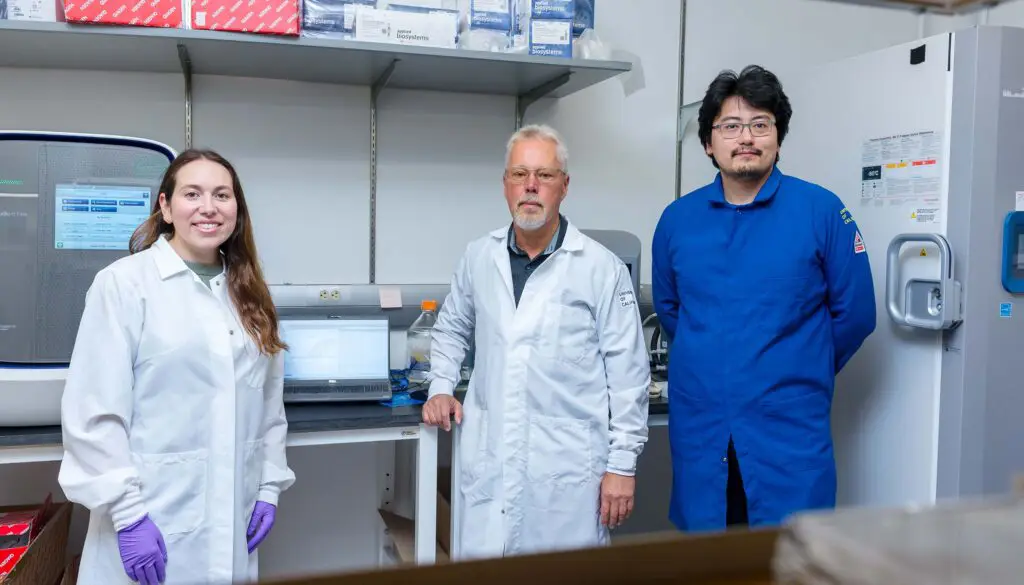
Graduate student Rachelle Stark (left), Professor Anders Näär, and postdoctoral fellow Chu Zhu in the UC Berkeley lab. Image credit: Mathew Burciaga/UC Berkeley
While the data paints a highly optimistic picture for the future of obesity and diabetes management, we must temper public expectations with scientific reality. Up to this point, human testing hasn’t yet been done on any of this, and that represents a significant medical gap. The biological pathways and metabolic systems of mice are remarkably similar to humans, which is why they’re used so frequently in laboratories, but they aren’t identical. There’s a long, highly documented history of promising medical outcomes from murine models that were never successfully translated to human medicine.
The safety profile, the correct human dosage, and the long-term efficacy of the compound in human subjects remain completely unknown. Moving a drug from a controlled laboratory setting into widespread public use requires passing through three incredibly strict phases of human clinical trials.
Phase I trials will require testing the drug on a small group of healthy human volunteers purely to evaluate safety, determine a safe dosage range, and identify any immediate side effects. If it passes that hurdle, Phase II will involve a larger group of patients who actually have the condition the drug aims to treat, allowing researchers to see if it is effective. Finally, Phase III involves large-scale testing across diverse populations to confirm its effectiveness, monitor side effects, and compare it to commonly used treatments.
The next critical step involves moving the compound out of the academic laboratory and into these rigorous clinical trials. To facilitate this massive financial and logistical undertaking, the core research team has founded a commercial spin-off company named ReRx Therapeutics. This venture is being heavily supported by Berkeley’s life sciences entrepreneurship ecosystem, including startup incubators like Nucleate and Berkeley SkyDeck. Typically, academic scientists don’t take the time and personal financial risk to start a startup company unless they’re highly confident in the robustness of their results and the viability of the intellectual property.
If these future trials are successful, we could be looking at a fundamental, generational shift in metabolic medicine. We may finally have a pharmacological tool that safely turns up the body’s internal furnace, helping patients shed dangerous visceral fat while keeping the skeletal muscle they desperately need for a healthy, active, and long life.