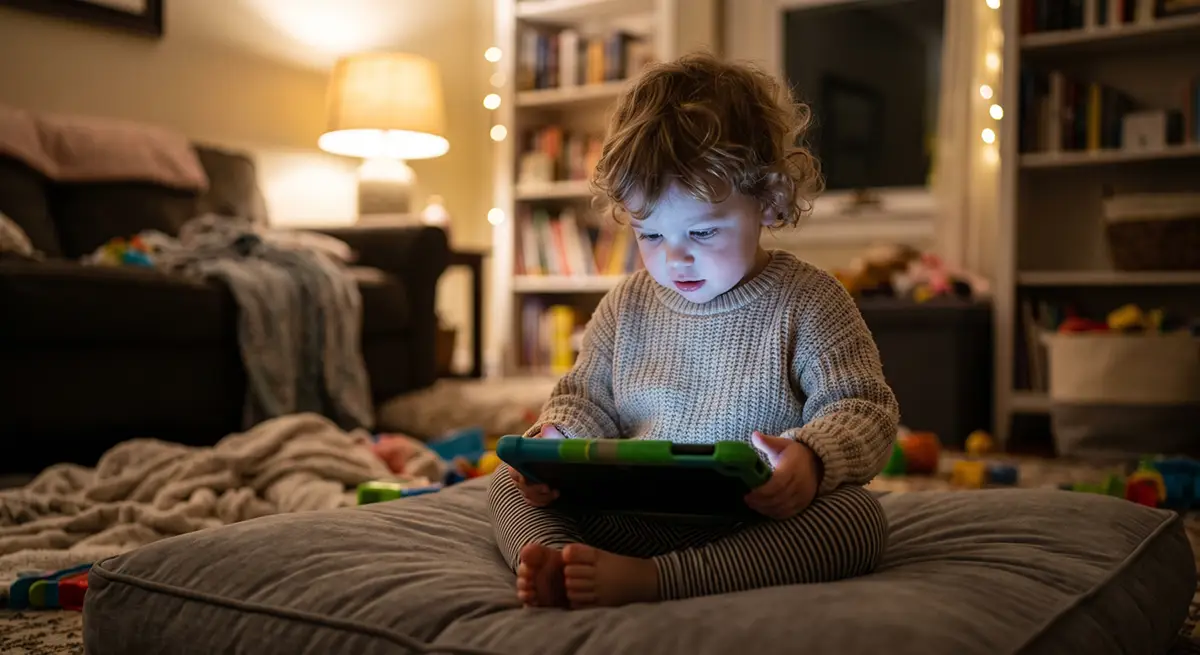
A one-year-old with a tablet is a common sight now. Many families hand a phone to a fussy infant without a second thought and most under-fives spend more time in front of a screen than the World Health Organization recommends.1World Health Organization. (2019). Guidelines on physical activity, sedentary behaviour and sleep for children under 5 years of age. World Health Organization. https://www.who.int/publications/i/item/9789241550536 We’ve known for a while that heavy screen use in early childhood links with weaker school performance later on. What we didn’t know was when the damage was really being done. Was it the toddler years? The primary school years? All of it, spread evenly? A new study out of Singapore followed 502 children from their first birthday to age ten and a half. The answer sharpens in a way nobody quite expected. Two ages seem to matter far more than the rest. One of them is twelve months.
What did they actually find?
At age nine, the children who had spent more time in front of screens as toddlers and infants were doing measurably worse at school. At age ten and a half, they scored worse on tests of working memory. Two windows in particular jumped out. Screen viewing at age one showed the strongest association with the poorer outcomes; screen viewing at age six showed the second-strongest. The years in between, roughly ages two to three, didn’t show a significant link at all. Total screen time across childhood also mattered, but the paper’s authors were clear that the age at which the heavy viewing happens looks more important than the raw total.
The paper appeared in the World Journal of Pediatrics in 2026. It draws on a decade of Singaporean data collected for other health research entirely.
Why did the researchers follow the same children for a decade?

Back-and-forth interaction, the kind screens can’t provide, is what the developing brain is built to expect.
Because a single snapshot can’t tell you when a habit does its work. Say you measure a nine-year-old’s reading level and ask their parents how much screen time the child has now. Even if you find a link, you’ve no idea whether the current screen time is the cause, whether it reflects a habit that started years ago, or whether both are being shaped by something else in the family’s life. A longitudinal cohort study fixes this by tracking the same people over time and taking measurements at fixed intervals.
The team used data from the Growing Up in Singapore Towards healthy Outcomes cohort, which the researchers call GUSTO for short. This cohort has been following Singaporean children since birth as part of broader health research. Parents reported their child’s average daily screen time at ages one, one and a half, two, three, six and eight. Years later, the same children sat academic tests at nine and had their working memory measured at ten and a half. The gap between exposure and outcome is what lets the researchers say something sensible about which time windows are worth worrying about.
What is working memory, and why test it at ten?
Working memory is the mental scratchpad you use to hold information in mind while doing something with it. Add two three-digit numbers in your head; follow a three-step instruction from a teacher; keep the start of a sentence in mind long enough to make sense of the end. Every one of those is working memory doing the work. Working memory is separate from long-term memory and from general intelligence, but it underpins pretty much everything a school demands: reading comprehension, mental arithmetic, following instructions, planning.
Testing it at ten and a half, rather than at four or five, matters for two reasons. First, working memory is easier to measure reliably in older children who can sit through a proper task without getting bored. Second, some effects of early experience take years to become visible. If screen time at age one is going to show up somewhere in a child’s cognition, working memory in late primary school is exactly where you’d expect to see it, because the brain systems supporting it have finished maturing enough by then to be tested cleanly.
Why do ages one and six matter more than the years in between?
This is the part of the finding that surprised the authors themselves. If screen time were simply bad across the board, you’d expect a smooth relationship: the more of it at every age, the worse the outcome. Instead, ages two and three came out roughly neutral, while ages one and six came out as the two strongest points.
Neuroscientists have a phrase for this: sensitive periods. At certain points in development, the brain is unusually open to being shaped by experience. What happens during a sensitive period leaves an imprint that later experience finds hard to overwrite. The clearest example is language. Babies learn to distinguish every sound in every human language for a few months, then narrow down to the ones they hear most. Miss the window and it never quite works the same way again.
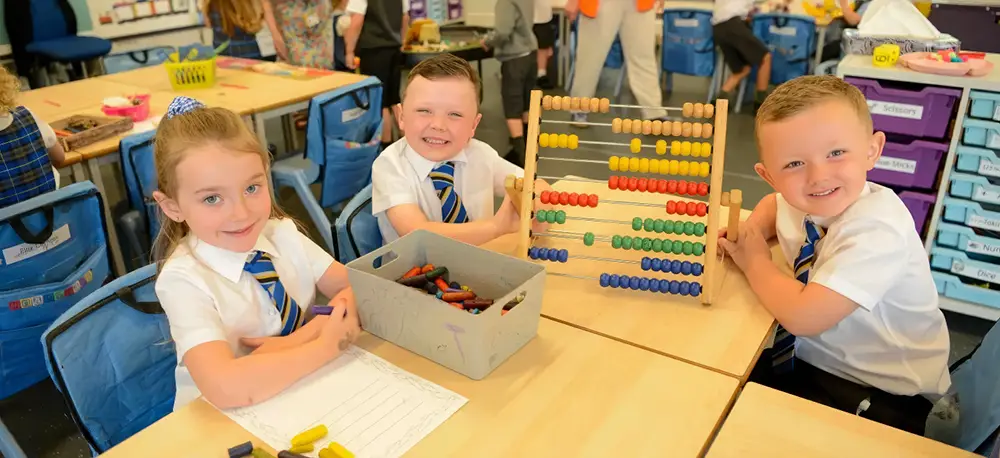
Age six lines up with the transition to formal school, the second of the two windows the study identified. Photo credit: Renfrewshire Council.
Age one lines up with a huge burst of activity in the developing brain, when connections between brain cells are forming at a rate they’ll never match again. Age six lines up with something different: the transition into formal school, when a child is suddenly asked to sit still, pay attention, follow instructions and hold information in mind for extended periods. Both are moments when the brain is doing something new and demanding, and both, on this evidence, are when heavy screen use seems to cost the most.
What is the brain doing at twelve months that a screen can’t do?
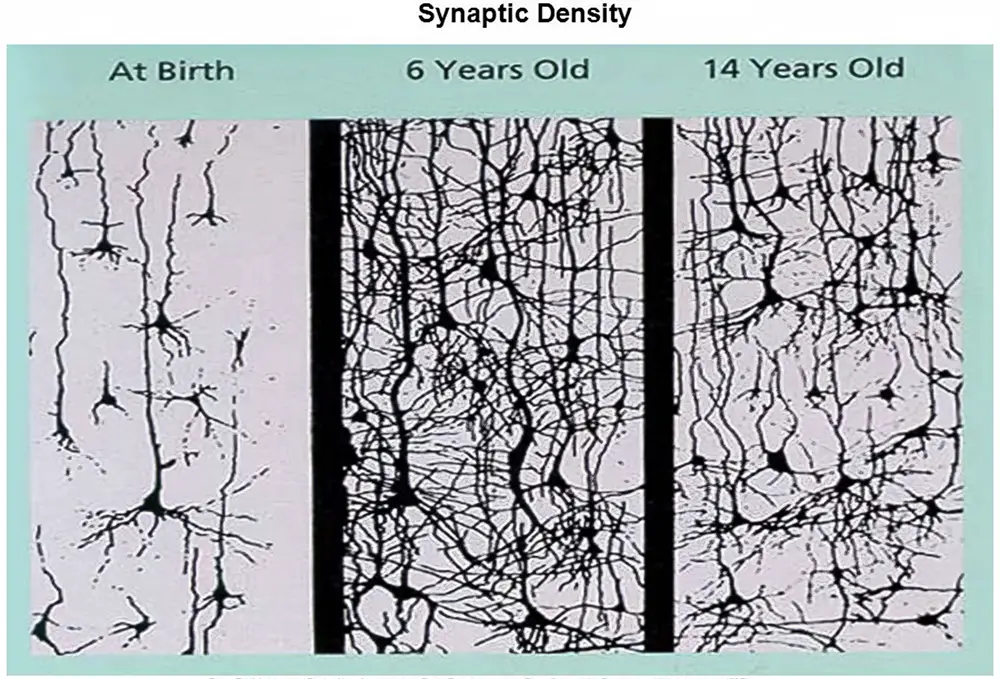
Synaptic density in the developing brain, showing the burst at age six and the pruning that follows into adolescence. Photo credit: Harry T. Chugani, CC BY 4.0.
Here’s where the wet cement analogy earns its place. In the first year of life, the infant brain is forming roughly a thousand new connections every second.2Tau, G. Z., & Peterson, B. S. (2010). Normal Development of Brain Circuits. Neuropsychopharmacology, 35(1), 147-168. https://pmc.ncbi.nlm.nih.gov/articles/PMC3055433/ At twelve months the human brain is closer to being fully mouldable than at any other point in life. The shape it takes depends on what presses into it during that narrow window. The child neurologist Peter Huttenlocher’s work in the 1970s and 1980s showed that synapse density peaks around this age, then gets slowly pruned back over childhood and adolescence. What survives is what gets used.
So what does the developing brain use? Interaction, specifically the back-and-forth kind it has with another person. A caregiver looks at the baby, the baby looks back. The baby babbles, the caregiver responds. The baby points at a bird, the caregiver names it. Researchers at Harvard’s Center on the Developing Child call this “serve and return”.3Center on the Developing Child at Harvard University. (2026). Serve and Return. Harvard University. https://developingchild.harvard.edu/key-concept/serve-and-return/ The developing brain is built to expect this specific type of input.
A screen can be many things, but it isn’t that. It moves, it makes sounds, it shows faces and colours, but it doesn’t respond to the individual baby watching it. When a one-year-old spends a large fraction of their waking time watching a screen, the wet cement is setting; it just isn’t taking the shape it was built to take. The building blocks that would have gone into the foundation of attention, memory and language are going into something the brain can’t do much with instead.
Does “linked to” mean “caused by”?
Not on its own, no. The authors of the paper are careful about this. What they found is an association, a statistical relationship between heavy screen use at particular ages and weaker outcomes later. Association isn’t proof of cause. Something else in a child’s life could be driving both. The two might just be travelling together.
The team tried to guard against this by adjusting for parental education, household income, birth weight and a handful of other family factors that might otherwise muddy the picture. The adjustment helps, but it doesn’t rule out everything. Parents themselves weren’t randomly assigned to give their children different amounts of screen time. No such trial would ever be ethical to run. The honest answer is that the paper strongly suggests a real effect, especially given the size of the association at age one. Its findings fit with what other lab-based studies show about the developing brain. But the study can’t prove causation on its own. The researchers say so.
One more caveat worth naming. Screen time was reported by the parents themselves, from memory, at each check-in. The reporting is imperfect, because parents tend to under-report and because the paper didn’t distinguish between different types of screen content. A video call with grandparents isn’t the same as a fast-cut cartoon. Neither is the same as a co-viewed programme with a caregiver naming what’s on screen. Those distinctions matter. Future studies will need to pick them apart.
What can a parent actually do about it?

Screen-free play is what the WHO and NHS both recommend for young children. Photo credit: Keiki blog.
Nothing about this research says a specific child is doomed by an hour on the tablet. The authors are clear on this: at the individual level, one extra hour of screen time a day probably won’t produce an obvious effect. What the research is pointing at is population scale. If millions of families cut their infants’ and six-year-olds’ screen time by a small amount, a meaningful number of children would end up doing better at school.
The World Health Organization’s guidance is simple, echoed in the UK government’s most recent evidence-informed advice for parents of under-fives.4Department for Education. (2026). Baby and toddler screen time guidance. Best Start in Life. https://beststartinlife.gov.uk/screen-time-under-5s/ Under 18 months: no screen time at all, except for video-chatting with family. Eighteen months to two years: only high-quality educational content watched together with a parent. Two to five years: an hour a day at most, less where possible. Most children, in most countries, get considerably more.
The practical steps, from the American Academy of Pediatrics and NHS guidance both, tend to be the same handful of things.5American Academy of Pediatrics Council on Communications and Media. (2016). Media and Young Minds. Pediatrics, 138(5): e20162591. https://publications.aap.org/pediatrics/article/138/5/e20162591/60503/Media-and-Young-Minds Don’t hand a screen to a fussy baby if you can help it; the reflex is understandable, and every parent has done it, but building the habit early is what creates the pattern. Keep screens out of the bedroom, out of mealtimes and out of the hour before sleep. Watch with your child rather than leaving them alone with a device, especially under five. When a screen does go on, treat it as one activity among many rather than as the default background.
The paper’s authors put it plainly: less is better. What their new finding adds is that when the “less” happens matters as much as how much less it is.