







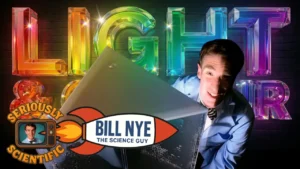








































Light & Colour
Did you know that white light is a mixture of all the colours of the rainbow? In this lesson, you will discover how prisms split light, why objects have colour, and what happens when light gets absorbed.
What Colour Is White Light?
Here is a question that stumped scientists for centuries: is white light one colour, or is it something else entirely?
A rainbow! White light is actually a mixture of every colour: red, orange, yellow, green, blue, indigo, and violet. Isaac Newton proved this in 1666 by splitting sunlight with a prism. Bill Nye the Science Guy calls this "the full spectrum of colours."
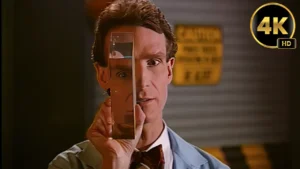
No! When Bill Nye tried to split a single colour with a second prism, nothing happened. The colour stayed the same. Each colour in the spectrum is pure. They cannot be broken down any further.
Put Your Instincts to the Test
Think about what you already know about light and colour. Pick an answer for each question, then see if your instincts were right.
The apple reflects red and absorbs the other colours. White light contains every colour. The chemicals in the apple's skin absorb most of those colours and only bounce red light back to your eyes. As Bill Nye the Science Guy says: "We don't see things, we see light bouncing off of things."
You get white light! Paint mixing is subtractive: each colour absorbs more light, so mixing them all gives you darkness. Light mixing is additive: you are adding wavelengths together, so mixing all colours gives you white. This is one of the most surprising facts in all of optics.
White keeps you cooler. Black clothing absorbs almost all wavelengths of light and converts that energy into heat. White clothing reflects almost all the light away, so less energy turns into heat. That is why people in hot climates traditionally wear light-coloured clothing.
Understanding Light and Colour
Tap each card to reveal the explanation.
Key Concepts
The Visible Spectrum
Tap to learn moreWhite light splits into ROY G. BIV: Red, Orange, Yellow, Green, Blue, Indigo, Violet. Each colour has a different wavelength. Red has the longest waves, and violet has the shortest. A prism bends each wavelength by a different amount, which is why they fan out into a rainbow.
Absorption and Reflection
Tap to learn moreEvery object absorbs some wavelengths of light and reflects others. The colour you see is the colour being reflected to your eyes. A red apple absorbs orange, yellow, green, blue, and violet, and bounces red back at you. A black object absorbs all colours. A white object reflects them all.
Light Becomes Heat
Tap to learn moreWhen light is absorbed, its energy does not vanish. It converts to heat. That is why black cars feel hotter in the sun than white ones. The black surface absorbs almost all the light energy, while the white surface bounces it away. This is also why solar panels are dark: they are designed to absorb as much light energy as possible.
Additive vs Subtractive
Tap to learn moreAdditive mixing (light): Red + Green + Blue = White. You are adding wavelengths together. TV screens and phone displays work this way, using tiny red, green, and blue dots that combine to make every colour you see. Subtractive mixing (paint and pigment): Red + Yellow + Blue = Brown or Black. Each pigment absorbs more light, so combining them all absorbs almost everything.
Light as Waves
Tap to learn moreLight travels in waves. Red light has long, slow waves. Blue and violet light have short, fast waves. The wavelength determines the colour. When light enters a soap bubble, some waves bounce off the inner surface and interfere with waves on the outer surface. That is why bubbles shimmer with rainbow colours.
Why Is the Sky Blue?
Tap to learn moreSunlight hits air molecules in the atmosphere. Blue light has short wavelengths, so it gets scattered (bounced around) much more than red light. That scattered blue light reaches your eyes from every direction, making the whole sky look blue. At sunset, the light travels through more atmosphere, scattering away the blue and leaving reds and oranges.
Why You See Colour at All
Tap to learn moreThe back of your eye, called the retina, contains millions of tiny detector cells. The colour-sensing ones are called cones, and there are three types: one tuned to red light, one to green, and one to blue. When yellow light hits your eye, your red and green cones both fire, and your brain reads that combination as yellow. Every colour you see is just a different mixture of signals from those three cone types.
Colour Blindness
Tap to learn moreAbout 1 in 12 men and 1 in 200 women are colour blind. The most common form is red-green colour blindness, where the red and green cones in the retina respond to almost the same wavelengths. This makes it hard to tell red from green, or to spot a red apple in green leaves. Colour blindness is usually inherited and cannot be cured, but special glasses can boost the contrast between red and green for some people.
Try It: What Colour Does It Look?
Pick an object and a light. Watch which colours of light bounce off it into your eye, and which it soaks up.
An object's colour is the light it bounces back. Try the yellow banana under blue light, or the white paper under red light: the object has not changed, only the light has.
Apply Your Knowledge
Now let us see if you can connect what you have learned to the real world.
Match the Object to Its Light Behaviour
Click an object to select it, then click the matching description to place it.
Real-World Challenge
Imagine you are designing the roof of a building in a hot desert climate. Based on what you have learned about light absorption and reflection, what colour would you paint the roof and why? Now imagine you are designing a solar-powered water heater. Would your answer change?
What Has Changed Since This Episode Aired
This episode of Bill Nye the Science Guy first aired in 1993. While the core science of light and colour remains accurate, here are a few things that have been refined or expanded since then.
Updated: Light is both a wave and a particle. This is called wave-particle duality. Scientists have confirmed through experiments that light behaves as a wave when it travels, but as a particle (called a photon) when it interacts with matter. Bill Nye the Science Guy simplified this for the episode, which was the right call for the target audience, but modern physics treats both descriptions as equally valid depending on the situation.
Updated: The basic explanation (Rayleigh scattering) is still correct. However, scientists now have much more detailed models of how aerosols, pollution, and wildfire smoke affect sky colour. Research since the 2000s has shown that climate change is subtly altering sky colours in some regions due to changes in atmospheric particulate matter. The fundamental physics has not changed, but our understanding of what modifies the effect has grown significantly.
Updated: In 1993, the dominant display technology was the CRT (cathode ray tube), which used electron beams hitting red, green, and blue phosphor dots. Today, LED, OLED, and MicroLED screens use entirely different methods to produce light, but they still rely on the same additive RGB principle that Bill Nye the Science Guy demonstrated. The physics has not changed, but the engineering has transformed dramatically. Modern OLED screens can display over a billion colours, far beyond what 1990s televisions could produce.
Test Your Understanding
Answer these questions and get instant feedback. How many can you get right?
Results
Your score:
Reflection
What surprised you most about how light and colour work? Can you think of an example from your everyday life where understanding absorption and reflection would be useful?
Episode Discussion
Share your thoughts on this Bill Nye The Science Guy episode