

















































Patterns
From the stripes on a zebra to the spiral of a seashell, the universe is filled with repeating shapes and sounds. In this lesson, we will explore how recognising patterns helps us predict the future, communicate with each other, and understand the world around us.
Can You Read Without Using Your Eyes?
They use their sense of touch! People who cannot see use a special pattern of raised dots called Braille. By feeling these small bumps, they can recognise the exact same letters and words that sighted people see on a page.
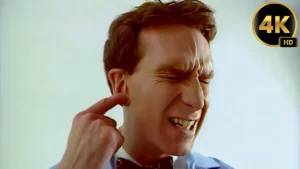
Spaces! Bill Nye the Science Guy demonstrates that without empty spaces between words or sounds, everything just blends together into a confusing blur of gibberish. To have a pattern, you must have spaces.
Put Your Instincts to the Test
Think about what you already know about the shapes and designs found in nature. Pick an answer for each question, then see if your instincts were right.
The stripes confuse predators by hiding their outline. This is a brilliant form of camouflage. When a herd of zebras runs together, their shifting pattern of stripes makes it incredibly hard for a lion to tell where one zebra starts and another ends.
A curving spiral. Spirals are nature's most efficient patterns. Bill Nye the Science Guy explains that by building its shell in an expanding spiral, the nautilus only has to build one single new wall to create a larger room for itself.
They all share the exact same pattern of bones! Despite looking completely different on the outside, humans, horses, and dinosaurs all have leg bones, rib bones, backbones, and skulls. This shared pattern is powerful evidence of evolution.
Understanding the Science
Tap each card to reveal the fascinating mechanics behind the patterns that build our world.
Key Concepts
What is a Pattern?
Tap to learn moreA pattern is anything that repeats in a predictable way. Patterns help humans organise information and make sense of a complicated world. Bill Nye the Science Guy explains that by finding and recognising patterns, we can predict the future, duplicate complex designs, and find our way through places we have never been before. We see patterns, smell them, hear them, and live right through them every day.
Patterns in Time
Tap to learn moreEarly humans realised that the environment changes in a very predictable way over time. By watching the turning of the Earth, they discovered the daily repeating pattern of sunrise and sunset. By watching the temperature and sunlight change over longer periods, they discovered the repeating pattern of the four seasons. Matching the growth of plants to these seasonal patterns allowed humans to invent agriculture and survive.
Animal Camouflage
Tap to learn moreAnimals use patterns on their bodies to survive. This is called camouflage, which comes from an old French word meaning disguise. A zebra uses a pattern of stripes to confuse predators, while a leopard uses a pattern of spots to blend perfectly into the dappled sunlight of a forest or jungle. Some reptiles use camouflage patterns so they can sneak up invisibly on the prey they want to eat.
Efficient Spirals
Tap to learn moreA spiral is an incredibly efficient pattern. It allows you to fit a huge amount of material into a very small space. Humans use this pattern to build spiral staircases that go up and up without taking up much floor space. Nature uses the exact same trick. DNA is a microscopic molecule twisted into a spiral, allowing it to pack a tremendous amount of chemical information into every living cell.
Fractals
Tap to learn moreIf you break a small piece off a fern plant, that tiny piece looks exactly like a miniature version of the entire plant. This special mathematical pattern is called a fractal. Fractals demonstrate a property called self-similarity, where all the small parts of the object look exactly the same as the whole thing itself. You can find beautiful fractals mathematically repeating in broccoli, leaves, and snowflakes.
The Fibonacci Sequence
Tap to learn moreMany patterns in nature follow strict mathematical rules. If you look closely at the seeds in the centre of a sunflower, or the ridges on a seashell, you will see spirals that get bigger and farther apart as they spread out. These natural shapes perfectly follow the Fibonacci sequence, a famous sequence of numbers discovered by an early mathematician that naturally appears everywhere in the environment.
Patterns in Communication
Tap to learn moreWe use patterns of sound to warn each other and communicate. A ringing telephone, a honking car horn, and a barking dog are all sound patterns that convey immediate information. Music is simply a pattern of sounds that humans use for fun. However, to make sense of any spoken pattern, you must have empty spaces in between the notes or words, otherwise it just sounds like meaningless noise.
Patterns in Construction
Tap to learn moreEngineers and builders rely on patterns to make structures safe and strong. If you look closely at bridges and buildings, you will see repeating patterns of triangles used to stiffen the architecture. Builders also bury a pattern of steel wires and rods, known as rebar, deep inside concrete walls to reinforce them. These repeating geometric shapes give human buildings incredible strength.
Try It: The Mathematical Fractal Explorer
A fractal is a never-ending pattern that creates self-similarity across different scales. Select a famous mathematical fractal from history, then drag the slider to watch the complex recursive mathematics smoothly draw themselves!
Apply Your Knowledge
Let us see if you can connect what you have learned about patterns to their real-world examples.
Match the Concepts
Click an object to select it, then click the matching description to place it.
Real-World Challenge
Imagine you are an architect hired to design a staircase for an incredibly tall, very narrow lighthouse built on a tiny rock in the ocean. Based on what you have learned about patterns in nature, what shape should the staircase be, and why is it more efficient than a normal straight staircase?
What Has Changed Since This Episode Aired
This episode first aired in 1998. While the core science of patterns remains completely accurate, here are a few massive discoveries scientists have made since then.
Updated: The pattern did not actually stop! Thanks to massive fossil discoveries made since 1998, scientists have proven that many dinosaurs had feathers. Today, we know that their direct descendants are not extinct at all: they are the birds flying around outside your window right now.
Updated: Yes, they changed modern communication! Engineers discovered that the "self-similar" repeating pattern of fractals is actually the ultimate shape for capturing radio waves. Today, almost every mobile phone uses a "fractal antenna" hidden inside it, allowing one tiny patterned shape to pick up Bluetooth, Wi-Fi, and 5G signals all at the same time.
Updated: In 1998, reading that entire complex pattern was considered almost impossible. But in 2003, scientists successfully completed the Human Genome Project. They mapped out the exact pattern of all 3 billion chemical "letters" that make up human DNA, totally revolutionising modern medicine and biology.
Test Your Understanding
Answer these questions and get instant feedback. How many can you get right?
Results
Your score:
Reflection
Look out of a window or take a walk outside. How many repeating patterns can you spot in the next five minutes? Are they natural patterns like the leaves on a tree, or human-made patterns like the bricks on a building?
Episode Discussion
Share your thoughts on this Bill Nye The Science Guy episode