













































































Structures
Have you ever wondered how a massive steel bridge can hold thousands of heavy cars without snapping in half? Every building, bridge, and chair you use relies on invisible forces called tension and compression. Let us discover the engineering secrets and hidden geometric shapes that keep the world standing tall!
How Do Giant Bridges Stay Up?
Yes they do! Good structures are actually designed to bend and flex slightly under heavy weights. If they were completely stiff and rigid, they would snap like a dry twig!
A hidden skeleton! Just like your body relies on bones to stand up, tall buildings have a hidden inner framework made of incredibly strong steel and concrete.
Put Your Instincts to the Test
Think about what you already know about building things. Pick an answer for each question, then see if your instincts were right.
A simple triangle! Unlike a square, a triangle cannot be pushed out of shape without physically breaking its solid sides.
Compression! Your heavy body weight is pushing straight down, tightly squeezing the wooden legs together against the floor.
Stretchy steel cables! Those huge metal cables are experiencing massive tension, physically pulling the extreme weight of the road up into the air.
Understanding the Science
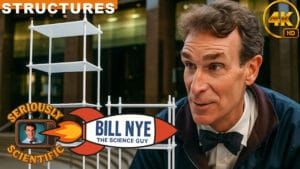
Let us break down the science of tension, compression, and weight distribution with Bill Nye the Science Guy.
Key Concepts
Structure
Tap to learn moreA structure is a carefully built object, like a house or a bridge, designed to successfully support a heavy load without collapsing.
Tension
Tap to learn moreTension is an invisible pulling force that stretches a material. When you pull tightly on a rubber band, you are putting it under tension.
Compression
Tap to learn moreCompression is an invisible pushing force that squeezes a material together. When you press down on a spring, you are putting it under compression.
Load
Tap to learn moreThe load is the total physical weight that a structure must successfully support without collapsing, including the materials, people, and weather.
Triangle
Tap to learn moreThe triangle is the most rigid and stable geometric shape in all of engineering. It perfectly spreads out any force applied to its corners.
Arch
Tap to learn moreAn arch is a brilliantly curved structure that takes the load from the very top and smoothly pushes the heavy weight outwards and safely down to the ground.
Suspension Bridge
Tap to learn moreA suspension bridge is hung from giant metal cables. The road pulls downwards, putting the main cables under extreme stretching tension.
Truss
Tap to learn moreA truss is a highly stable structural framework made entirely of connected metal or wooden triangles, often used in bridges and roofs.
Try It: The Interactive Bridge Engineering Challenge
Become a master engineer. Pick a preset to see classic bridge types in action, or switch to Free Build and design your own bridge by clicking anchor points to draw beams. Choose your materials wisely, stay within budget, and then send the truck across the canyon. If your structure cannot handle the load, your bridge will fail and the truck will plunge into the gorge below.
Apply Your Knowledge
Let us see if you can match these structural engineering concepts to their correct descriptions.
Match the Concepts
Click an object to select it, then click the matching description to place it.
Real World Challenge
Imagine you are an architect tasked with building a massive new skyscraper in a city that experiences frequent and violent earthquakes. Knowing how connected triangles prevent metal frames from wobbling, how would you design the skeleton of your building to keep it standing during a severe shaking event?
Test Your Understanding
Answer these questions and get instant feedback. How many can you get right?
Results
Your score:
Reflection
Look around the room you are sitting in right now. Try to find three different triangles hidden in the structures around you like your furniture, the shelving, or the roof outside. Why do you think the original builder put those shapes exactly there?
Episode Discussion
Share your thoughts on this Bill Nye The Science Guy episode