


























Static Electricity
Introduction
Have you ever felt a shock after walking on a carpet? Maybe your hair stood up after rubbing a balloon on it. That’s static electricity! In this episode, Bill Nye The Science Guy explains how electric charges build up, transfer, and discharge. He shows why some materials attract, how lightning works, and how this invisible force affects daily life. With fun experiments and real-world examples, Bill sparks curiosity in an electrifying way.
What is Static Electricity?
Electricity comes in two forms. Current electricity moves through wires to power devices like lights and computers. Static electricity, however, builds up on surfaces and stays put until it finds a way to discharge.
Bill demonstrates this concept with exciting experiments:
✔ Balloon Trick – When you rub a balloon on your head, it steals electrons, causing your hair to stand up!
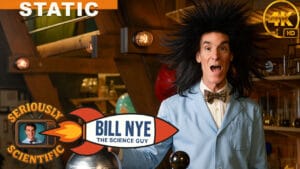
✔ Van de Graaff Generator – Watch as a high-voltage static charge makes hair defy gravity.
✔ Jumping Sparks – Bill shows how excess charge jumps between objects, creating mini lightning bolts.
Static electricity happens because of electrons moving between objects. When materials rub together, some lose electrons while others gain them. This difference creates positive and negative charges. If the charge builds up too much, it suddenly discharges—resulting in a spark, a zap, or even a bolt of lightning!
How Static Electricity Impacts Everyday Life
Static electricity isn’t just a science trick. It plays an important role in technology and nature.
✔ Photocopiers & Printers – Electrostatic forces help ink stick to paper.
✔ Lightning – A massive static discharge occurs when clouds build up charge.
✔ Factories – Industries control static to prevent fires and explosions.
✔ Airplane Safety – Static wicks on wings release built-up charge to prevent interference.
Bill Nye explains why winter is the perfect season for static electricity. Dry air allows more charge to build up. That’s why you get more shocks in cold weather!
Scientific Adjustment
Since this episode aired, scientists have developed ways to harness static electricity for power. Triboelectric nanogenerators (TENGs) can now convert static charge into usable energy. This breakthrough could allow self-charging electronic devices or even floors that generate power when people walk on them.
Additionally, new anti-static materials help protect sensitive electronics from electrostatic discharge (ESD), which can damage circuits. These advancements show that static electricity is more than just a fun science trick—it has practical, real-world applications!
Conclusion
Static electricity may seem invisible, but its effects are everywhere. Whether it’s shocking your fingertips, lighting up the sky, or making technology work, this force plays a major role in our world. Bill Nye makes it fun, engaging, and easy to understand. Watch and get electrified by science
More Seriously Scientific Links
Visit our homepage for more Seriously Scientific news and documentaries: https://seriouslyscientific.com.
Subscribe to our YouTube channel for more science content: https://youtube.com/@seriouslyscientific.
Get free science worksheets for students and educators: https://teacherspayteachers.com/Store/Seriously-Scientific.
Follow us on BlueSky: https://bsky.app/profile/seriouslysci.bsky.social.
Bill Nye The Science Guy
02 // EPISODE_INDEX100 remastered episodes across 5 seasons of science education
Season 1 (20 episodes)
Bill Nye The Science Guy | Flight
Bill Nye The Science Guy | Earth's Crust
Bill Nye The Science Guy | Dinosaurs
Bill Nye The Science Guy | Skin
Bill Nye The Science Guy | Buoyancy
Bill Nye The Science Guy | Gravity
Bill Nye The Science Guy | Digestion
Bill Nye The Science Guy | Phases of Matter
Bill Nye The Science Guy | Biodiversity
Bill Nye The Science Guy | Simple Machines
Bill Nye The Science Guy | The Moon
Bill Nye The Science Guy | Sound
Bill Nye The Science Guy | Garbage
Bill Nye The Science Guy | Structures
Bill Nye The Science Guy | Earth's Seasons
Bill Nye The Science Guy | Light & Color
Bill Nye The Science Guy | Cells
Bill Nye The Science Guy | Electricity
Bill Nye The Science Guy | Outer Space
Bill Nye The Science Guy | Eyeballs
Season 2 (20 episodes)
Bill Nye The Science Guy | Magnetism
Bill Nye The Science Guy | Wind
Bill Nye The Science Guy | Blood & Circulation
Bill Nye The Science Guy | Chemical Reactions
Bill Nye The Science Guy | Static Electricity
Bill Nye The Science Guy | Food Webs
Bill Nye The Science Guy | Light Optics
Bill Nye The Science Guy | Bones & Muscle
Bill Nye The Science Guy | Oceanography
Bill Nye The Science Guy | Heat
Bill Nye The Science Guy | Insects
Bill Nye The Science Guy | Balance
Bill Nye The Science Guy | The Sun
Bill Nye The Science Guy | The Brain
Bill Nye The Science Guy | Forests
Bill Nye The Science Guy | Communication
Bill Nye The Science Guy | Momentum
Bill Nye The Science Guy | Reptiles
Bill Nye The Science Guy | Atmosphere
Bill Nye The Science Guy | Respiration
Season 3 (21 episodes)
Bill Nye The Science Guy | Planets & Moons
Bill Nye The Science Guy | Pressure
Bill Nye The Science Guy | Plants
Bill Nye The Science Guy | Rocks & Soil
Bill Nye The Science Guy | Energy
Bill Nye The Science Guy | Evolution
Bill Nye The Science Guy | The Water cycle
Bill Nye The Science Guy | Friction
Bill Nye The Science Guy | Germs
Bill Nye The Science Guy | Climates
Bill Nye The Science Guy | Waves
Bill Nye The Science Guy | Ocean Life
Bill Nye The Science Guy | Mammals
Bill Nye The Science Guy | Spinning Things
Bill Nye The Science Guy | Fish
Bill Nye The Science Guy | Human Transportation
Bill Nye The Science Guy | Wetlands
Bill Nye The Science Guy | Birds
Bill Nye The Science Guy | Populations
Bill Nye The Science Guy | Animal Locomotion
Bill Nye The Science Guy | Invertebrates
Season 4 (19 episodes)
Bill Nye The Science Guy | Rivers & Streams
Bill Nye The Science Guy | Nutrition
Bill Nye The Science Guy | Marine Mammals
Bill Nye The Science Guy | Earthquakes
Bill Nye The Science Guy | NTV Music Videos
Bill Nye The Science Guy | Spiders
Bill Nye The Science Guy | Pollution Solutions
Bill Nye The Science Guy | Probability
Bill Nye The Science Guy | Pseudoscience
Bill Nye The Science Guy | Flowers
Bill Nye The Science Guy | Archaeology
Bill Nye The Science Guy | Deserts
Bill Nye The Science Guy | Amphibians
Bill Nye The Science Guy | Volcanoes
Bill Nye The Science Guy | The Heart
Bill Nye The Science Guy | Inventions
Bill Nye The Science Guy | Computers
Bill Nye The Science Guy | Fossils
Bill Nye The Science Guy | Time
Season 5 (20 episodes)
Bill Nye The Science Guy | Forensics
Bill Nye The Science Guy | Space Exploration
Bill Nye The Science Guy | Genes
Bill Nye The Science Guy | Architecture
Bill Nye The Science Guy | Farming
Bill Nye The Science Guy | Life Cycles
Bill Nye The Science Guy | The Scientific Method
Bill Nye The Science Guy | Atoms
Bill Nye The Science Guy | Ocean Exploration
Bill Nye The Science Guy | Lakes and Ponds
Bill Nye The Science Guy | Smell
Bill Nye The Science Guy | Caves
Bill Nye The Science Guy | Erosion
Bill Nye The Science Guy | Fluids
Bill Nye The Science Guy | Comets and Meteors
Bill Nye The Science Guy | Measurement
Bill Nye The Science Guy | Patterns
Bill Nye The Science Guy | Storms
Bill Nye The Science Guy | Music
Bill Nye The Science Guy - Motion
Loading Biography...
Static Electricity
Based on Bill Nye the Science Guy · Season 2, Episode 5 · 23 min
You are walking across a carpet in your socks, you reach out to open a door, and suddenly ZAP! A tiny bolt of lightning jumps from your finger. What exactly is going on, and where did that energy come from?
Have You Ever Been Zapped by a Doorknob?
Tiny invisible particles jumping through the air! As Bill Nye the Science Guy explains, you have built up a charge of tiny particles called electrons. The shock is the feeling of those electrons jumping from your finger to the metal to balance things out.
They are exactly the same thing! A lightning bolt is just a giant spark of static electricity. Millions of electrons build up in a storm cloud and jump to the earth in a massive flash of light.
Put Your Instincts to the Test
Think about what you already know about shocks and sparks. Pick an answer for each question, then see if your instincts were right.
They push away from each other! In science, like charges repel. If two objects both have a negative charge, they will push each other away like the wrong ends of a magnet.
Every hair gets the same charge and they repel! Because each individual strand of hair becomes negatively charged, they all try to push as far away from each other as possible.
Directly into the earth! This is called grounding. Electricians use special wires to connect buildings to the ground so that stray electrons have a safe path to travel instead of building up and causing sparks.
Understanding the Science
Tap each card to uncover the invisible particles and forces that make static electricity so shocking.
Atoms
Tap to learn moreEverything in the universe is made of atoms. They are the microscopic building blocks of matter, and they contain even smaller parts inside them.
Electrons
Tap to learn moreThese are tiny particles with a negative charge. They orbit the outside of an atom and can easily jump from one object to another!
Protons
Tap to learn moreThese are particles with a positive charge. Unlike electrons, protons are stuck firmly in the centre of the atom and do not move around freely.
Static Charge
Tap to learn moreThe word "static" means stationary. Static electricity is what happens when extra electrons build up on an object and just sit there, waiting to jump.
Attraction
Tap to learn moreIn the world of electricity, opposites attract! An object with a negative charge will pull toward an object with a positive charge.
Repulsion
Tap to learn moreLike charges repel. If you bring two negatively charged objects together, they will push away from each other invisibly.
Sparks
Tap to learn moreWhen there is a big difference in charge, electrons jump through the air to balance it out. This rapid jump creates a flash of light called a spark.
Grounding
Tap to learn moreBy connecting a wire directly into the earth, stray electrons have a safe path to travel so they do not build up and cause dangerous sparks.
Try It: The Zap Challenge
In this lab, distance is everything. You can build up an "Overload" of 100% static charge, but it won't jump the gap until you move your hand.
The Mission: Build a 100% charge while far away, then slide slowly to see the maximum voltage spark!
Apply Your Knowledge
Let us see if you can connect these electrical concepts to their vital jobs.
Match the Concepts
Click an object to select it, then click the matching description to place it.
Real-World Challenge
Bill Nye the Science Guy demonstrates how a balloon rubbed on your hair can mysteriously bend a thin stream of falling water without even touching it. Based on what you know about positive and negative charges, explain why the water is attracted to the balloon.
What Has Changed Since This Episode Aired
This episode aired in 1994. While the core physics of static electricity remains completely accurate, the technology we use has changed.
Updated: If you try this at home today, it probably will not work! Modern flat-screen TVs (like LCD and OLED models) use entirely different technology to display images and do not shoot beams of electrons at the screen, so they do not build up a heavy static charge on the surface.
Updated: While physical lightning rods are still crucial, modern lightning protection is much more advanced. Today, buildings also require complex surge protectors to save our sensitive electronic devices (like computers and smartphones) from the invisible electromagnetic pulse that a lightning strike creates.
Test Your Understanding
Answer these questions and get instant feedback. How many can you get right?
Results
Your score:
Reflection
Think about the weather where you live. Have you ever noticed that static electricity shocks happen more often during certain times of the year? Based on what you learned, why do you think dry or humid air might affect how electrons jump?
Episode Discussion
Share your thoughts on this Bill Nye episode