






































Do It Yourself Science (Scientific Method)
Become a Backyard Scientist! You do not need a fancy laboratory to make ground-breaking discoveries. The world around us is filled with science waiting to be explored, from the air we breathe to the static electricity in our clothes. Let us see how everyday objects can help us test huge scientific ideas!
The World is Your Laboratory
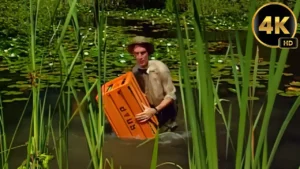
It crushes inwards! As the hot steam cools, it condenses back into a tiny amount of liquid water, creating a vacuum inside the drum. The massive, invisible air pressure from the room instantly crushes the metal.
Yes, if the glass is completely full. The air pressure pushing up on the cardboard from the outside is actually stronger than the weight of the water pushing down from the inside.
Test Your Scientific Instincts
Before we dive into the formal steps of discovery, see if you can predict the outcome of this classic household experiment.
Salt water is more dense! Dissolved salt adds mass to the water. This makes the liquid dense enough to support the weight of the egg and push it to the surface.
The Rules of Discovery
Science is not just a collection of random facts. It is a highly structured way of thinking! By carefully observing the world and testing our ideas repeatedly, we uncover the hidden rules that govern the universe. Tap the cards below to uncover the essential vocabulary.
Key Concepts
Scientific Method
Tap to learn moreA rigorous, step-by-step process used by researchers to investigate natural phenomena. It involves making careful observations, formulating a testable hypothesis, conducting controlled experiments, and rigorously analysing the resulting data to draw a valid conclusion.
Repeatability
Tap to learn moreThe fundamental cornerstone of valid research. A successful experiment must yield the exact same results when performed by different people under the exact same conditions, proving the discovery is a universal rule and not just a random accident.
Observation
Tap to learn moreGathering factual information using your physical senses or highly calibrated scientific tools. Accurate observation is always the starting point that sparks a new scientific question.
Air Pressure
Tap to learn moreThe powerful, invisible force exerted onto a surface by the weight of the atmosphere pressing down from above. It pushes in all directions simultaneously, holding water in an upside-down glass or crushing a sealed vacuum.
Condensation
Tap to learn moreThe physical process where a gas rapidly loses thermal energy (heat) and transforms back into a liquid state. Because liquids are denser than gases, this phase change causes the matter to take up significantly less space.
Static Electricity
Tap to learn moreAn electrical imbalance either within or on the surface of a material. It is typically caused by the physical transfer of electrons from one object to another, creating attractive or repulsive forces.
Refraction
Tap to learn moreThe physical bending of light as it passes from one transparent substance into another. This happens because light travels at slightly different speeds through air compared to water or glass.
Density
Tap to learn moreA crucial scientific measurement of how much mass is contained within a specific volume. If you add salt to a cup of water, you increase its mass without increasing its size, making it denser.
Interactive Lab: Executing the Scientific Method
A true scientist follows a structured process. Click through the phases below to form a hypothesis, run your experiment, and analyse the data to reach a conclusion regarding density and buoyancy.
Buoyancy Research Interface
Observation: The raw egg instantly sinks to the bottom of the beaker when placed in pure tap water. Why does it not float?
The Command Module Matching Challenge
Let us test your scientific vocabulary. Can you match the specific terminology to the correct definitions?
Match the Concepts
Click a scientific term to select it, then click the matching description to lock it in place.
The Backyard Scientist Challenge
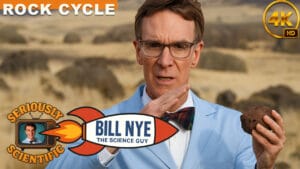
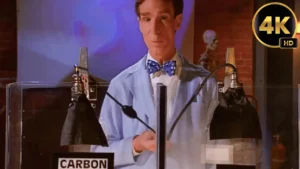
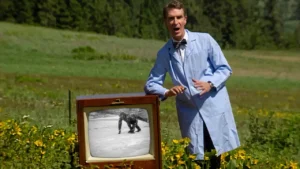
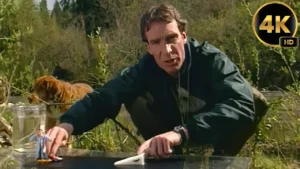
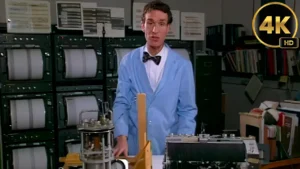
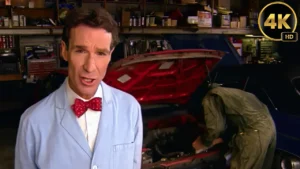
Bill Nye the Science Guy showed us that you can use a broomstick, a couple of paper bags, vinegar, and baking soda to prove that invisible gases have weight.
Your Challenge: Design a new experiment at home using three basic household items to test a hypothesis about gravity, friction, or air pressure. Remember to write down your steps precisely so your experiment is completely repeatable by another scientist!
Science Education in the Modern Age
This episode originally aired in 1997. Our understanding of how to safely teach and explain these concepts has evolved since then!
Updated: The original show masterfully focused on the fun, accessible side of science to encourage children to experiment at home. While this is fantastic for sparking curiosity, modern classroom standards explicitly organise these steps into the rigorous "Scientific Method", placing a much heavier emphasis on using control variables and seeking peer review before making claims.
Updated: Bill Nye the Science Guy demonstrated air pressure using heavy metal drums and glass bottles over open flames, which made for incredibly dramatic television. Today, classroom teachers prefer to use safer, shatter-proof plastics and highly controllable hot plates to demonstrate the exact same incredible forces without the risk of injury.
Updated: Static electricity is explained simply as electrons jumping from one surface to another. While true, modern physicists now understand the "triboelectric series" in much greater detail at the quantum level. This advanced, precise understanding of static charges has allowed us to engineer modern capacitive touchscreens on our smartphones!
Test Your Understanding
Answer these 10 questions and get instant feedback. How many can you get right?
Results
Your score:
Reflection
Think of a time you observed something strange in your everyday life. How could you design a repeatable experiment to figure out exactly why it happened?
Episode Discussion
Share your thoughts on this Bill Nye The Science Guy episode