

























































Wind
Have you ever stepped outside on a blustery day and wondered what exactly is pushing the air around? It feels invisible, but wind has the power to change our weather, carve mountains, and even generate electricity. Let us investigate what gets the air moving in the first place.
Where Does the Wind Come From?
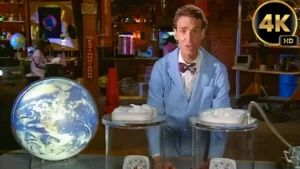
It sinks to the floor! Cold air contracts and becomes denser, meaning it is heavier than the warm air around it, so it sinks down.
It rises! When air heats up, the molecules spread out and become less dense. Bill Nye the Science Guy shows us that this simple rising and sinking of air is the main ingredient for wind!
Put Your Instincts to the Test
Think about what you already know about wind and weather. Pick an answer for each question, then see if your instincts were right.
The heating and cooling of the Earth by the sun. The sun warms the Earth unevenly. Warm air rises at the equator, and cold air from the poles rushes in to take its place. This endless cycle of moving air is what we feel as wind!
Because the Earth is spinning. As the Earth rotates, it causes moving air masses to curve. Gaspard Coriolis discovered this phenomenon, which is why it is called the Coriolis effect. It makes our weather patterns swirl!
Sunny, clear skies. High pressure means the air is thick and heavy, pushing down and generally keeping stormy clouds away. Low pressure means the air is lighter and rising, which allows clouds and storms to form.
Understanding the Science
Tap each card to reveal the science behind the breeze.
Key Concepts
Thermal Expansion
Tap to learn moreWhen the sun heats the land, the land warms the air above it. The air molecules speed up and spread farther apart. Because they take up more room without adding mass, the air becomes less dense, causing the warm air to rise.
Thermal Contraction
Tap to learn moreWhen air cools down, such as near the Earth's poles, the molecules slow down and pack closely together. This cold air takes up less space and becomes denser and heavier. As a result, cold air sinks toward the ground.
Wind
Tap to learn moreWind is simply moving air. It happens because warm air rises and cold air rushes in to take its place. This continuous cycle of heating, rising, cooling, and sinking is happening all over the globe, driven by energy from the sun.
The Coriolis Effect
Tap to learn moreBecause the Earth is constantly spinning, wind does not travel in a straight line. The planet's rotation causes the moving air to curve. Named after the French scientist Gaspard Coriolis, this effect is what makes hurricanes, typhoons, and tornadoes spin.
Barometric Pressure
Tap to learn moreA barometer is an instrument scientists use to weigh the atmosphere. "Baro" comes from an old word meaning "weight". When the air above us is thick and heavy, we have high barometric pressure. When the air is thin and light, we have low pressure.
High vs. Low Pressure
Tap to learn moreChanges in air pressure create changes in the weather. Normally, high pressure brings sunny, clear skies because the heavy air suppresses cloud formation. Low pressure allows air to rise and form clouds, usually bringing rain and storms.
Hail Formation
Tap to learn moreHail starts out as liquid raindrops. In a thunderstorm, massive updrafts of wind blow the freezing raindrops high into the clouds over and over again. Each time they go up and down, a new layer of ice freezes on the outside until the hailstones are too heavy to stay up.
Wind Erosion
Tap to learn moreWind has the power to permanently change the landscape. By blowing sand and dirt against rocks over thousands of years, the wind acts like sandpaper to wear away mountains and shift massive sand dunes. This process is called erosion.
Try It: Sea Breeze
Spend a day at the beach. Move the clock and watch the land and the sea warm up and cool down. When does the wind blow in from the sea, and when does it blow out?
Apply Your Knowledge
Now let us see if you can connect what you have learned to the world map and weather forecasts.
Match the Concepts
Click an object to select it, then click the matching description to place it.
Real-World Challenge
Imagine you are a meteorologist tracking a massive, dense cold air mass moving rapidly toward a city experiencing a very hot, humid day. Based on what you have learned about hot air rising, cold air sinking, and the Coriolis effect, what kind of weather event would you predict for that city when the two air masses collide? Explain your reasoning.
What Has Changed Since This Episode Aired
This episode first aired in 1994. While the core science remains accurate, here are a few things that have scaled up and broken global records since then.
Updated: Wind energy technology has scaled up massively. Modern offshore wind turbines, such as the Haliade-X, are enormous feats of engineering and can generate enough electricity to power up to 16,000 homes. Even newer models currently in development are expected to power over 20,000 homes each!
Updated: Just two years after this episode aired, a new global record was set! In 1996, an automated weather station recorded a wind gust of 408 kilometres per hour (253 miles per hour) during Cyclone Olivia at Barrow Island, Australia. This broke a record from 1934 that scientists thought would never be beaten.
Test Your Understanding
Answer these questions and get instant feedback. How many can you get right?
Results
Your score:
Reflection
Wind is invisible, yet it has the power to carve mountains, power cities, and create massive storms. Next time you step outside and feel a breeze, think about where that air might have come from. What is the most surprising thing you learned about how the weather works today?
Episode Discussion
Share your thoughts on this Bill Nye The Science Guy episode