































































Heart
There is one muscle in your body that never stops, never rests, and never waits for you to think about it. Find out how your heart keeps every part of you supplied with oxygen, one beat at a time.
The One Muscle That Never Takes a Break
Probably tens of thousands of times already, and it has not stopped once. A resting heart beats somewhere between 60 and 100 times a minute, and over a full lifetime, the episode points out that this adds up to about two and a half billion beats. Every single one of those beats pushes blood to a part of your body that needs it.
Not really, no. Your arm muscles get to relax completely between uses, but your heart, as Bill Nye puts it, never relaxes. It just keeps squeezing, beat after beat, your whole life, without you ever having to remind it to.
Put Your Instincts to the Test
Think about what you already know about your heart and your blood. Pick an answer for each question below, then see if your instincts were right.
A darker, duller red. Blood is always red, it just gets darker as it gives up its oxygen. The episode describes this blood as blue, which is a common way people describe it, but blood never truly turns blue inside your body. We will come back to exactly why a little later.
It speeds up. Your body reacts to being startled by telling your heart to pump more blood, in case you need to react fast. Scientists call this the fight-or-flight response, and the episode shows exactly this happening the moment someone gets a scare.
The hand held up high. Gravity works with your heart when blood flows down to a hand at your side, but against your heart when blood has to travel up to a raised hand. That is why the raised hand often looks a touch paler, since it takes more work to keep blood moving there, while the hand at your side looks darker and redder.
Understanding the Science
Tap each card below to reveal how your heart actually works, from its basic structure to its own built-in electrical system.
Key Concepts
The Heart Is a Muscle Pump
Tap to learn moreYour heart is a muscle about the size of your fist, and unlike the muscles in your arm, it never gets to relax, not even for a second. Its only job is to pump blood to every part of your body, pushing a fresh wave out with every single beat.
Two Sides, Four Chambers
Tap to learn moreTo send blood in two different directions with every beat, your heart is split into a left side and a right side, and each side has a top chamber and a bottom chamber. That gives you four chambers in total, working together like two pumps built into one.
Valves: Gates That Keep Blood Moving One Way
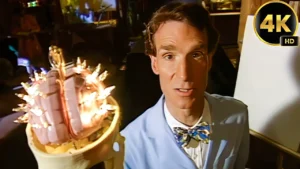
Tap to learn moreBetween the top and bottom chambers on each side sit valves, flap-like gates that open to let blood through and snap shut to stop it flowing backward. Bill Nye's ultrasound of his own heart shows these valves opening and closing with every lub-dub, the sound of the two sets of valves shutting one after another.
The Double Loop: Lungs and Body
Tap to learn moreBlood low in oxygen comes back from your body into the right side of your heart, which pumps it to your lungs to pick up a fresh supply. From the lungs, that oxygen-rich blood returns to the left side of your heart, which pumps it back out to the rest of your body. Scientists call this two-part journey, lungs then body, double circulation.
Your Heart's Own Spark Plug
Tap to learn moreA small patch of cells on the heart wall, called the sinoatrial node, fires an electrical signal that starts every single heartbeat, acting like a spark plug. That signal tells the top chambers to squeeze first, then spreads to a second group of cells that tells the bottom chambers to squeeze right after.
A Muscle Unlike Any Other
Tap to learn moreMuscles in your arm are striped and only move when your nervous system tells them to, while smooth muscles like the ones in your stomach contract slowly and never work on their own either. Cardiac muscle is different: it can start and send its own electrical signals, which is why your heart keeps beating even without you thinking about it.
Exercise Makes Your Heart Stronger
Tap to learn moreYour heart beats faster when you exercise or feel scared, part of what scientists call the fight-or-flight response, because your muscles and body suddenly need more oxygen delivered fast. Just like the muscles in your arms, your heart gets stronger the more you use it, so regular exercise genuinely trains your heart too.
Clots, Clogs, and a Heart-Healthy Diet
Tap to learn moreWhen you get a cut, your blood forms a clot using special proteins that seal the wound, which is a good thing. But if a clot forms on a fatty deposit inside a blood vessel, it can jam up the flow completely. When that happens in a vessel feeding the heart, it can cause a heart attack, which is one reason the episode favours fruits, vegetables, and whole grains over foods high in fat.
Try It: Ruby's Round Trip
Tap the heart to make it beat and send Ruby, a single blood cell, on her journey. Watch her colour change as she picks up oxygen at the lungs and delivers it to the body.
Blood is always red, never blue, even inside your body. Oxygen-rich blood is a brighter red, and oxygen-poor blood is a darker, dustier red. Diagrams often colour low-oxygen blood blue simply to make the two types easy to tell apart at a glance, and veins can look bluish through your skin because of how skin scatters light, not because the blood underneath has actually changed colour.
Apply Your Knowledge
You have learned how your heart is built and how it keeps blood moving. Now let's put those ideas to work.
Match the Concepts
Click an object to select it, then click the matching description to place it.
Real-World Challenge
Your friend says her heart is racing even though she is just sitting on the couch watching a scary movie. Using what you know about the heart's electrical signal and the fight-or-flight response, explain to her why her heart might speed up even when her body is not actually in danger and is not moving at all.
What Has Changed Since This Episode Aired
This episode first aired in 1997. The heart itself has not changed, but a few things about how we study it, and how we think about protecting it, have moved on since then.
Updated: Blood is always red, even at its lowest oxygen level. Oxygen-rich blood is a brighter red, and oxygen-poor blood is a darker, dustier red, but it never turns blue. Veins can look bluish through your skin, but that is because skin scatters light in a way that reflects blue back to your eyes, not because the blood underneath has changed colour. Diagrams often use blue for low-oxygen blood anyway, simply because it makes the two types easier to tell apart at a glance.
Updated: Doctors still use sound waves to picture the heart, but the technology has moved a long way past a single flat image. Cardiac ultrasound can now build a full three-dimensional, moving picture of the heart in real time, showing its shape and motion from every angle. Small handheld ultrasound devices, some with built-in artificial intelligence to help capture a clear image, can now be used right at a patient's side instead of only in a hospital ultrasound room.
Updated: The type of fat matters more than the total amount. Research since the 1990s showed that trans fats, once common in many fried and packaged foods, raise unhealthy cholesterol, and they have been almost entirely removed from the food supply as a result. Meanwhile, unsaturated fats, the kind found in fish, nuts, and olive oil, are now understood to actually support a healthy heart rather than harm it. Today's guidance is less about eating less fat overall and more about choosing the right kind.
Test Your Understanding
Answer these questions and get instant feedback. How many can you get right?
Results
Your score:
Reflection
What surprised you most about how your heart works? Think of one moment today when your heart rate probably changed without you doing anything on purpose, like getting startled, running, or feeling excited, and describe what you think was happening inside your heart at that moment.
Episode Discussion
Share your thoughts on this Bill Nye The Science Guy episode