







































































Storms
If you have ever found yourself in a blizzard, a downpour, or a howling wind, you have experienced extreme weather. In this lesson, we will explore how the heat of the sun, water in the air, and the spin of the Earth combine to create the most powerful storms on the planet.
Can a Storm Last for Centuries?
Absolutely not! The planet Jupiter is home to a massive storm called the Great Red Spot[cite: 6]. It is a gigantic hurricane that is wider than our entire planet, and it has been raging for hundreds of years[cite: 6].
It is all about size and spin! Jupiter is incredibly huge and it spins exceptionally fast[cite: 6]. A day on Jupiter only lasts ten Earth hours, creating massive wind speeds that sustain the storm for centuries[cite: 6].
Put Your Instincts to the Test
Think about what you already know about extreme weather. Pick an answer for each question, then see if your instincts were right.
Lightning heating the air so fast it explodes! When a bolt of lightning strikes, it instantly heats the surrounding air to five times the temperature of the sun[cite: 6]. The air expands so rapidly that it creates a massive sound wave, which we hear as thunder[cite: 6].
Squatting low in an open space. Lightning usually strikes the highest point around, making a tall tree a prime target[cite: 6]. Bill Nye the Science Guy explains that you should get short and make as little contact with the ground as possible, so the electricity finds another path to the earth[cite: 6].
The hot air punches a hole and spins upward! If the conditions are right, the trapped hot air rushes up through the cold air like water draining from a bathtub, just upside down[cite: 6]. When this violently spinning column of air forms, you have got a tornado[cite: 6].
Understanding the Science
Tap each card to reveal the fascinating mechanics behind the world's most powerful weather systems.
Key Concepts
The Coriolis Effect
Tap to learn moreThe Coriolis effect is the essential engine behind global weather patterns and extreme storms. Because the Earth is a spinning sphere, the equator rotates much faster than the poles. As warm air rises from heated ocean waters and rushes toward low-pressure areas, this difference in rotational speed causes the moving air to deflect to the right in the Northern Hemisphere and to the left in the Southern Hemisphere. Bill Nye the Science Guy demonstrates that without this planetary spin, warm air would simply drift in straight lines rather than organising into massive, spinning storms.
Lightning
Tap to learn moreLightning is pure electricity, which is simply the sudden flow of electrons. In a storm cloud, static electricity causes millions of negatively charged electrons to build up. Because they all share a negative charge, they fiercely repel each other and want to spread out. The easiest way for them to escape the cloud is to find a sudden, explosive path directly to the ground.
The Sound of Thunder
Tap to learn moreYou cannot have thunder without lightning. When a lightning bolt flashes, it instantly superheats the surrounding air to a temperature five times hotter than the surface of the sun. This immense heat causes the air to expand outward so violently and rapidly that it creates a massive shockwave. We hear this explosive atmospheric shockwave as the booming sound of thunder.
Tornadoes
Tap to learn moreA tornado, or twister, forms when air masses of extremely different temperatures come together over land. If a heavy slab of cold air traps a pocket of rapidly heating air near the ground, the hot air will eventually punch a hole straight through the cold layer. As the hot air rushes upwards, it begins to spin faster and faster, creating a violent, destructive funnel.
Hurricanes and Typhoons
Tap to learn moreWhile tornadoes form over land, hurricanes and typhoons form over the open ocean. These gigantic storm systems are created when massive areas of seawater soak up a tremendous amount of heat from the sun. The warm air rises, carrying dense water vapour with it. As the Earth rotates, it spins these massive, moisture-heavy clouds into devastating storms the size of entire countries.
The Eye of the Storm
Tap to learn moreBecause hurricanes and typhoons spin incredibly fast, a unique feature forms right in the very middle of the vortex. This central hollow spot is called the eye of the storm. Bill Nye the Science Guy explains that while the terrifying winds are howling violently all around the outside of the hurricane, the weather inside the eye is actually perfectly calm and quiet.
El Niño
Tap to learn moreEl Niño is a fascinating phenomenon that occurs in the eastern Pacific Ocean. Normally, steady trade winds keep the ocean water cool. However, from time to time, these winds mysteriously stop. The sun then beats down and drastically warms the sea, which in turn warms the air above it. This sudden heat shift severely disrupts weather patterns, causing violent storms all over the globe.
Extraterrestrial Storms
Tap to learn morePlanet Earth is not the only place with severe storms. The gas giant Jupiter has a legendary storm called the Great Red Spot that has been actively raging for hundreds of years. It never hits land to slow down, and the planet's incredibly fast rotation speed provides a constant supply of energy, allowing the massive extraterrestrial hurricane to churn for centuries.
Try It: The Coriolis Effect Simulator
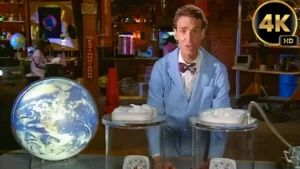
Heat the ocean surface to create rising water vapour. Then, activate the Earth's spin to watch the Coriolis effect organise those drifting clouds into massive, spinning typhoons!
Apply Your Knowledge
Let us see if you can connect what you have learned about extreme weather to their correct definitions.
Match the Concepts
Click an object to select it, then click the matching description to place it.
Real-World Challenge
Imagine you are an architect tasked with building a new school. If you were building the school on a flat plain known for frequent tornadoes, how would your design differ from a school built on a tropical coastline known for typhoons and hurricanes? Think about the differences in wind direction, potential flooding, and where people should safely take shelter.
What Has Changed Since This Episode Aired
This episode first aired in 1998. While the core meteorology remains highly accurate, our understanding of weather patterns has expanded significantly. Here are three things we know now.
Updated: Scientists now rigorously monitor the El Niño Southern Oscillation cycle. Using a vast global network of ocean buoys, satellites, and complex climate models, meteorological agencies continuously track sea surface temperatures. This modern technology allows experts to reliably predict El Niño events and their global weather impacts months in advance.
Updated: Recent measurements from NASA and the Hubble Space Telescope confirm the ancient storm has been continuously shrinking for decades. While it remains the largest storm in the solar system, it is currently only about 1.3 times the width of Earth. Scientists are actively studying whether this massive hurricane might eventually disappear entirely.
Updated: Scientists have confirmed the existence of Transient Luminous Events, which include phenomena known as Red Sprites and Blue Jets. These are massive, colourful electrical discharges that shoot upwards from the tops of intense thunderstorms towards the edge of space. They occur so high in the atmosphere that they are often best photographed by astronauts aboard the International Space Station.
Test Your Understanding
Answer these questions and get instant feedback. How many can you get right?
Results
Your score:
Reflection
Think back to the most extreme weather you have ever personally experienced. What did the sky look like, what did the air feel like, and how did you make sure you stayed safe?
Episode Discussion
Share your thoughts on this Bill Nye The Science Guy episode