




































Electricity
Introduction to Electricity
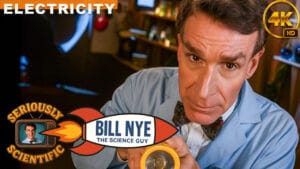
Electricity powers our homes, lights up cities, and keeps technology running. But how exactly does it work? In this episode, Bill Nye explores electricity, explaining how it flows, how circuits function, and why it is essential to modern life.
Electricity is the movement of tiny charged particles called electrons. This flow creates energy, which allows us to power everything from light bulbs to computers. Bill Nye breaks down how we generate, store, and control electricity to make it useful.
How Does Electricity Work?
Electricity moves through conductors, such as metal wires, allowing power to travel from one place to another. The flow of electricity is called a current, which must follow a complete circuit to function.
- Conductors – Materials like copper and aluminum let electricity pass through easily.
- Insulators – Substances like rubber and plastic prevent electricity from flowing.
- Circuits – A complete loop that allows electricity to move and power devices.
Since circuits control the flow of electricity, they help turn devices on and off safely.
Bill Nye’s Fun Experiments on Electricity
Bill Nye makes electricity exciting with hands-on experiments!
- Static electricity test – He shows how rubbing objects together can create an electric charge.
- Simple circuit demonstration – He builds a basic circuit to explain how electricity moves.
- Battery power experiment – He tests how different materials conduct electricity.
These experiments prove that electricity is more than just plugging in a device—it’s about moving energy efficiently to power everyday life.
Where Does Electricity Come From?
We generate electricity in power plants, which convert different energy sources into electrical energy. The most common sources include:
- Fossil fuels – Coal, oil, and gas are burned to create power.
- Hydroelectric power – Moving water generates electricity in dams.
- Wind and solar power – Renewable sources that convert natural energy into electricity.
- Nuclear power – Atoms split to release massive amounts of energy.
Because electricity cannot be stored easily, power grids distribute it quickly to homes and businesses.
How We Use Electricity Every Day
Electricity makes modern life possible. It powers:
- Lights and appliances – Making everyday life easier.
- Transportation – Electric cars and trains rely on it.
- Communication – Phones, computers, and the internet all depend on electrical energy.
Bill Nye explains why conserving electricity is important. Using energy-efficient appliances and turning off unused devices helps reduce waste and protect the planet.
Conclusion on Electricity
Electricity is the invisible force that powers our world. Bill Nye reminds us that without it, modern life would be completely different.
Next time you flip a light switch or charge your phone, think about the science behind it. Electricity keeps everything running efficiently!
Home Page Link
Visit our homepage for more Seriously Scientific news and documentaries: SeriouslyScientific.com.
YouTube Channel Link
Subscribe to our YouTube channel for more science content: Seriously Scientific YouTube.
Free Worksheets for Teachers & Students
Get free science worksheets for students and educators: Seriously Scientific on TPT.
Bill Nye The Science Guy
02 // EPISODE_INDEX100 remastered episodes across 5 seasons of science education
Season 1 (20 episodes)
Bill Nye The Science Guy | Flight
Bill Nye The Science Guy | Earth's Crust
Bill Nye The Science Guy | Dinosaurs
Bill Nye The Science Guy | Skin
Bill Nye The Science Guy | Buoyancy
Bill Nye The Science Guy | Gravity
Bill Nye The Science Guy | Digestion
Bill Nye The Science Guy | Phases of Matter
Bill Nye The Science Guy | Biodiversity
Bill Nye The Science Guy | Simple Machines
Bill Nye The Science Guy | The Moon
Bill Nye The Science Guy | Sound
Bill Nye The Science Guy | Garbage
Bill Nye The Science Guy | Structures
Bill Nye The Science Guy | Earth's Seasons
Bill Nye The Science Guy | Light & Color
Bill Nye The Science Guy | Cells
Bill Nye The Science Guy | Electricity
Bill Nye The Science Guy | Outer Space
Bill Nye The Science Guy | Eyeballs
Season 2 (20 episodes)
Bill Nye The Science Guy | Magnetism
Bill Nye The Science Guy | Wind
Bill Nye The Science Guy | Blood & Circulation
Bill Nye The Science Guy | Chemical Reactions
Bill Nye The Science Guy | Static Electricity
Bill Nye The Science Guy | Food Webs
Bill Nye The Science Guy | Light Optics
Bill Nye The Science Guy | Bones & Muscle
Bill Nye The Science Guy | Oceanography
Bill Nye The Science Guy | Heat
Bill Nye The Science Guy | Insects
Bill Nye The Science Guy | Balance
Bill Nye The Science Guy | The Sun
Bill Nye The Science Guy | The Brain
Bill Nye The Science Guy | Forests
Bill Nye The Science Guy | Communication
Bill Nye The Science Guy | Momentum
Bill Nye The Science Guy | Reptiles
Bill Nye The Science Guy | Atmosphere
Bill Nye The Science Guy | Respiration
Season 3 (21 episodes)
Bill Nye The Science Guy | Planets & Moons
Bill Nye The Science Guy | Pressure
Bill Nye The Science Guy | Plants
Bill Nye The Science Guy | Rocks & Soil
Bill Nye The Science Guy | Energy
Bill Nye The Science Guy | Evolution
Bill Nye The Science Guy | The Water cycle
Bill Nye The Science Guy | Friction
Bill Nye The Science Guy | Germs
Bill Nye The Science Guy | Climates
Bill Nye The Science Guy | Waves
Bill Nye The Science Guy | Ocean Life
Bill Nye The Science Guy | Mammals
Bill Nye The Science Guy | Spinning Things
Bill Nye The Science Guy | Fish
Bill Nye The Science Guy | Human Transportation
Bill Nye The Science Guy | Wetlands
Bill Nye The Science Guy | Birds
Bill Nye The Science Guy | Populations
Bill Nye The Science Guy | Animal Locomotion
Bill Nye The Science Guy | Invertebrates
Season 4 (19 episodes)
Bill Nye The Science Guy | Rivers & Streams
Bill Nye The Science Guy | Nutrition
Bill Nye The Science Guy | Marine Mammals
Bill Nye The Science Guy | Earthquakes
Bill Nye The Science Guy | NTV Music Videos
Bill Nye The Science Guy | Spiders
Bill Nye The Science Guy | Pollution Solutions
Bill Nye The Science Guy | Probability
Bill Nye The Science Guy | Pseudoscience
Bill Nye The Science Guy | Flowers
Bill Nye The Science Guy | Archaeology
Bill Nye The Science Guy | Deserts
Bill Nye The Science Guy | Amphibians
Bill Nye The Science Guy | Volcanoes
Bill Nye The Science Guy | The Heart
Bill Nye The Science Guy | Inventions
Bill Nye The Science Guy | Computers
Bill Nye The Science Guy | Fossils
Bill Nye The Science Guy | Time
Season 5 (20 episodes)
Bill Nye The Science Guy | Forensics
Bill Nye The Science Guy | Space Exploration
Bill Nye The Science Guy | Genes
Bill Nye The Science Guy | Architecture
Bill Nye The Science Guy | Farming
Bill Nye The Science Guy | Life Cycles
Bill Nye The Science Guy | The Scientific Method
Bill Nye The Science Guy | Atoms
Bill Nye The Science Guy | Ocean Exploration
Bill Nye The Science Guy | Lakes and Ponds
Bill Nye The Science Guy | Smell
Bill Nye The Science Guy | Caves
Bill Nye The Science Guy | Erosion
Bill Nye The Science Guy | Fluids
Bill Nye The Science Guy | Comets and Meteors
Bill Nye The Science Guy | Measurement
Bill Nye The Science Guy | Patterns
Bill Nye The Science Guy | Storms
Bill Nye The Science Guy | Music
Bill Nye The Science Guy - Motion
Loading Biography...
Electricity
Based on Bill Nye the Science Guy · Season 1, Episode 18 · 22 min
Have you ever wondered what exactly happens when you flip a switch and a light bulb turns on? Electricity powers almost everything we use, but it is completely invisible! Let us explore the shocking truth about how electrons flow and power our world.
Spark Your Curiosity with Electricity!
Tiny particles called electrons! They buzz around the outside of atoms, and when they are able to jump from atom to atom, they create the electrical energy we use every day.
No, it needs a specific path! Electricity only flows easily through materials called conductors, and it must have an unbroken loop, known as a "circuit", to do any work.
Put Your Instincts to the Test
Think about what you already know about electricity. Pick an answer for each question, then see if your instincts were right.
The electricity stops flowing. Electricity needs a complete, unbroken loop (a circuit) to travel! This is exactly what happens when you flip a light switch off.
Rubber. Rubber is an insulator, meaning it holds onto its electrons tightly and stops the flow. This is why power cords are wrapped in rubber to keep us safe.
Chemical reactions. Inside a battery, goopy chemicals (called an electrolyte) react to push electrons from one end to the other, creating a direct current of power.
Understanding the Science
Tap each card to reveal the explanation and break down the powerful science of electricity with Bill Nye the Science Guy.
Key Concepts
Electron
Tap to learn moreElectrons are tiny particles that are part of an atom. The movement of these particles jumping from atom to atom creates what we call electricity.
Circuit
Tap to learn moreA circuit is a closed path that allows electrons to flow continuously. The word comes from an old term for "go around". If this path is ever broken, the flow stops immediately.
Conductor
Tap to learn moreA conductor is a material, like metal, that allows electrons to jump easily from atom to atom. Copper wire is an excellent conductor used in most homes.
Insulator
Tap to learn moreAn insulator is a material, like plastic or rubber, that blocks the flow of electrons. We wrap our wires in insulators so we can handle them safely.
Voltage
Tap to learn moreVoltage refers to the electrical "pressure" that pushes electrons through a circuit. The higher the voltage, the more the electrons want to jump.
Current (Amperage)
Tap to learn moreThe current, measured in amps, is the actual number of electrons flowing through a wire. Bill Nye the Science Guy compares this to the amount of water coming out of a drinking fountain.
Direct Current (DC)
Tap to learn moreDirect Current is a flow of electricity that moves strictly in one direction. This is the kind of power that comes from a battery, where electrons flow from the negative to the positive end.
Alternating Current (AC)
Tap to learn moreAlternating Current is electricity where the electrons constantly switch directions, vibrating back and forth. This is the highly efficient type of power that comes from your wall outlets and massive power plants.
Try It: Circuit Construction Kit: DC
Build your own circuits with batteries, wires, and light bulbs to visualise how electrons flow!
Apply Your Knowledge
Let us test how well you can identify the different parts of electrical systems.
Match the Concepts
Click an object to select it, then click the matching description to place it.
Real-World Challenge
Look around your room and identify three items that use Direct Current (run on batteries) and three items that use Alternating Current (plugged into a wall). Can you imagine how you would redesign one of the AC items to run on solar power instead?
What Has Changed Since This Episode Aired
This episode first aired in 1994. While the core science remains completely accurate, the technology we use to generate and store electricity has advanced dramatically.
Updated: Not anymore! The old incandescent bulbs wasted a lot of energy as heat. Today, we use LED bulbs. To get the exact same brightness, a modern LED only uses about 14 watts. If Bill were pedalling for an LED bulb today, he would barely break a sweat because they use 85% less energy!
Updated: Yes, massively! In the early 1990s, commercial solar panels were very expensive and only about 14% efficient at turning sunlight into power. Today's solar panels are up to 27% efficient, and the cost has dropped by almost 90%, making them a standard feature on many homes and buildings.
Updated: The battery breakthrough! Back then, vehicles relied on incredibly heavy lead-acid or nickel batteries. The invention and refinement of the lightweight lithium-ion battery completely changed the world. This breakthrough made batteries powerful enough to make Electric Vehicles (EVs) fast, reliable, and common on our roads.
Test Your Understanding
Answer these questions and get instant feedback. How many can you get right?
Results
Your score:
Reflection
Think about a world without electricity. Write down three daily tasks that would become much harder, and describe how you would organise your day to solve them without electric power.
Episode Discussion
Share your thoughts on this Bill Nye episode