
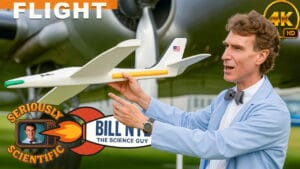



































































Flight
When you look up at the sky, it seems completely empty. So how can a massive jumbo jet weighing hundreds of tonnes fly through nothing? Let us discover the invisible forces that make flight possible!
How Can a Heavy Metal Machine Float on Air?
Air, which is a real substance! Even though we cannot see it, air is full of molecules. It is thick enough that aeroplanes can actually push against it to fly.
About 1 kilogram per square centimetre! The air around us creates massive pressure, and aeroplanes use clever shapes to change this pressure and lift themselves off the ground.
Put Your Instincts to the Test
Think about what you already know about aeroplanes and helicopters. Pick an answer for each question, then see if your instincts were right.
The aeroplane speeds up! Thrust pushes the plane forward, while drag tries to hold it back. When the forward push wins, you accelerate through the sky.
It turns the air downward and changes the air pressure! By forcing the air downward, the wing gets pushed upward in response, giving the aeroplane lift.
To stop the main body from spinning! Without the tail rotor pushing back, the spinning main rotor would cause the entire helicopter body to spin wildly in the opposite direction.
Understanding the Science
Tap each card to reveal the explanation and break down the forces of flight with Bill Nye the Science Guy.
Key Concepts
Lift
Tap to learn moreLift is the upward force that pushes an aircraft into the air. It is created by the wings moving rapidly through the air and deflecting it downward. For an aeroplane to take off, lift must be greater than gravity.
Weight (Gravity)
Tap to learn moreWeight is the downward force pulling all objects toward the centre of the Earth due to gravity. An aeroplane is extremely heavy, so its engines and wings must work very hard to fight this downward pull.
Thrust
Tap to learn moreThrust is the forward force produced by the aeroplane's powerful engines or propellers. This gives the plane the speed it needs to force air over the wings and generate lift.
Drag
Tap to learn moreDrag is the backward force caused by air resistance. It acts opposite to the direction of motion and tries to slow the aircraft down, much like walking through water feels harder than walking through air.
Airfoil
Tap to learn moreAn airfoil is the specific teardrop-like shape of a wing. It is carefully designed to cut through the air efficiently, changing the air pressure and turning the flow of air downward.
Aerodynamics
Tap to learn moreAerodynamics is the study of how air and gases flow around moving solid objects. Engineers study this to design aeroplanes, fast cars, and even to understand how birds fly so effortlessly.
Air Pressure
Tap to learn moreAir pressure is the heavy weight of all the air molecules pressing down on objects. At sea level, this pressure is incredibly strong, and aeroplanes use their shaped wings to manipulate this pressure to lift off.
Control Surfaces
Tap to learn moreAeroplanes steer using moving parts called control surfaces, like ailerons and elevators. By tilting these small flaps on the wings and tail, the pilot redirects the airflow, allowing the heavy plane to roll, pitch, and turn smoothly.
Try It: Interactive Wind Tunnel
Adjust the "Angle of Attack" (how much the wing is tilted up) and watch how the air flows around it. See if you can find the perfect angle for maximum lift before the wing stalls and loses power!
Apply Your Knowledge
Let us see if you can match the parts of an aeroplane to the four forces of flight they control.
Match the Concepts
Click an object to select it, then click the matching description to place it.
Real-World Challenge
Imagine you are an aerospace engineer tasked with designing a new aeroplane that needs to fly very slowly but carry a heavy load of cargo. How would you design the wings to create maximum lift at low speeds?
What Has Changed Since This Episode Aired
This episode first aired in 1993. While the core science of flight remains the same, aerospace engineering and our explanations of lift have advanced significantly.
Updated: While pressure differences are part of the equation, modern aerodynamics education has refined this explanation! Scientists now emphasise that lift is primarily caused by the wing turning the airflow downward. According to Isaac Newton's Third Law, pushing the air down creates an equal and opposite reaction that pushes the wing up!
Updated: Not entirely! Today, modern marvels like the Boeing 787 Dreamliner are made using more than 50% composite materials, such as carbon fibre. These composites are significantly lighter and stronger than aluminium, allowing aeroplanes to fly further while burning far less fuel.
Updated: Unmanned Aerial Vehicles (UAVs), commonly known as drones, have completely revolutionised aviation! Driven by advances in lightweight batteries and GPS, drones are now used globally to deliver packages, inspect bridges, film movies, and even explore other planets (like the Mars helicopter, Ingenuity).
Test Your Understanding
Answer these questions and get instant feedback. How many can you get right?
Results
Your score:
Reflection
Think about how heavily we rely on flight today, from passenger travel to next-day package deliveries. If aeroplanes were never invented, how would your daily life and the global economy be different?
Episode Discussion
Share your thoughts on this Bill Nye The Science Guy episode