




































Digestion
Bill Nye takes us on a journey through the digestive system, showing how our bodies break down food for energy. Every time we eat, our body works hard to process food, absorb nutrients, and get rid of waste. But how does it all happen?
In this episode, Bill Nye explains digestion step by step. He explores the roles of the stomach, intestines, and other digestive organs. He also shows how enzymes break down food and why our bodies need different nutrients to stay healthy.
How Digestion Works
Digestion begins the moment we take a bite. First, our teeth grind food into smaller pieces. Meanwhile, saliva starts breaking it down chemically. Once swallowed, food travels down the esophagus and into the stomach.
The stomach releases strong acids and enzymes to dissolve food into a liquid. Then, this mixture moves into the small intestine, where nutrients are absorbed into the blood. Finally, the leftover waste moves to the large intestine, where water is removed before the body gets rid of it.
Bill Nye compares digestion to a food factory. Each organ plays a role in turning food into usable energy. Without digestion, our bodies wouldn’t get the fuel they need to function.
Bill Nye’s Fun Experiments
Bill Nye brings digestion to life with exciting experiments.
- Stomach acid in action – He shows how stomach acid breaks down food, just like it does inside our bodies.
- Enzymes at work – Bill demonstrates how saliva and digestive enzymes help turn food into nutrients.
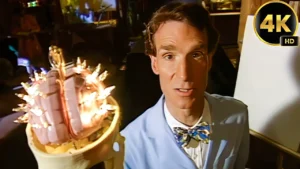
- The digestive system model – He uses a simple model to show how food moves through the body, explaining each step along the way.
Through these experiments, he proves that digestion is both fascinating and essential.
Why Digestion is Important
Digestion helps our bodies absorb nutrients from food. These nutrients give us energy, help us grow, and keep us healthy. Without digestion, we wouldn’t get essential vitamins, proteins, or minerals.
Bill also explains why eating the right foods matters. Fiber, for example, helps digestion by keeping food moving through the intestines. Meanwhile, water helps the body absorb nutrients more efficiently.
Modern Science and Digestion
Today, scientists study digestion to improve health and nutrition. Research has helped us understand the role of gut bacteria and how they help break down food. Additionally, medical advancements have led to better treatments for digestive problems like acid reflux and food intolerances.
Scientists continue to explore how digestion affects overall health, including its link to the immune system and brain function. Bill Nye reminds us that taking care of our digestive system leads to a healthier body.
Conclusion
Bill Nye wraps up by reminding us that digestion is a complex but amazing process. Every bite we take goes on a journey through our body, fueling us for daily life. Eating a balanced diet and staying hydrated helps keep the digestive system running smoothly.
So, the next time you eat your favorite food, remember—it’s all about digestion!
Home Page Link
Visit our homepage for more Seriously Scientific news and documentaries: SeriouslyScientific.com.
YouTube Channel Link
Subscribe to our YouTube channel for more science content: Seriously Scientific YouTube.
Bill Nye The Science Guy
02 // EPISODE_INDEX100 remastered episodes across 5 seasons of science education
Season 1 (20 episodes)
Bill Nye The Science Guy | Flight
Bill Nye The Science Guy | Earth's Crust
Bill Nye The Science Guy | Dinosaurs
Bill Nye The Science Guy | Skin
Bill Nye The Science Guy | Buoyancy
Bill Nye The Science Guy | Gravity
Bill Nye The Science Guy | Digestion
Bill Nye The Science Guy | Phases of Matter
Bill Nye The Science Guy | Biodiversity
Bill Nye The Science Guy | Simple Machines
Bill Nye The Science Guy | The Moon
Bill Nye The Science Guy | Sound
Bill Nye The Science Guy | Garbage
Bill Nye The Science Guy | Structures
Bill Nye The Science Guy | Earth's Seasons
Bill Nye The Science Guy | Light & Color
Bill Nye The Science Guy | Cells
Bill Nye The Science Guy | Electricity
Bill Nye The Science Guy | Outer Space
Bill Nye The Science Guy | Eyeballs
Season 2 (20 episodes)
Bill Nye The Science Guy | Magnetism
Bill Nye The Science Guy | Wind
Bill Nye The Science Guy | Blood & Circulation
Bill Nye The Science Guy | Chemical Reactions
Bill Nye The Science Guy | Static Electricity
Bill Nye The Science Guy | Food Webs
Bill Nye The Science Guy | Light Optics
Bill Nye The Science Guy | Bones & Muscle
Bill Nye The Science Guy | Oceanography
Bill Nye The Science Guy | Heat
Bill Nye The Science Guy | Insects
Bill Nye The Science Guy | Balance
Bill Nye The Science Guy | The Sun
Bill Nye The Science Guy | The Brain
Bill Nye The Science Guy | Forests
Bill Nye The Science Guy | Communication
Bill Nye The Science Guy | Momentum
Bill Nye The Science Guy | Reptiles
Bill Nye The Science Guy | Atmosphere
Bill Nye The Science Guy | Respiration
Season 3 (21 episodes)
Bill Nye The Science Guy | Planets & Moons
Bill Nye The Science Guy | Pressure
Bill Nye The Science Guy | Plants
Bill Nye The Science Guy | Rocks & Soil
Bill Nye The Science Guy | Energy
Bill Nye The Science Guy | Evolution
Bill Nye The Science Guy | The Water cycle
Bill Nye The Science Guy | Friction
Bill Nye The Science Guy | Germs
Bill Nye The Science Guy | Climates
Bill Nye The Science Guy | Waves
Bill Nye The Science Guy | Ocean Life
Bill Nye The Science Guy | Mammals
Bill Nye The Science Guy | Spinning Things
Bill Nye The Science Guy | Fish
Bill Nye The Science Guy | Human Transportation
Bill Nye The Science Guy | Wetlands
Bill Nye The Science Guy | Birds
Bill Nye The Science Guy | Populations
Bill Nye The Science Guy | Animal Locomotion
Bill Nye The Science Guy | Invertebrates
Season 4 (19 episodes)
Bill Nye The Science Guy | Rivers & Streams
Bill Nye The Science Guy | Nutrition
Bill Nye The Science Guy | Marine Mammals
Bill Nye The Science Guy | Earthquakes
Bill Nye The Science Guy | NTV Music Videos
Bill Nye The Science Guy | Spiders
Bill Nye The Science Guy | Pollution Solutions
Bill Nye The Science Guy | Probability
Bill Nye The Science Guy | Pseudoscience
Bill Nye The Science Guy | Flowers
Bill Nye The Science Guy | Archaeology
Bill Nye The Science Guy | Deserts
Bill Nye The Science Guy | Amphibians
Bill Nye The Science Guy | Volcanoes
Bill Nye The Science Guy | The Heart
Bill Nye The Science Guy | Inventions
Bill Nye The Science Guy | Computers
Bill Nye The Science Guy | Fossils
Bill Nye The Science Guy | Time
Season 5 (20 episodes)
Bill Nye The Science Guy | Forensics
Bill Nye The Science Guy | Space Exploration
Bill Nye The Science Guy | Genes
Bill Nye The Science Guy | Architecture
Bill Nye The Science Guy | Farming
Bill Nye The Science Guy | Life Cycles
Bill Nye The Science Guy | The Scientific Method
Bill Nye The Science Guy | Atoms
Bill Nye The Science Guy | Ocean Exploration
Bill Nye The Science Guy | Lakes and Ponds
Bill Nye The Science Guy | Smell
Bill Nye The Science Guy | Caves
Bill Nye The Science Guy | Erosion
Bill Nye The Science Guy | Fluids
Bill Nye The Science Guy | Comets and Meteors
Bill Nye The Science Guy | Measurement
Bill Nye The Science Guy | Patterns
Bill Nye The Science Guy | Storms
Bill Nye The Science Guy | Music
Bill Nye The Science Guy - Motion
Loading Biography...
Digestion
Based on Bill Nye the Science Guy · Season 1, Episode 7 · 22 min
Every day we eat meals and drink water, but where does it all go? Your body is an incredible biological machine designed to break down food into fuel. Let us take a journey down the dark, twisting tubes of your digestive system to see how your body gets the energy it needs to survive!
What Happens to the Food You Eat?
Not at all! Your stomach is just one stop on a very long journey. The entire process takes place across a continuous tube that stretches from your mouth all the way to the other end of your body.
For energy and building materials! Food is fuel. Your digestive system breaks large pieces of food into microscopic molecules so your blood can carry them to every single cell in your body.
Put Your Instincts to the Test
Think about what you already know about your own body. Pick an answer for each question, then see if your instincts were right.
In the mouth! Digestion starts the second you put food in your mouth. Your teeth crush the food, and your saliva begins to break it down chemically.
About 7 metres long! It is coiled up incredibly tightly inside your abdomen so it can fit inside your body.
12 hours to 2 days! It is a very slow and careful process to ensure your body extracts every last drop of energy and water.
Understanding the Science
Let us break down the twisting tubes and powerful acids that turn your dinner into energy with Bill Nye the Science Guy.
Key Concepts
Digestion
Tap to learn moreDigestion is the essential process of breaking food down into molecules small enough to be absorbed by your cells. It is how your body turns solid matter into useable fuel.
The Mouth
Tap to learn moreThe Mouth is where the journey begins. Teeth mechanically mash the food, while saliva chemically breaks it down to make it soft and slippery.
Oesophagus
Tap to learn moreThe oesophagus is the long muscular tube that pushes food from the back of your throat straight down into your stomach using powerful waves of muscle contractions.
Stomach
Tap to learn moreThe stomach is a muscular sac that acts like a blender. It mashes the food and mixes it with powerful hydrochloric acid to break the food apart completely.
Chyme
Tap to learn moreChyme is the scientific name for the soupy, liquid mixture of partially digested food and acid that leaves the stomach and enters the intestines.
Small Intestine
Tap to learn moreThe small intestine is a coiled tube measuring about 7 metres long. This is where the body actively absorbs the vital chemicals and nutrients it needs to live.
Large Intestine
Tap to learn moreThe large intestine is the wider tube that comes directly after the small intestine. Its primary job is to absorb water back into the body to prevent dehydration.
Faeces
Tap to learn moreFaeces is the name given to the solid waste produced by the digestive system. It is made of anything your body cannot use or digest, and it is eventually pushed out of the body entirely.
Try It: The Digestive Journey Simulator
Take control of the human digestive tract! Select different types of food to eat and watch as the bolus travels down the oesophagus. Monitor the real time data panel to track stomach acid levels and watch the nutrients get absorbed!
Live Vitals
Apply Your Knowledge
Let us see if you can match the parts of your digestive tract to the specific jobs they perform.
Match the Concepts
Click an object to select it, then click the matching description to place it.
Real-World Challenge
Imagine you are a doctor advising an athlete before a major marathon. Based on how long different foods take to pass through the stomach, what type of meal should they eat to get quick energy without feeling sick during the race?
What Has Changed Since This Episode Aired
This episode first aired in the 1990s. While our digestive organs are still in the exact same place, our scientific understanding of the bacteria living inside them has completely revolutionised modern medicine!
Updated: No! In the 1990s, scientists understood the basic mechanics of the intestines, but we barely understood the billions of bacteria living inside them. We now know that trillions of microbes make up the "gut microbiome". These friendly bacteria are absolutely crucial for breaking down tough foods, making vitamins, and keeping our immune system strong.
Updated: It is far more advanced than that! Scientists have discovered that the gut has its own complex network of nerves. It is often called the "second brain" because it constantly sends chemical signals directly to our actual brain, profoundly affecting our mood, stress levels, and overall mental health.
Updated: Not anymore! Engineers have successfully built advanced artificial robotic stomachs in modern laboratories. These incredible machines perfectly mimic human digestion, complete with realistic muscle contractions and artificial stomach acid, allowing scientists to safely test exactly how new medicines and foods break down.
Test Your Understanding
Answer these questions and get instant feedback. How many can you get right?
Results
Your score:
Reflection
Your digestive system works constantly, completely automatically, without you even having to think about it. What is one new healthy food you could add to your diet to help your digestive system run more smoothly?
Episode Discussion
Share your thoughts on this Bill Nye episode