















































Rivers & Streams
Every drop of rain that hits the ground begins a journey downhill, pulled by gravity toward the ocean. Along the way, that water carves valleys, builds waterfalls, feeds entire ecosystems, and powers human civilisation. Join Bill Nye the Science Guy on a wild ride down the river to discover how moving water shapes the land beneath it.
Where Does All That Water Go?
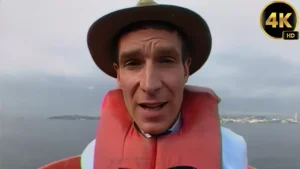
Gravity! Every single molecule of water in a river is being pulled downhill by the force of gravity. That is why rivers never flow uphill. As Bill Nye the Science Guy puts it while riding a boat: "We're all moving the same way: down, down!"
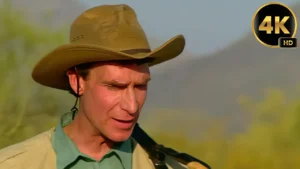
The Colorado River! It carved the Grand Canyon over millions of years. The word "canyon" comes from the Spanish cañon, meaning "tube." Bill Nye the Science Guy describes it as a huge U-shaped tube cut right through the desert floor by nothing more than flowing water and time.
Put Your Instincts to the Test
Think about what you already know about water and land. Pick an answer for each question, then see if your instincts were right.
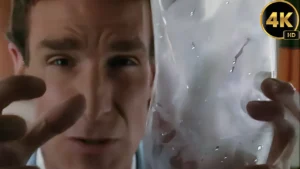
Branching, winding rills! Bill Nye the Science Guy demonstrates this using his "Big Clear Plastic Plates of Science." When water flows over sand, it breaks into small rivulets called rills, which merge into streams and eventually rivers. The water always finds the quickest path downhill, and that path is almost never straight.
Momentum! Water is heavy, and once it is moving in one direction, it tends to keep going that way. Bill Nye the Science Guy demonstrates this with a toy car on a ramp: the car does not just fall off the edge; it keeps moving upward for a moment. Rivers behave the same way. When water hits a rock or a curve in the bank, it changes direction rather than stopping, and over time those direction changes create the winding curves we call meanders.
Differential erosion! Bill Nye the Science Guy explains that rivers flow over layers of rock. Some layers are harder than others. The water wears away the soft rock much faster, creating an undercut beneath the hard layer. Eventually the hard rock juts out as a shelf, and the water pours over it as a waterfall.
Understanding the Science
Tap each card to unpack the physical forces and geological processes that allow rivers to shape entire continents over time.
Key Concepts
Gravity and Water Flow
Tap to learn moreThe force of gravity pulls every molecule of water downhill, which is why rivers never flow upward. The steeper the slope, the faster the water moves.
Rills and Tributaries
Tap to learn moreA rill is a tiny channel carved by rain or snowmelt first flowing across the surface. Rills merge into streams, streams join to form tributaries, and tributaries feed into rivers.
Erosion
Tap to learn moreErosion is the process by which flowing water wears away rock and soil, physically reshaping the land. The faster and heavier the flow, the more material it removes. The outside of a river bend erodes fastest because that is where the strongest current is concentrated.
Sediment Transport
Tap to learn moreRivers carry sediment (particles of rock, sand, and silt) from high ground to low ground. When the river slows down, it drops this load in a process called deposition, building sandbars, deltas, and flood plains.
Meanders
Tap to learn moreA meander is a natural curve in a river's path, formed when slow-moving water is deflected sideways by rocks and sediment. The more meanders a river has, the older it is.
Waterfalls
Tap to learn moreA waterfall forms when a river flows over layers of rock with different hardness. The soft rock underneath erodes faster than the hard rock on top, creating a ledge that the water pours over. This is called differential erosion.
Continental Divide
Tap to learn moreA continental divide is a mountain ridge that separates the drainage basins of an entire continent. Rain falling on one side flows to one ocean; rain on the other side flows to a different ocean. The Rocky Mountains divide North America's rivers between the Atlantic and Pacific.
Riparian Ecosystems
Tap to learn moreA riparian ecosystem is the community of plants and animals living along a river's banks. The vegetation acts like a sponge, soaking up water during floods and holding soil in place. Human pollution and river modification can damage these ecosystems.
Interactive: The Stream Table
Pour water from a single source and watch the channel pattern it carves across each material.
Instructions: Choose a material, then press POUR WATER. The same source produces a very different pattern depending on the bank strength of the material. Loose sand has weak banks and braids into many channels around bars. Cohesive clay has strong banks and cuts a single meandering channel. Try all three and compare.
Erosion on this surface: —
Width is how wide the wetted channel becomes. Sinuosity is how bendy it is: the channel's winding length divided by the straight distance to the sea, where 1.0 is dead straight. Together they name the pattern. A braided channel is wide with low sinuosity, a meandering channel is narrow with high sinuosity, and a straight channel is narrow with low sinuosity.
Apply Your Knowledge
Match each river feature to the geological process that creates it.
Match the Concepts
Click a scientific term to select it, then click the matching description to place it.
Real-World Challenge
Imagine your town is planning to build a small dam on a river upstream of your school. Using what you have learned about erosion, sediment transport, and riparian ecosystems, write a short report to the town council explaining at least three consequences (positive or negative) the dam could have on the river environment below it. Consider the fish, the vegetation on the banks, and the sediment that currently flows downstream.
What Has Changed Since This Episode Aired
This episode originally aired in the mid-1990s. Since then, our understanding of rivers and how we manage them has changed significantly.
Updated: Modern river science recognises that while dams provide benefits, they also cause significant ecological harm. Since the 1990s, over 1,900 dams have been removed across the United States. The most dramatic example is the Elwha Dam removal (2011 to 2014) on the Olympic Peninsula in Washington State, where salmon populations returned to upstream habitats within just a few years of the dam being taken out. Scientists now understand that dams block sediment transport, prevent fish migration, alter water temperature, and disrupt the natural flood cycles that riparian ecosystems depend on. Modern engineering increasingly looks for alternatives like run-of-river turbines that generate power without blocking the entire channel.
Updated: The pollution problem has expanded beyond visible litter. Research published since 2010 has revealed that rivers are major transport highways for microplastics, tiny fragments of plastic less than 5 millimetres across that are invisible to the naked eye. These particles come from degrading plastic waste, synthetic clothing fibres washed in laundry machines, and tyre wear on roads. Studies now estimate that rivers carry between 1.2 and 2.4 million tonnes of plastic into the oceans every year. Microplastics accumulate in river sediment, enter the food chain through aquatic organisms, and have been detected in drinking water supplies worldwide.
Updated: Climate change is fundamentally altering river systems worldwide. Warmer temperatures are accelerating glacier melt, which initially increases river flow but threatens to reduce it dramatically once glaciers disappear entirely. Many rivers that historically provided reliable year-round water are becoming seasonal or shrinking. Simultaneously, climate models show that extreme rainfall events are becoming more frequent and intense, leading to more severe flash floods. The Colorado River, which Bill Nye the Science Guy credits with carving the Grand Canyon, has seen its average flow decline by roughly 20% since 2000 due to reduced snowpack and increased evaporation in the warming American West.
Test Your Understanding
Answer these 10 questions and get instant feedback. How many can you get right?
Results
Your score:
Reflection
Bill Nye the Science Guy says "there's probably a river near where you're living right now." Think about the nearest river or stream to your home. Based on everything you have learned, would you describe it as a young river or an old river? What evidence would you look for to tell the difference?
Episode Discussion
Share your thoughts on this Bill Nye The Science Guy episode