












Gravity
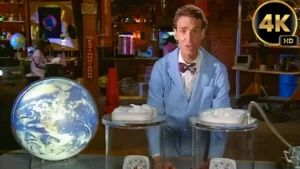
In this episode, Bill Nye explores how gravity works. He shows why all things, big or small, experience this force. From dropping objects to astronauts floating in space, gravity is always at play. As a result, we can predict how objects move and understand why planets stay in motion.
Gravity is the invisible force that pulls everything down. It keeps planets in orbit, makes objects fall, and holds us on Earth. Without gravity, we would float away!
What is Gravity?
Gravity is a pulling force between objects. The bigger the object, the stronger its gravity. For example, Earth’s gravity keeps us on the ground. Meanwhile, the Moon’s gravity is weaker, so astronauts feel much lighter there.
Everything falls because of gravity. However, in space, astronauts seem weightless. That’s because they are falling around Earth at the same speed as their spacecraft. Consequently, they experience microgravity, which creates the feeling of floating.
Bill Nye’s Fun Experiments
Bill Nye loves hands-on learning! In this episode, he demonstrates gravity with exciting experiments.
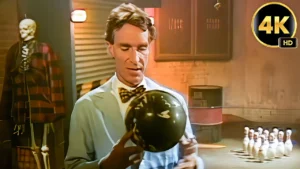
- Dropping objects – A bowling ball and a feather fall at the same speed in a vacuum. Without air resistance, all objects drop at the same rate. This proves that gravity affects all things equally.
- Jumping on different planets – Gravity is weaker on Mars than on Earth. Therefore, you could jump much higher. On the other hand, Jupiter’s gravity is much stronger, making it harder to jump.
- Centrifugal force – Bill explains why astronauts appear weightless in space. They are actually in constant free fall while orbiting Earth. As a result, they float inside their spacecraft.
Gravity in Everyday Life
Gravity does more than just pull things down. Engineers use gravity to design roller coasters, bridges, and rockets. For example, roller coasters wouldn’t have thrilling drops without gravity!
In space travel, scientists must calculate gravity carefully. Rockets need strong engines to escape Earth’s pull. Furthermore, astronauts train to move in low gravity before space missions. This helps them prepare for the challenges of space.
The Power of Gravity in Space
Gravity holds the universe together. It keeps planets orbiting the Sun and moons circling planets. In addition, it even shapes galaxies!
One of the strangest things in space is a black hole. Black holes have such strong gravity that nothing—not even light—can escape them. Consequently, scientists study gravity to understand how the universe works.
Conclusion
Bill Nye reminds us that gravity is everywhere. It keeps us grounded and controls the movement of planets and stars. Thanks to gravity, we experience gravity-defying fun on roller coasters. Additionally, it helps us explore the universe.
By understanding gravity, we can build better machines, travel to space, and uncover cosmic mysteries. So, the next time you drop something, remember—it’s gravity in action!
More Seriously Scientific Links
Visit our homepage for more Seriously Scientific news and documentaries: https://seriouslyscientific.com.
Subscribe to our YouTube channel for more science content: https://youtube.com/@seriouslyscientific.
Get free science worksheets for students and educators: https://teacherspayteachers.com/Store/Seriously-Scientific.
Follow us on BlueSky: https://bsky.app/profile/seriouslysci.bsky.social.
Bill Nye The Science Guy
02 // EPISODE_INDEX100 remastered episodes across 5 seasons of science education
Season 1 (20 episodes)
Bill Nye The Science Guy | Flight
Bill Nye The Science Guy | Earth's Crust
Bill Nye The Science Guy | Dinosaurs
Bill Nye The Science Guy | Skin
Bill Nye The Science Guy | Buoyancy
Bill Nye The Science Guy | Gravity
Bill Nye The Science Guy | Digestion
Bill Nye The Science Guy | Phases of Matter
Bill Nye The Science Guy | Biodiversity
Bill Nye The Science Guy | Simple Machines
Bill Nye The Science Guy | The Moon
Bill Nye The Science Guy | Sound
Bill Nye The Science Guy | Garbage
Bill Nye The Science Guy | Structures
Bill Nye The Science Guy | Earth's Seasons
Bill Nye The Science Guy | Light & Color
Bill Nye The Science Guy | Cells
Bill Nye The Science Guy | Electricity
Bill Nye The Science Guy | Outer Space
Bill Nye The Science Guy | Eyeballs
Season 2 (20 episodes)
Bill Nye The Science Guy | Magnetism
Bill Nye The Science Guy | Wind
Bill Nye The Science Guy | Blood & Circulation
Bill Nye The Science Guy | Chemical Reactions
Bill Nye The Science Guy | Static Electricity
Bill Nye The Science Guy | Food Webs
Bill Nye The Science Guy | Light Optics
Bill Nye The Science Guy | Bones & Muscle
Bill Nye The Science Guy | Oceanography
Bill Nye The Science Guy | Heat
Bill Nye The Science Guy | Insects
Bill Nye The Science Guy | Balance
Bill Nye The Science Guy | The Sun
Bill Nye The Science Guy | The Brain
Bill Nye The Science Guy | Forests
Bill Nye The Science Guy | Communication
Bill Nye The Science Guy | Momentum
Bill Nye The Science Guy | Reptiles
Bill Nye The Science Guy | Atmosphere
Bill Nye The Science Guy | Respiration
Season 3 (21 episodes)
Bill Nye The Science Guy | Planets & Moons
Bill Nye The Science Guy | Pressure
Bill Nye The Science Guy | Plants
Bill Nye The Science Guy | Rocks & Soil
Bill Nye The Science Guy | Energy
Bill Nye The Science Guy | Evolution
Bill Nye The Science Guy | The Water cycle
Bill Nye The Science Guy | Friction
Bill Nye The Science Guy | Germs
Bill Nye The Science Guy | Climates
Bill Nye The Science Guy | Waves
Bill Nye The Science Guy | Ocean Life
Bill Nye The Science Guy | Mammals
Bill Nye The Science Guy | Spinning Things
Bill Nye The Science Guy | Fish
Bill Nye The Science Guy | Human Transportation
Bill Nye The Science Guy | Wetlands
Bill Nye The Science Guy | Birds
Bill Nye The Science Guy | Populations
Bill Nye The Science Guy | Animal Locomotion
Bill Nye The Science Guy | Invertebrates
Season 4 (19 episodes)
Bill Nye The Science Guy | Rivers & Streams
Bill Nye The Science Guy | Nutrition
Bill Nye The Science Guy | Marine Mammals
Bill Nye The Science Guy | Earthquakes
Bill Nye The Science Guy | NTV Music Videos
Bill Nye The Science Guy | Spiders
Bill Nye The Science Guy | Pollution Solutions
Bill Nye The Science Guy | Probability
Bill Nye The Science Guy | Pseudoscience
Bill Nye The Science Guy | Flowers
Bill Nye The Science Guy | Archaeology
Bill Nye The Science Guy | Deserts
Bill Nye The Science Guy | Amphibians
Bill Nye The Science Guy | Volcanoes
Bill Nye The Science Guy | The Heart
Bill Nye The Science Guy | Inventions
Bill Nye The Science Guy | Computers
Bill Nye The Science Guy | Fossils
Bill Nye The Science Guy | Time
Season 5 (20 episodes)
Bill Nye The Science Guy | Forensics
Bill Nye The Science Guy | Space Exploration
Bill Nye The Science Guy | Genes
Bill Nye The Science Guy | Architecture
Bill Nye The Science Guy | Farming
Bill Nye The Science Guy | Life Cycles
Bill Nye The Science Guy | The Scientific Method
Bill Nye The Science Guy | Atoms
Bill Nye The Science Guy | Ocean Exploration
Bill Nye The Science Guy | Lakes and Ponds
Bill Nye The Science Guy | Smell
Bill Nye The Science Guy | Caves
Bill Nye The Science Guy | Erosion
Bill Nye The Science Guy | Fluids
Bill Nye The Science Guy | Comets and Meteors
Bill Nye The Science Guy | Measurement
Bill Nye The Science Guy | Patterns
Bill Nye The Science Guy | Storms
Bill Nye The Science Guy | Music
Bill Nye The Science Guy - Motion
Loading Biography...
Gravity
Based on Bill Nye the Science Guy · Season 1, Episode 6 · 22 min
Have you ever wondered why everything that goes up must eventually come down? It is not just a random rule of nature. It is a massive, invisible force pulling you towards the exact centre of the Earth! Let us dive into the heavy science of gravity and discover what holds the entire universe together.
What Keeps Your Feet Firmly on the Ground?
Not exactly! There is no real "down" in space. Gravity actually pulls everything towards the exact centre of an object's mass. This is why people in Australia do not fall off the bottom of the Earth!
No, it exists everywhere! Absolutely everything with mass has gravity, including you! Your body is currently pulling gently on everything in the room around you, but the Earth is just so massive that its pull overrides yours.
Put Your Instincts to the Test
Think about what you already know about falling objects and space. Pick an answer for each question, then see if your instincts were right.
They both hit at the exact same time! Gravity pulls all objects and makes them accelerate at the exact same rate, no matter how heavy they are.
Because gravity pulls equally towards the centre! When a planet has enough mass, gravity crushes it from all sides into a perfectly round ball.
On Jupiter! Because Jupiter is incredibly massive, its gravitational pull is significantly stronger than Earth's, making you feel overwhelmingly heavy.
Understanding the Science
Let us break down the invisible forces, falling objects, and massive celestial bodies with Bill Nye the Science Guy.
Key Concepts
Gravity
Tap to learn moreGravity is the invisible pulling force that exists between all objects with mass. It is what keeps us on the ground and holds the moon securely in the sky.
Mass
Tap to learn moreMass is the absolute amount of matter or "stuff" inside an object. The more mass an object has, the stronger its gravitational pull becomes.
Weight
Tap to learn moreWeight is a measurement of how strongly gravity is pulling on your specific mass. Your mass stays the exact same everywhere, but your weight changes depending on what planet you visit!
Acceleration
Tap to learn moreAcceleration is the rate at which a falling object speeds up. On Earth, gravity accelerates all falling objects at a constant speed, completely regardless of how heavy they are.
Orbit
Tap to learn moreAn orbit is the circular path an object takes around a much more massive object. The Earth stays in orbit around the Sun because the Sun's massive gravity constantly pulls on it like an invisible tether.
Sphere
Tap to learn moreA sphere is the natural shape of all planets and stars. Gravity pulls matter equally from all sides towards the very centre, forming a beautifully perfect round ball.
Air Resistance
Tap to learn moreAir resistance is the upward friction caused by air molecules pushing against a falling object. A flat piece of paper falls slower than a crumpled one only because the air catches its wide surface.
Microgravity
Tap to learn moreMicrogravity is the unique feeling of weightlessness astronauts experience in space. They are not free from gravity; they are just falling completely around the Earth at the exact same speed as their spaceship!
Try It: Interactive Planetary Drop Zone
Test Galileo's famous experiment across the solar system! Use the yellow slider to select a celestial body, then press Drop to release an apple and a bowling ball at the exact same time. Notice how the pull of gravity changes their acceleration!
Apply Your Knowledge
Let us see if you can match these gravitational effects to their real-world examples.
Match the Concepts
Click an object to select it, then click the matching description to place it.
Real-World Challenge
Imagine you are designing a brand new sport to be played on the Moon. Because the Moon has only one-sixth the gravity of Earth, how would you specifically design the playing field, the ball, and the scoring system to make the game fun and challenging?
What Has Changed Since This Episode Aired
This episode first aired in 1993. While objects still fall to the ground at the exact same speed, our advanced understanding of gravity across the universe has completely evolved!
Updated: Yes! In 2015, scientists successfully detected gravitational waves for the very first time. When two massive black holes collided over 1.3 billion light years away, they sent violent, invisible ripples through the fabric of the universe that we measured right here on Earth.
Updated: Actually, it is slightly lumpy! Advanced satellites like the GRACE mission have meticulously mapped Earth's gravity and found it varies. The gravitational pull is slightly stronger over incredibly dense mountain ranges and slightly weaker over deep, empty ocean trenches.
Updated: In 2019, scientists successfully captured the very first actual photograph of a supermassive black hole in the galaxy M87! Its gravity is so unimaginably powerful because the black hole is an astounding 6.5 billion times more massive than our Sun.
Test Your Understanding
Answer these questions and get instant feedback. How many can you get right?
Results
Your score:
Reflection
Gravity connects everything in the universe, from the apple falling from a tree to the moon orbiting our planet. If you could temporarily turn off gravity in your bedroom for ten minutes, what is the very first experiment you would try?
Episode Discussion
Share your thoughts on this Bill Nye episode