





































































Magnetism
Did you know that you live on a giant magnet? In this lesson, we will explore the mysterious power of magnetism, discover why opposites attract, and learn how moving electrons create magnetic fields that stretch all the way into space!
The Invisible Power
No, it will not! Magnets only stick to three specific metals: iron, nickel, and cobalt[cite: 4]. They will not stick to gold, silver, aluminium, or rubber dinosaurs[cite: 4]. Because steel contains a lot of iron, magnets stick to refrigerators and even giant steel structures like the Eiffel Tower[cite: 4].
You get two smaller magnets! Bill Nye the Science Guy shows us that you cannot separate a North pole from a South pole[cite: 4]. If you break a magnet in half, both new pieces will immediately have their own North and South poles[cite: 4].
Put Your Instincts to the Test
Think about what you already know about magnets. Pick an answer for each question, then see if your instincts were right.
They push away from each other. This is called repelling[cite: 4]. Like poles always repel. However, opposite poles pull together. Remember the golden rule of magnetism: opposites attract[cite: 4]!
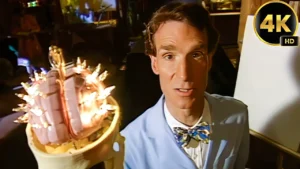
An electromagnet! Magnetism comes from moving electrons[cite: 4]. When you connect the battery, electricity flows through the wire coil, creating a magnetic field that turns the iron nail into a temporary magnet[cite: 4]. If you disconnect the battery, the magnetism stops immediately[cite: 4].
Jupiter! Bill Nye explains that while some planets like Mars and Venus lack planetary magnetic fields, Jupiter has a massive one[cite: 4]. The Earth's magnetic field is strong enough to extend into space, but Jupiter's is 20,000 times stronger[cite: 4].
Understanding the Science
Tap each card to reveal the explanation of how invisible magnetic forces shape our world.
Key Concepts
Poles of a Magnet
Tap to learn moreEvery magnet has two ends, called a North pole and a South pole[cite: 4]. The invisible force of magnetism flows between these two ends. Opposite poles attract each other, pulling together[cite: 4]. Like poles repel each other, pushing apart with surprising strength! Bill Nye demonstrates this using magnetic electron cars, showing that you can never have a magnet with just one pole[cite: 4].
Magnetic Domains
Tap to learn moreInside a piece of iron, tiny electrons are spinning around in areas called domains[cite: 4]. In normal iron, these domains point in all different directions[cite: 4]. But when the iron becomes magnetised, all the domains line up in the exact same direction[cite: 4]. This alignment creates the powerful North and South poles.
The Earth as a Magnet
Tap to learn moreThe centre of our planet is full of churning, melted iron and nickel[cite: 4]. As the Earth spins, these liquid metals move, causing electrons to flow in huge loops[cite: 4]. This turns the entire Earth into a giant magnet and is the reason a compass needle always points North[cite: 4]. The magnetic field extends way out into space, protecting us from solar particles.
Electromagnets
Tap to learn moreMagnetism is caused by moving electrons, which is another word for electricity[cite: 4]. If you run electricity through a coil of wire wrapped around a piece of iron, you create an electromagnet[cite: 4]! You can turn these magnets on and off just by flipping a switch. Bill Nye shows how connecting a battery to a wire coil instantly creates enough magnetism to lift a heavy weight[cite: 4].
The Auroras
Tap to learn moreThe sun shoots out charged particles called the solar wind[cite: 4]. When these particles hit the Earth, our magnetic field traps them and funnels them toward the poles[cite: 4]. When they hit the atmosphere, they make the air glow, creating the Northern and Southern Lights, also known as the Aurora Borealis and Aurora Australis[cite: 4].
Magnetic Resonance Imaging (MRI)
Tap to learn moreMagnets are used in medicine too! An MRI machine uses incredibly powerful magnets and radio waves to look deep inside the human body[cite: 4]. Doctors use these giant magnets to safely take detailed pictures of a patient's brain without having to do surgery[cite: 4].
Lodestone
Tap to learn moreNot all magnets are made in a factory. Magnetite, also known as lodestone, is a naturally occurring magnetic rock found in the Earth. Ancient people discovered that if they floated a piece of lodestone on water, it would naturally align itself with the Earth's magnetic North, creating the very first compasses.
Magnetic Field Lines
Tap to learn moreEven though we cannot see magnetism, it surrounds a magnet in a specific pattern[cite: 4]. These are called magnetic field lines. They always flow out from the North pole and curve around to enter the South pole. You can actually see this shape if you sprinkle iron powder over a piece of paper with a magnet underneath, as Bill Nye demonstrates in his laboratory[cite: 4].
Try It: The Electromagnet Crane
Press and hold the button to close the circuit. Watch how moving electrons create a temporary magnetic field capable of lifting the iron block!
Apply Your Knowledge
Let us see if you can connect what you have learned about magnetism to real-world examples.
Match the Concepts
Click an object to select it, then click the matching description to place it.
Real-World Challenge
Imagine you have been hired to build a recycling machine that separates different types of rubbish. People throw in aluminium cans, plastic bottles, gold jewellery, iron nails, and copper wire. How could you use a giant electromagnet to help sort this material? What would stick to the magnet, and what would fall right past it?
What Has Changed Since This Episode Aired
This episode of Bill Nye the Science Guy first aired in 1993. While the core science of magnetism remains accurate, our understanding has advanced significantly in the past few decades.
Updated: Scientists have recently discovered that birds can actually "see" the magnetic field using a quantum mechanical process. A special light-sensitive protein in their eyes called cryptochrome reacts to blue light and the Earth's magnetic field simultaneously. This allows migratory birds to perceive the magnetic field's inclination, essentially overlaying a magnetic compass directly onto their vision.
Updated: Yes! NASA's Parker Solar Probe recently flew directly into the Sun's atmosphere to discover how the solar wind gets supercharged. Scientists found that powerful "magnetic switchbacks", which are large kinks in the Sun's magnetic field lines, act like explosive slingshots. This process, called magnetic reconnection, heats and accelerates the plasma particles to hundreds of kilometres per second before they ever reach Earth.
Updated: Maglev trains are no longer just experimental prototypes. Commercial Maglev (Magnetic Levitation) trains now operate in several countries. Because they float on powerful magnetic fields, there is no friction from wheels on a track. The Shanghai Maglev Train in China, for example, reaches incredible speeds of over 430 kilometres per hour, pointing the way to a future of hyper-fast travel.
Test Your Understanding
Answer these questions and get instant feedback. How many can you get right?
Results
Your score:
Reflection
Look around the room you are in right now. Based on what you learned about magnetism and moving electrons, how many items can you spot that probably have hidden magnets inside them?
Episode Discussion
Share your thoughts on this Bill Nye The Science Guy episode