











































NTV Studio Countdown
Eleven science songs. One smoke ring cannon. You are the VJ in the NTV studio, and the only way to lock a record into the chart is to blast the right answer clean off the wall. Tap an answer, fire the box, and count it down from 11 to 1.
Roll Camera
Welcome to NTV
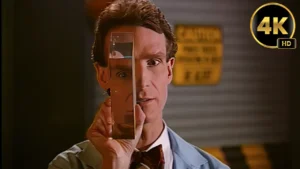
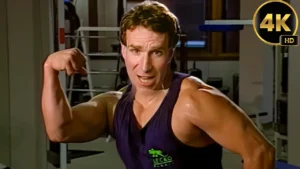
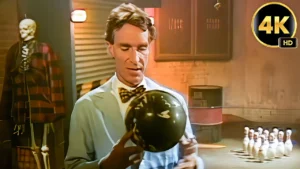
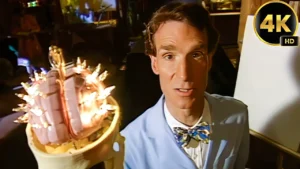
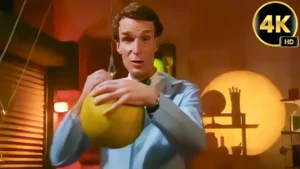
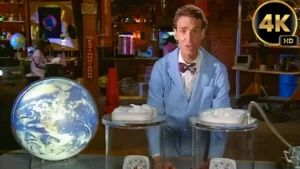
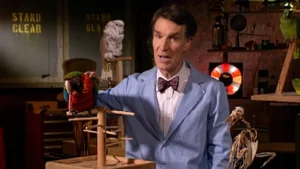
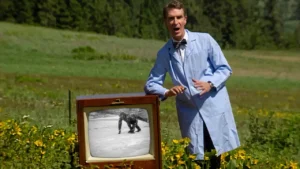
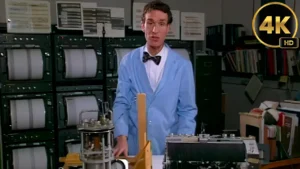
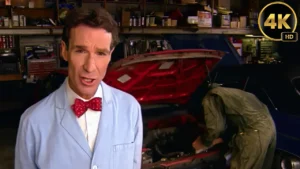
In December 1995, Bill Nye turned his studio over to the NTV Music Awards! There was no need for explosive experiments, just a massive countdown of some of the biggest science soundtracks from the show so far. It was all hosted by a man in a bow tie who defintely chose the right way to roll with it! Let's have check you're plugged it, then let the countdown begin...
Because eleven is a prime number, and Bill thought that was funnier than a round ten. A prime can only be divided cleanly by itself and one. Ten splits into halves and fifths. Eleven refuses to split into anything.
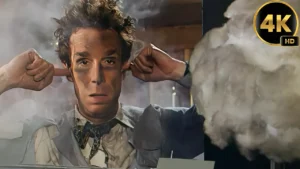
It's Bill's vortex ring generator. A box with a hole in the front and a stretchy sheet across the back. Tap the sheet and the pressure inside rises, so air escapes through the hole. Fill it with fog first and you can watch the ring fly across the room.
Nine of the eleven are parodies of real chart hits from the early nineties, recorded by joke bands with names like AB+, Momentisey and Trash-E-Trash. Two of them are not based on any real song. Watch for those.
The Countdown
Fire the smoke ring cannon
Each record rolls in with a question. Tap the answer you think is right and the cannon fires a smoke ring at it. You must find the correct answer to unlock the record, flip the sleeve over, and reveal the real chart hit it parodies!
NTV Studio Countdown
Press Start Countdown to bring in the first record.
Sleeve flip
Track List
Where every record came from
Not one of these songs was written for the countdown. Each was lifted from an earlier episode, which means every track on the chart is a door into a full lesson. Two of them are not parodies of anything, and the joke is hiding in the band name instead.
No. 11 · Blood Stream, by AB+
Tap to learn moreA parody of "Love Shack" by The B-52's. Your heart has four chambers and works as two pumps side by side. Blood leaves through arteries and returns through veins.
No. 10 · Let's Talk About Stress, by Stress N' Tension
Tap to learn moreA parody of Salt-N-Pepa. Compression squashes a material and tension stretches it. Every building standing up is holding both at once.
No. 9 · The Faster You Push Me, by Momentisey
Tap to learn moreA parody of Morrissey, and the band name is the best joke on the record. Momentum is mass multiplied by velocity, so a heavier thing at the same speed carries more of it.
No. 8 · Whether the Weather, by Climate Report
Tap to learn moreA parody of "Lucas with the Lid Off", a 1994 one hit wonder. Climate is the pattern a place gets year after year, not the weather outside today.
No. 7 · Whatta Brain, by En Lobe
Tap to learn moreA parody of "Whatta Man" by En Vogue with Salt-N-Pepa. The brain and the spinal cord together make the central nervous system.
No. 6 · How Can We Communicate?, by Mary Chapin Communicator
Tap to learn moreA parody of Mary Chapin Carpenter. Squid talk in colour, flashing signals using skin cells called chromatophores.
No. 5 · Two Eyes, by The Eye Doctors
Tap to learn moreA parody of "Two Princes" by the Spin Doctors. Two eyes give two slightly different views, and your brain fuses them into a sense of depth.
No. 4 · Friction Happens, by Grace Slip
Tap to learn moreThis one is not a parody. There is no original song behind it, it was written from scratch, and the joke is the made-up band name, a play on the singer Grace Slick. Friction turns movement into heat, and without it you could not walk.
No. 3 · Power to the Plankton, by James Baleen
Tap to learn moreAlso not a parody. Another original tune with no source song. James Baleen is James Brown crossed with a whale. Plankton drifts at the base of the ocean food web, and nearly everything else depends on it.
No. 2 · R-E-C-Y-C-L-E, by Trash-E-Trash
Tap to learn moreA parody of "Respect", sung by Aretha Franklin but written by Otis Redding. Reduce comes first for a reason: the easiest rubbish to deal with is the rubbish you never made.
No. 1 · Water Cycle Jump, by J.A.C.
Tap to learn moreA parody of "Jump" by Kris Kross. The whole water cycle is powered by the sun, and it never stops running.
Build It
Build your own air cannon
In the studio Bill used a fog machine so you could see the rings flying. We are going to build the same thing a safer way, as an air cannon, with no smoke at all. It fires an invisible ring of spinning air that can knock a tower of paper cups flying from right across the room and ruffle someone's hair from the far side. It takes about ten minutes to make, and the science is exactly the same as the one Bill demonstrates. An adult should always help, especially with the cutting.
What you need
How to build it, step by step
- Pick your container. A sturdy cardboard box works, and so does a bucket or a round tub with one open end. A round container makes rounder rings, but a box is easiest to find. Tape any flaps shut so the only opening you make is the one you want.
- Cut the hole. In the middle of one end, cut a neat round hole about as wide as your fist. Ask an adult to do this part. The rest of that end must stay solid, because the hole is the only escape route for the air.
- Fit the drum skin. Stretch a bin bag, an old shower curtain, or a large balloon tightly across the open end. Pull it as tight as a drum skin, then tape it down all the way round so no air can sneak out at the edges. The tighter and more airtight it is, the harder your cannon will hit.
- Aim and fire. Point the hole at a tower of paper cups a few steps away. Give the middle of the sheet a firm, quick tap with your hand. A burst of air shoots out of the hole and knocks the cups flying, even though you cannot see a thing.
- Try some challenges. How far back can you stand and still topple the cups? Can you put out a candle from across the room, with an adult watching? Line up a target and see how accurate you can be. Try a bigger hole and a smaller one, and notice how it changes the shot.
Want to see the rings, like Bill did? You do not need to, the cannon works perfectly with plain air. But if you want them visible, an adult can add a little fog. The safe, flame free options are a party fog machine, or a small water mister. Dry ice in warm water also works but it burns skin and needs gloves and an open window, so that one is strictly an adult job. Never use anything that burns or makes a flame inside the box.
Always fire away from faces, and always ask an adult before you start.
The science, in three taps
A spinning ring of air, shaped like a doughnut, curling from the outside in as it travels. That spin is what holds it together and lets it cross a whole room, while an ordinary puff of air falls apart right in front of your face. When you tap the sheet you squeeze the air inside, raising the pressure, and it rushes out of the hole as a pressure wave that rolls itself into the ring.
A ring can only hold so much spin. Once you have pushed out a puff about four times as long as the hole is wide, the ring is full and lets go. Shove harder than that and the extra air never joins the ring, it just trails behind and does nothing. Scientists call this limit the formation number. A firm, quick tap sits right on the sweet spot.
A squid swims by squirting rings of water out behind it, at a stroke almost exactly four times the width of its nozzle, the same sweet spot. It has been doing it for millions of years. Track 6 of your countdown was singing about that very animal.
Episode Discussion
Share your thoughts on this Bill Nye The Science Guy episode