









Eyeballs
Introduction to Eyeballs
Your eyes let you see the world, but how do they actually work? In this episode, Bill Nye explores eyeballs, explaining how light enters the eye, how the brain processes images, and why different animals see in unique ways.
The human eye works a lot like a camera. It captures light, focuses it, and sends signals to the brain. Because of this, we can see colors, shapes, and movement. Bill Nye explains why some people need glasses and how vision changes in different lighting.
How Do Eyeballs Work?
Light is the key to vision. When light enters the eye, it travels through several parts that help focus and process the image:
- Cornea – The clear outer layer that bends light.
- Pupil – The dark center that adjusts to control how much light enters.
- Lens – A flexible part that focuses light onto the retina.
- Retina – A layer of cells that detects light and sends signals to the brain.
- Optic nerve – Carries the image to the brain, where it is processed.
Since our brains interpret what our eyes see, vision is actually a combination of light, focus, and brainpower.
Bill Nye’s Fun Experiments on Eyeballs
Bill Nye makes learning about eyeballs exciting with hands-on experiments!
- Blind spot test – He shows how everyone has a small area where they can’t see.
- Pupil reaction demo – He explains why pupils get bigger or smaller in different lighting.
- Upside-down vision test – He demonstrates how the brain flips images to help us see correctly.
These experiments prove that vision is not just about the eyes—it also depends on the brain.
Why Do Some People Need Glasses?
Not everyone sees perfectly. Some people need glasses or contact lenses because their eyes don’t focus light correctly. This happens when:
- Nearsightedness (Myopia) – The eyeball is too long, making distant objects blurry.
- Farsightedness (Hyperopia) – The eyeball is too short, making close objects blurry.
- Astigmatism – The cornea has an irregular shape, distorting vision.
Because lenses bend light, they help correct vision by focusing images properly on the retina.
How Do Animals See the World?
Not all eyes work the same way. Animals have different types of vision based on their needs.
- Owls have large eyes to see in the dark.
- Insects have compound eyes that detect movement quickly.
- Fish have eyes adapted for underwater vision.
- Eagles have sharp eyesight to spot prey from far away.
Since vision helps animals survive, their eyes have evolved in ways that suit their environment.
Conclusion on Eyeballs
Your eyes are an amazing part of your body. Bill Nye reminds us that vision depends on light, focus, and the brain working together.
Next time you blink, adjust to bright light, or wear glasses, remember—your eyeballs are doing incredible work!
Home Page Link
Visit our homepage for more Seriously Scientific news and documentaries: SeriouslyScientific.com.
YouTube Channel Link
Subscribe to our YouTube channel for more science content: Seriously Scientific YouTube.
Free Worksheets for Teachers & Students
Get free science worksheets for students and educators: Seriously Scientific on TPT.
Bill Nye The Science Guy
02 // EPISODE_INDEX100 remastered episodes across 5 seasons of science education
Season 1 (20 episodes)
Bill Nye The Science Guy | Flight
Bill Nye The Science Guy | Earth's Crust
Bill Nye The Science Guy | Dinosaurs
Bill Nye The Science Guy | Skin
Bill Nye The Science Guy | Buoyancy
Bill Nye The Science Guy | Gravity
Bill Nye The Science Guy | Digestion
Bill Nye The Science Guy | Phases of Matter
Bill Nye The Science Guy | Biodiversity
Bill Nye The Science Guy | Simple Machines
Bill Nye The Science Guy | The Moon
Bill Nye The Science Guy | Sound
Bill Nye The Science Guy | Garbage
Bill Nye The Science Guy | Structures
Bill Nye The Science Guy | Earth's Seasons
Bill Nye The Science Guy | Light & Color
Bill Nye The Science Guy | Cells
Bill Nye The Science Guy | Electricity
Bill Nye The Science Guy | Outer Space
Bill Nye The Science Guy | Eyeballs
Season 2 (20 episodes)
Bill Nye The Science Guy | Magnetism
Bill Nye The Science Guy | Wind
Bill Nye The Science Guy | Blood & Circulation
Bill Nye The Science Guy | Chemical Reactions
Bill Nye The Science Guy | Static Electricity
Bill Nye The Science Guy | Food Webs
Bill Nye The Science Guy | Light Optics
Bill Nye The Science Guy | Bones & Muscle
Bill Nye The Science Guy | Oceanography
Bill Nye The Science Guy | Heat
Bill Nye The Science Guy | Insects
Bill Nye The Science Guy | Balance
Bill Nye The Science Guy | The Sun
Bill Nye The Science Guy | The Brain
Bill Nye The Science Guy | Forests
Bill Nye The Science Guy | Communication
Bill Nye The Science Guy | Momentum
Bill Nye The Science Guy | Reptiles
Bill Nye The Science Guy | Atmosphere
Bill Nye The Science Guy | Respiration
Season 3 (21 episodes)
Bill Nye The Science Guy | Planets & Moons
Bill Nye The Science Guy | Pressure
Bill Nye The Science Guy | Plants
Bill Nye The Science Guy | Rocks & Soil
Bill Nye The Science Guy | Energy
Bill Nye The Science Guy | Evolution
Bill Nye The Science Guy | The Water cycle
Bill Nye The Science Guy | Friction
Bill Nye The Science Guy | Germs
Bill Nye The Science Guy | Climates
Bill Nye The Science Guy | Waves
Bill Nye The Science Guy | Ocean Life
Bill Nye The Science Guy | Mammals
Bill Nye The Science Guy | Spinning Things
Bill Nye The Science Guy | Fish
Bill Nye The Science Guy | Human Transportation
Bill Nye The Science Guy | Wetlands
Bill Nye The Science Guy | Birds
Bill Nye The Science Guy | Populations
Bill Nye The Science Guy | Animal Locomotion
Bill Nye The Science Guy | Invertebrates
Season 4 (19 episodes)
Bill Nye The Science Guy | Rivers & Streams
Bill Nye The Science Guy | Nutrition
Bill Nye The Science Guy | Marine Mammals
Bill Nye The Science Guy | Earthquakes
Bill Nye The Science Guy | NTV Music Videos
Bill Nye The Science Guy | Spiders
Bill Nye The Science Guy | Pollution Solutions
Bill Nye The Science Guy | Probability
Bill Nye The Science Guy | Pseudoscience
Bill Nye The Science Guy | Flowers
Bill Nye The Science Guy | Archaeology
Bill Nye The Science Guy | Deserts
Bill Nye The Science Guy | Amphibians
Bill Nye The Science Guy | Volcanoes
Bill Nye The Science Guy | The Heart
Bill Nye The Science Guy | Inventions
Bill Nye The Science Guy | Computers
Bill Nye The Science Guy | Fossils
Bill Nye The Science Guy | Time
Season 5 (20 episodes)
Bill Nye The Science Guy | Forensics
Bill Nye The Science Guy | Space Exploration
Bill Nye The Science Guy | Genes
Bill Nye The Science Guy | Architecture
Bill Nye The Science Guy | Farming
Bill Nye The Science Guy | Life Cycles
Bill Nye The Science Guy | The Scientific Method
Bill Nye The Science Guy | Atoms
Bill Nye The Science Guy | Ocean Exploration
Bill Nye The Science Guy | Lakes and Ponds
Bill Nye The Science Guy | Smell
Bill Nye The Science Guy | Caves
Bill Nye The Science Guy | Erosion
Bill Nye The Science Guy | Fluids
Bill Nye The Science Guy | Comets and Meteors
Bill Nye The Science Guy | Measurement
Bill Nye The Science Guy | Patterns
Bill Nye The Science Guy | Storms
Bill Nye The Science Guy | Music
Bill Nye The Science Guy - Motion
Loading Biography...
Sight and Vision
Based on Bill Nye the Science Guy · Season 1, Episode 20 · 23 min
You might think your eyes work like perfect little video cameras, but the truth is much stranger. Did you know that the images projected onto the back of your eye are actually completely upside down?
How Does Your Brain See the World?
It is completely upside down! Your brain takes the upside down images from both eyes, turns them right side up, mixes them together, and makes sense of what you see.
To give us depth perception and let us see in 3-D. Because your eyes are spaced slightly apart, they send two slightly different pictures to your brain. Your brain fuses these together to figure out how far away objects are!
Put Your Instincts to the Test
Think about what you already know about your eyes. Pick an answer for each question, then see if your instincts were right.
Cones! Your retina is packed with two types of cells: rods and cones. Cones need bright light to work and are responsible for letting you see thousands of different colours.
The amount of melanin in the iris. People with brown eyes have a lot of melanin, while people with blue eyes have very little. The iris is the part that regulates how much light enters your eye!
It changes its shape and thickness. It squeezes and stretches by about a tenth of a millimetre to shift focus from the end of your nose to 20 miles away!
Understanding the Science
Tap each card to reveal how the different parts of your eye work together to let you see the world.
Key Concepts
The Iris
Tap to learn moreThis is the coloured part of your eye. It controls how much light enters by changing the size of the pupil, acting like the shutters on a window.
The Lens
Tap to learn moreSitting right behind the iris, this clear part changes shape and bends light to focus an image exactly onto the back of your eye.
The Retina
Tap to learn moreThis is the back surface of the eye where the focused image lands (upside down!). It is covered in special light-sensitive cells.
Rods
Tap to learn moreThese cells on the retina are amazing at seeing in low light and only see in shades of grey. They give us our night vision.
Cones
Tap to learn moreThese cells need bright light to work and let us see the world in full, vibrant colour. They help us identify thousands of different shades.
The Optic Nerve
Tap to learn moreThis is the thick bundle of nerves that carries the image signals from the eye directly to the brain, like a high-speed data cable.
Tear Ducts
Tap to learn moreTears are constantly washing your eyes to keep them clean and moist. They drain out through tiny holes in the corner of your eye directly into your nose!
Ocularist
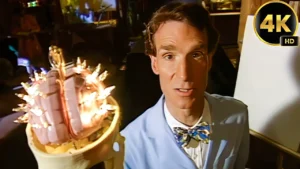
Tap to learn moreAn ocularist is a specially trained professional who makes artificial eyes. As we saw in the episode, they use both science and art to create eyes that look incredibly realistic, carefully matching the colour of the iris and even using fine nylon threads for veins!
Try It: Color Vision
Explore how the brain perceives colour when different wavelengths of light enter the eye.
Apply Your Knowledge
Now let us see if you can connect what you have learned to the real world.
Match the Eye Parts
Click an object to select it, then click the matching description to place it.
Real-World Challenge
Imagine you are walking into a dark cinema from the bright, sunny outdoors. Based on what you have learned, explain what happens to your iris, your rods, and your cones during the first few minutes you are in the dark room.
What Has Changed Since This Episode Aired
This episode of Bill Nye the Science Guy first aired in 1994. While the core anatomy of the eye remains perfectly accurate, here are a few things that have been refined or expanded through modern technology.
Updated: Scientists are making incredible breakthroughs! Researchers successfully used gene therapy to cure red-green colour blindness in adult monkeys in 2009. Progress and human trials are actively ongoing today, so watch this space for future treatments!
Updated: While hand-painting is still an incredible art form used today, some modern ocularists also use 3D printing and digital imaging to perfectly replicate the exact blood vessel patterns and iris details of a patient's other eye.
Updated: Today, we squint at screens constantly! We now know a lot more about "digital eye strain." Staring at screens for hours makes us blink significantly less, leading to dry eyes and blurry vision. The modern "20-20-20 rule" (looking at something 20 feet away for 20 seconds every 20 minutes) was developed to combat this!
Updated: Scientists have actually developed early "bionic eyes" (retinal implants)! These devices use external cameras on glasses to send electrical signals directly to the optic nerve, allowing some blind patients to perceive shapes and movement.
Test Your Understanding
Answer these questions and get instant feedback. How many can you get right?
Results
Your score:
Reflection
Bill Nye the Science Guy mentions that many scientists consider the eyes to be an actual part of the brain. Based on how they work together to process images and flip them right-side up, why does this make sense to you?
Episode Discussion
Share your thoughts on this Bill Nye episode