






















































Ocean Life
Did you know that every time you take a deep breath, you can thank microscopic floating plants in the ocean? Join Bill Nye the Science Guy to discover the amazing world of plankton, filter-feeding whales, and the massive food webs that connect every living thing in the sea!
Dive Into the Invisible Ocean Forest
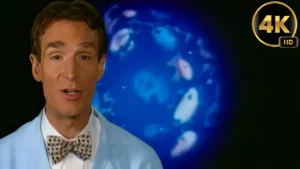
Microscopic plants! Every single living creature in the sea, no matter how big, depends directly or indirectly on tiny drifting plants called phytoplankton. Without them, the entire marine food web would collapse!
To eat! The tiny plants that serve as food only grow near the surface where there is sunlight. When it gets dark, millions of deep-sea creatures swim up to graze on this floating buffet before returning to the shadows.
Put Your Instincts to the Test
Think about how animals survive in the ocean. Pick an answer for each question, then see if your instincts were right.
It filters millions of tiny shrimp-like animals! Blue whales do not even have teeth. They use long plates called baleen to strain tonnes of seawater every day just to eat microscopic zooplankton.
Microscopic floating plants in the ocean! Phytoplankton, like diatoms, use sunlight to make food and release oxygen. Because the ocean is so massive, these tiny drifters provide a huge amount of the oxygen we breathe every day!
Understanding the Science
Tap each card to uncover the vocabulary and science behind the marine food web and the amazing creatures that call the ocean home.
Key Concepts
Plankton
Tap to learn moreA mass of tiny living plants and animals that drift along with the ocean currents. The word comes from an old term meaning "drifter."
Phytoplankton
Tap to learn moreMicroscopic, single-celled plants floating freely in the ocean. They capture the sun's energy and give off oxygen.
Zooplankton
Tap to learn moreTiny animal drifters that depend entirely on phytoplankton for food and oxygen.
Food Web
Tap to learn moreA complex system of interconnected food chains, showing exactly how energy flows from phytoplankton up to the largest marine predators.
Photic Zone
Tap to learn moreThe top layer of the ocean where sunlight can successfully reach. This is the only place where phytoplankton can survive.
Baleen
Tap to learn moreLong, comb-like plates hanging from the roof of certain whales' mouths, used to filter thousands of tonnes of seawater to catch tiny food.
Diatoms
Tap to learn moreSpecific types of microscopic, single-celled phytoplankton that are the basic food supply of the sea and produce huge amounts of oxygen.
Krill
Tap to learn moreTiny, shrimp-like zooplankton that swim in massive swarms. They are the primary food source for the largest animals on the planet.
Try It: The Plankton Pyramid Lab
Balance the marine food web!
Instructions: Press Start Lab, then adjust the Sunlight and Pollution sliders. Watch how energy travels up the pyramid and listen for the calls of the blue whales when the ocean is healthy!
STATUS: PAUSED
Apply Your Knowledge
Real-World Challenge
If a massive pollution spill blocked sunlight from reaching the top layer of the ocean, what would happen to the phytoplankton, and how would that quickly affect the fish and whales?
What Has Changed Since This Episode Aired
This episode originally aired in 1995. Since then, our understanding of ocean ecosystems and the threats they face has expanded significantly!
Updated: Today, we know that excess carbon dioxide from human activities is making the ocean more acidic. This "ocean acidification" makes it very hard for some plankton and coral reefs to build their protective shells, threatening the entire marine food web!
Updated: Modern science has revealed a massive crisis with "microplastics." These tiny pieces of broken-down plastic are often mistaken for food by zooplankton and filter-feeders, introducing dangerous toxins directly into the base of the food chain.
Updated: Scientists have recently discovered vast, thriving ecosystems at the very bottom of the ocean around hydrothermal vents, where life relies entirely on chemical energy from the Earth rather than sunlight!
Test Your Understanding
Answer these 10 questions and get instant feedback. How many can you get right?
Results
Your score:
Reflection
Why is it important for humans to protect the ocean, even if we live hundreds of miles away from the nearest beach?
Episode Discussion
Share your thoughts on this Bill Nye The Science Guy episode