












































































Spinning Things
From the wheels on a bicycle to the orbit of our planet, spinning objects are absolutely everywhere. Join Bill Nye the Science Guy to discover the invisible forces that keep things turning and learn exactly why a spinning top refuses to fall over.
A World in Constant Motion!
No, it flies off in a straight line! Without the string providing a centripetal force pulling it towards the centre, the ball's inertia takes over and forces it to travel completely straight.
Because their weight is moving through a smaller circle! By pulling their arms in, they conserve their angular momentum, forcing their body to spin faster to compensate for the smaller radius.
Put Your Instincts to the Test
Think about how forces interact to create rotation. Pick an answer for each question, then see if your instincts were right.
It will keep spinning forever! This is due to the law of inertia. A spinning object will continue to spin endlessly unless an external force, like friction, actively works to slow it down.
To prevent the main body from spinning uncontrollably! This is the anti-torque rotor. It actively pushes sideways to counteract the main engine's massive twisting torque.
Understanding the Science
Tap each card to uncover the fundamental laws of physics that govern rotation, torque, and momentum.
Key Concepts
Inertia
Tap to learn moreThe fundamental property of matter that resists changes to its current state of motion. A spinning object will continue to spin endlessly unless an external force, like friction, actively works to slow it down.
Centripetal Force
Tap to learn moreA real, centre-seeking force that constantly pulls a moving object inward. This crucial force keeps objects locked in a circular path instead of flying away in a straight line.
Centrifugal "Force"
Tap to learn moreA fictitious force that makes you feel as though you are being pushed outward when riding on a spinning ride. It is actually just your body's inertia attempting to travel in a straight line while the ride pulls you in a circle.
Gyroscope
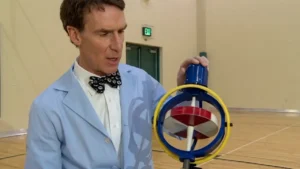
Tap to learn moreA precise scientific device featuring a heavy, rapidly spinning wheel that strongly resists changes to its orientation. When you push it sideways, the cross product of its vectors causes it to react by moving at a 90-degree right angle.
Torque
Tap to learn moreA twisting or turning force that causes an object to rotate around a central axis or pivot point. It is calculated by multiplying force by distance from the pivot.
Angular Momentum
Tap to learn moreA principle stating that if no external torque acts on a spinning system, its total angular momentum remains constant. Because it must be conserved, a spinning ice skater will experience a rapid increase in rotational speed simply by pulling their mass closer to their centre of rotation.
Anti-Torque Rotor
Tap to learn moreThe small but absolutely essential tail rotor on a traditional helicopter. It actively pushes sideways to counteract the main engine's massive torque, preventing the entire fuselage from spinning uncontrollably in the opposite direction.
Friction
Tap to learn moreA resistance force that occurs whenever two surfaces interact with one another. This is the primary external force that slowly steals kinetic energy from a spinning top and eventually forces it to a complete stop.
Interactive: The Angular Momentum Laboratory
This simulation demonstrates the Conservation of Angular Momentum.
Instructions: Start the platform spinning. Then, drag the slider to move the masses closer to the centre. Watch the live data panel to see how reducing the Moment of Inertia forces the Angular Velocity (RPM) to increase so the total system momentum remains perfectly conserved!
Apply Your Knowledge
Let us see if you can correctly identify the fundamental physical forces governing rotation.
Match the Concepts
Click a scientific term to select it, then click the matching description to place it.
Real-World Challenge
If you spin a raw egg on a table, stop it briefly with your finger, and let go, it will often start spinning again on its own. Using your knowledge of inertia, explain exactly why the egg behaves this way.
What Has Changed Since This Episode Aired
This episode originally aired in the mid-1990s. Since then, the mechanical application of spinning things has rapidly evolved!
Updated: Today, your smartphone contains microscopic, non-mechanical MEMS (Micro-Electro-Mechanical Systems) gyroscopes! They do not use spinning wheels, but instead measure tiny vibrating masses that respond to rotational forces, allowing the phone to know exactly which way you are holding it.
Updated: Yes! Modern quadcopters and flying drones solve this torque problem without needing tail rotors. They use multiple main blades that spin in opposite directions to perfectly cancel out each other's torque, allowing for incredibly stable flight.
Test Your Understanding
Answer these 10 questions and get instant feedback. How many can you get right?
Results
Your score:
Reflection
Look around your home or classroom. Identify three different spinning objects and explain what forces are causing them to spin and what forces will eventually make them stop.
Episode Discussion
Share your thoughts on this Bill Nye The Science Guy episode