













































Space Exploration
We live on a big round rock hurtling through a vast emptiness. Exploring that emptiness requires massive machines, brilliant engineering, and a deep understanding of the forces that govern our universe.
The Harsh Reality of the Void
It would literally bubble and boil! Your blood contains dissolved gases like oxygen and nitrogen. Space is a complete vacuum with absolutely zero air pressure. Without air pressure pushing against your body to hold those gases inside, the gas would rapidly escape from your blood, exactly like bubbles fizzing out of a newly opened bottle of soda.
A massive amount! Gravity constantly pulls everything back down to the ground. To break free of the Earth, rockets must be built with gigantic fuel tanks. The fuel tank is often five times larger than the actual spacecraft where the astronauts live and work.
Put Your Instincts to the Test
Think about what you already know about gravity, forces, and motion. Pick an answer for each question, then see if your instincts were right.
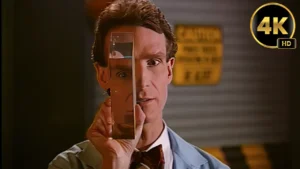
Special tiles that dissipate heat incredibly fast. Bill Nye the Science Guy demonstrates this by blasting a special thermal tile with a blowtorch. Even though the centre is glowing red hot, the edges of the tile cool down so fast that he can safely pick it up with his bare hands just seconds later.
The astronaut's body will spin in the opposite direction. Because the astronaut is floating in microgravity, they have nothing anchoring them down. When they push forcefully against the bolt, the force pushes back and spins their own body around. This is why spaceships are covered in special foot restraints and handholds.
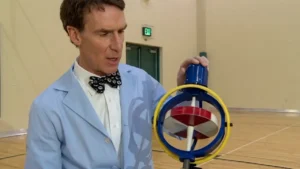
It travels sideways so fast that it falls around the curve of the Earth. Bill Nye the Science Guy swings a toy car on a string to show how orbits work. The spaceship is falling down, but because it is moving forward at thousands of kilometres per hour, the Earth curves away beneath it at the exact same rate it falls.
Understanding the Science
Tap each card to reveal the incredible physics and engineering that allow humans to survive the cosmos.
Key Concepts
The Vacuum of Space
Tap to learn moreAlmost everywhere you go in the universe, there is absolutely nothing. Space is a vacuum. It is a massive void containing no air, no atmosphere, and no physical pressure. Because humans evolved on Earth under the constant, heavy weight of atmospheric pressure, our bodies cannot function in a vacuum. Without surrounding pressure, the gases dissolved inside our blood would instantly bubble out.
Spacesuits
Tap to learn moreTo survive the harsh environment outside their ships, astronauts wear highly complex spacesuits. Bill Nye the Science Guy describes a spacesuit as a self contained spaceship built for one person. They are completely airtight, pumping in breathable oxygen while simultaneously pushing back against the astronaut's body to simulate the atmospheric pressure of Earth.
Liquid Cooling Garments
Tap to learn moreSpace experiences wild extremes in temperature. Facing the sun, an astronaut can be boiling hot, while the shadows are freezing cold. To prevent astronauts from overheating inside their heavy, airtight spacesuits, they wear a special suit underneath called a liquid cooling garment. This suit is woven with tiny tubes that constantly pump cool water across their skin.
Gravity
Tap to learn moreGravity is the powerful force that pulls everything toward the centre of the Earth. It is the reason cars do not float away and the reason rocket ships require an unbelievable amount of fuel just to lift off the launchpad. Even when a spaceship is orbiting hundreds of kilometres high in space, gravity is still reaching out and constantly pulling the ship back down.
Orbits
Tap to learn moreWhen a spacecraft achieves an orbit, it means the ship is travelling sideways so incredibly fast that its forward momentum perfectly balances the downward pull of gravity. As the ship is pulled down, the spherical Earth curves away beneath it. Bill Nye the Science Guy notes that orbiting ships are technically always falling, they are just falling around the Earth rather than crashing into it.
Telescopes
Tap to learn moreBefore humans ever built rockets, we explored space using telescopes. A telescope acts as a giant magnifier to gather light from distant stars and planets. By putting instruments like the Hubble Space Telescope into orbit, scientists get a crystal clear view of the universe without having to look through the blurry, distorted clouds of the Earth's atmosphere.
Foot Restraints
Tap to learn moreWithout the friction of the ground beneath their feet, astronauts experience Newton's Third Law in a dramatic way. If they push a heavy object, they will float backwards. If they try to turn a stiff wheel, their body will spin around instead. To solve this, spaceships and stations are equipped with foot restraints and handholds so astronauts can lock themselves into place while they work.
Atmospheric Re-entry
Tap to learn moreReturning to Earth is incredibly dangerous. As a spaceship smashes back into the gases of the atmosphere at high speed, extreme friction generates massive heat. This process is called atmospheric re-entry. To survive the 1,200 degree Celsius temperatures, ships are covered in thermal tiles that are specially designed to dissipate heat almost instantly, preventing the ship from burning up.
Try It: Orbital Mechanics (Solar System Tour)
Test the delicate mathematical balance of gravity and speed! Select a planet and use the slider to set your horizontal launch speed. To succeed, your rocket must complete one full orbit while remaining entirely inside the glowing yellow Target Zone.
Apply Your Knowledge
Let us see if you can connect what you have learned about space technology to its real-world function.
Match the Concepts
Click an object to select it, then click the matching description to place it.
Real-World Challenge
Imagine you have been selected as the lead engineer to design the first permanent human habitat on the surface of Mars. Mars has almost no atmosphere and freezing temperatures. Using what you have learned about spacesuits, vacuums, and temperature control, what specific safety systems must you build into the living quarters to keep the astronauts alive?
What Has Changed Since This Episode Aired
This episode first aired in 1997. Since then, aerospace engineering has advanced at incredible speeds. Here is what we know now.
Updated: While Hubble is still taking amazing pictures, NASA launched the James Webb Space Telescope (JWST) in 2021. JWST is much larger and uses powerful infrared sensors to see straight through thick dust clouds, allowing scientists to look back further in time than Hubble ever could!
Updated: No! Aerospace companies like SpaceX have engineered fully reusable rocket boosters. After launching the main payload into space, these massive boosters flip around, fly back down through the atmosphere, and land themselves perfectly on robotic ships so they can be fueled up and flown again.
Updated: We have successfully landed a whole fleet of advanced, car-sized rovers on Mars, like Curiosity and Perseverance! We have even successfully flown a robotic helicopter named Ingenuity in the incredibly thin Martian atmosphere, proving that powered flight on another planet is possible.
Test Your Understanding
Answer these questions and get instant feedback. How many can you get right?
Results
Your score:
Reflection
If you were given the chance to travel on a reusable rocket and spend a week living in a habitat orbiting the Earth, would you go? What do you think would be the hardest part about living in microgravity?
Episode Discussion
Share your thoughts on this Bill Nye The Science Guy episode