





























Atoms
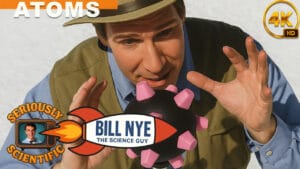
Everything in the universe is made of atoms, including you! In this episode, Bill Nye dives deep into the tiny world of matter, molecules, and subatomic particles, showing how atoms are the building blocks of everything around us. Whether it’s the air we breathe, the water we drink, or the chair you are sitting on right now, it is all made of atoms. But how do they work? Let’s break it down, literally!
What Are Atoms? Bill Nye Explains
Atoms are the tiny particles that make up all matter. Bill Nye explains how each atom has a nucleus at its center, surrounded by electrons moving at lightning speed. Inside the nucleus, you will find protons with a positive charge and neutrons with no charge.
Each element on the periodic table has a unique number of protons, which determines what kind of atom it is. Bill also explores how atoms combine to form molecules, creating the materials and substances we see every day.
Electrons, Protons, and Neutrons: The Parts of an Atom
Atoms are not just tiny, they are incredibly complex. Bill Nye explores how each part of an atom plays a role:
-
Protons: Positively charged particles found in the nucleus
-
Neutrons: Neutral particles that help stabilize the atom
-
Electrons: Negatively charged particles that orbit the nucleus
The number of protons determines an atom’s identity, while electrons are responsible for chemical reactions and bonding. Without electrons, we would not have electricity, chemistry, or even life as we know it.
The Periodic Table and Elements
Atoms come in different types called elements, and all known elements are organized in the periodic table. Bill Nye explains how each element has a unique atomic number, which represents how many protons are in its nucleus.
For example:
-
Hydrogen (H) has 1 proton
-
Oxygen (O) has 8 protons
-
Gold (Au) has 79 protons
When atoms combine, they form molecules and compounds such as H₂O (water) and CO₂ (carbon dioxide).
Energy and Atomic Reactions
Atoms do not just sit still, they can store and release energy. Bill Nye demonstrates how atoms interact through:
-
Chemical reactions: When atoms share or transfer electrons
-
Nuclear reactions: When atoms split (fission) or fuse together (fusion)
-
Electricity: How moving electrons power everything from lights to cell phones
Without atomic reactions, we would not have batteries, fuel, or even the Sun’s energy.
Fun Atomic Experiments with Bill Nye
Want to see atoms in action? In this episode, Bill Nye shows how to:
-
Make a simple molecule model using everyday objects
-
Test chemical reactions with baking soda and vinegar
-
See static electricity in action using a balloon and your hair
These hands-on activities bring atomic science to life in a fun and easy way.
Why Are Atoms So Important?
Atoms might be small, but they make up everything. Bill Nye explains how atomic science helps us understand:
-
The materials we use every day
-
How food and fuel give us energy
-
The way the universe is built, from stars to tiny particles
By understanding atoms, scientists can create new medicines, advanced technology, and even discover new elements.
Conclusion
Atoms may be tiny, but they have a huge impact on the universe. Bill Nye makes learning about matter, molecules, and atomic energy exciting and easy to understand. By the end of this episode, you will see everything around you in a whole new way, because it is all made of atoms.
More Seriously Scientific Links
Visit our homepage for more Seriously Scientific news and documentaries: https://seriouslyscientific.com.
Subscribe to our YouTube channel for more science content: https://youtube.com/@seriouslyscientific.
Get free science worksheets for students and educators: https://teacherspayteachers.com/Store/Seriously-Scientific.
Follow us on BlueSky: https://bsky.app/profile/seriouslysci.bsky.social.
Bill Nye The Science Guy
02 // EPISODE_INDEX100 remastered episodes across 5 seasons of science education
Season 1 (20 episodes)
Bill Nye The Science Guy | Flight
Bill Nye The Science Guy | Earth's Crust
Bill Nye The Science Guy | Dinosaurs
Bill Nye The Science Guy | Skin
Bill Nye The Science Guy | Buoyancy
Bill Nye The Science Guy | Gravity
Bill Nye The Science Guy | Digestion
Bill Nye The Science Guy | Phases of Matter
Bill Nye The Science Guy | Biodiversity
Bill Nye The Science Guy | Simple Machines
Bill Nye The Science Guy | The Moon
Bill Nye The Science Guy | Sound
Bill Nye The Science Guy | Garbage
Bill Nye The Science Guy | Structures
Bill Nye The Science Guy | Earth's Seasons
Bill Nye The Science Guy | Light & Color
Bill Nye The Science Guy | Cells
Bill Nye The Science Guy | Electricity
Bill Nye The Science Guy | Outer Space
Bill Nye The Science Guy | Eyeballs
Season 2 (20 episodes)
Bill Nye The Science Guy | Magnetism
Bill Nye The Science Guy | Wind
Bill Nye The Science Guy | Blood & Circulation
Bill Nye The Science Guy | Chemical Reactions
Bill Nye The Science Guy | Static Electricity
Bill Nye The Science Guy | Food Webs
Bill Nye The Science Guy | Light Optics
Bill Nye The Science Guy | Bones & Muscle
Bill Nye The Science Guy | Oceanography
Bill Nye The Science Guy | Heat
Bill Nye The Science Guy | Insects
Bill Nye The Science Guy | Balance
Bill Nye The Science Guy | The Sun
Bill Nye The Science Guy | The Brain
Bill Nye The Science Guy | Forests
Bill Nye The Science Guy | Communication
Bill Nye The Science Guy | Momentum
Bill Nye The Science Guy | Reptiles
Bill Nye The Science Guy | Atmosphere
Bill Nye The Science Guy | Respiration
Season 3 (21 episodes)
Bill Nye The Science Guy | Planets & Moons
Bill Nye The Science Guy | Pressure
Bill Nye The Science Guy | Plants
Bill Nye The Science Guy | Rocks & Soil
Bill Nye The Science Guy | Energy
Bill Nye The Science Guy | Evolution
Bill Nye The Science Guy | The Water cycle
Bill Nye The Science Guy | Friction
Bill Nye The Science Guy | Germs
Bill Nye The Science Guy | Climates
Bill Nye The Science Guy | Waves
Bill Nye The Science Guy | Ocean Life
Bill Nye The Science Guy | Mammals
Bill Nye The Science Guy | Spinning Things
Bill Nye The Science Guy | Fish
Bill Nye The Science Guy | Human Transportation
Bill Nye The Science Guy | Wetlands
Bill Nye The Science Guy | Birds
Bill Nye The Science Guy | Populations
Bill Nye The Science Guy | Animal Locomotion
Bill Nye The Science Guy | Invertebrates
Season 4 (19 episodes)
Bill Nye The Science Guy | Rivers & Streams
Bill Nye The Science Guy | Nutrition
Bill Nye The Science Guy | Marine Mammals
Bill Nye The Science Guy | Earthquakes
Bill Nye The Science Guy | NTV Music Videos
Bill Nye The Science Guy | Spiders
Bill Nye The Science Guy | Pollution Solutions
Bill Nye The Science Guy | Probability
Bill Nye The Science Guy | Pseudoscience
Bill Nye The Science Guy | Flowers
Bill Nye The Science Guy | Archaeology
Bill Nye The Science Guy | Deserts
Bill Nye The Science Guy | Amphibians
Bill Nye The Science Guy | Volcanoes
Bill Nye The Science Guy | The Heart
Bill Nye The Science Guy | Inventions
Bill Nye The Science Guy | Computers
Bill Nye The Science Guy | Fossils
Bill Nye The Science Guy | Time
Season 5 (20 episodes)
Bill Nye The Science Guy | Forensics
Bill Nye The Science Guy | Space Exploration
Bill Nye The Science Guy | Genes
Bill Nye The Science Guy | Architecture
Bill Nye The Science Guy | Farming
Bill Nye The Science Guy | Life Cycles
Bill Nye The Science Guy | The Scientific Method
Bill Nye The Science Guy | Atoms
Bill Nye The Science Guy | Ocean Exploration
Bill Nye The Science Guy | Lakes and Ponds
Bill Nye The Science Guy | Smell
Bill Nye The Science Guy | Caves
Bill Nye The Science Guy | Erosion
Bill Nye The Science Guy | Fluids
Bill Nye The Science Guy | Comets and Meteors
Bill Nye The Science Guy | Measurement
Bill Nye The Science Guy | Patterns
Bill Nye The Science Guy | Storms
Bill Nye The Science Guy | Music
Bill Nye The Science Guy - Motion
Loading Biography...
Atoms and Molecules
Based on Bill Nye the Science Guy · Season 5, Episode 8 · 23 min
Look around you. Your screen, your clothes, the air you breathe, and even your own body are made of stuff. But what happens if you take a piece of that stuff and cut it in half, over and over again? Will you eventually hit a piece so small it cannot be cut anymore?
What is Everything Made Of?
Atoms! The word atom actually comes from a Greek word meaning "uncuttable." They are the basic building blocks of all matter in the universe.
Surprisingly, no! Atoms are mostly empty space. The parts of an atom are spaced so incredibly far apart that if the centre was the size of a vibrating ball, the outer parts would be five football pitches away!
Put Your Instincts to the Test
Think about what you already know about matter. Pick an answer for each question, then see if your instincts were right.
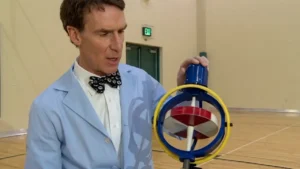
The outer parts of the atoms move so fast and repel each other. Bill Nye the Science Guy compares this to a spinning fan. Even though there is space between the blades, they move so fast that you cannot push a piece of paper through them!
The number of protons inside their atoms. All matter is made of the same basic parts, but the exact number of heavy, positive particles called protons determines which specific element an atom will be.
Slightly less than two cups. Water and alcohol are made of molecules. Because there are tiny empty pockets between the alcohol molecules, the water molecules can fit perfectly into those spaces, resulting in less total volume.
Understanding the Science
Tap each card to reveal the explanation of these fundamental scientific concepts.
Key Concepts
Matter
Tap to learn moreMatter is everything in the universe that takes up space and has weight. From apples to zebras, and even the invisible air we breathe, if it is a "thing", it is matter. The only thing in the universe that is not matter is energy, like heat or light.
The Atom
Tap to learn moreAn atom is the tiny, invisible building block of all matter. Atoms are so incredibly small that a single sheet of paper is about one million atoms thick!
The Nucleus
Tap to learn moreThe nucleus is the heavy, dense centre of an atom. It contains two types of particles: protons, which have a positive electrical charge, and neutrons, which have no charge at all.
Electrons
Tap to learn moreElectrons are extremely small, lightweight particles with a negative charge. They buzz around the nucleus at incredible speeds, creating a large area of mostly empty space.
Molecules
Tap to learn moreWhen atoms stick together, they form molecules. If atoms are the letters of the universe, molecules are the words. For example, two hydrogen atoms and one oxygen atom combine to make a molecule of water, also known as H2O.
Try It: Build a Molecule
Drag atoms together to build real molecules and see how different combinations create different substances!
Apply Your Knowledge
Now that you understand the building blocks of the universe, let's put that knowledge to the test.
Match the Concepts
Click an object to select it, then click the matching description to place it.
Real-World Challenge
Imagine you have a magical magnifying glass that lets you zoom in to see individual atoms. If you looked at a glass of water, what "letters" (atoms) and "words" (molecules) would you see, and how would they be arranged?
What Has Changed Since This Episode Aired
This episode first aired in the 1990s. While the core science remains perfectly accurate, our tools for looking at the universe have advanced, revealing new details!
Updated: While atoms are the basic blocks of elements, we now know for certain that protons and neutrons can be broken down even further! They are made of even smaller, truly fundamental particles called quarks. In the episode, a guest physicist briefly mentions studying them, but today, quarks are a fully mapped part of the Standard Model of particle physics.
Updated: Not quite! In the 1990s, the periodic table had around 109 confirmed elements. Today, scientists have used incredible technology to smash atoms together and create superheavy elements in laboratories. We have now fully completed the seventh row of the periodic table, bringing the total to exactly 118 confirmed elements!
Test Your Understanding
Answer these questions and get instant feedback. How many can you get right?
Results
Your score:
Reflection
Look at an everyday object near you. Can you imagine the billions of tiny atoms buzzing inside it right now? How does knowing about atoms change the way you look at the world around you?
Episode Discussion
Share your thoughts on this Bill Nye episode