






















































Ocean Exploration
You probably think you know your way around the Earth, but you hardly know anything about most of our planet. The ocean is an enormous, crushing, pitch black wilderness, and it is one of the hardest places in the universe to reach.
Journey into the Abyss
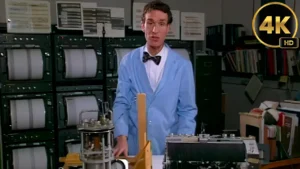
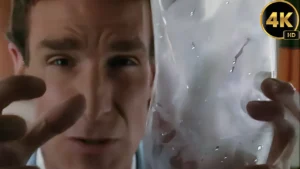
It gets completely crushed! Foam cups have tiny air spaces hidden inside the plastic. Bill Nye the Science Guy explains that the immense water pressure at the bottom of the sea squeezes all the air out, shrinking the cup to a tiny fraction of its original size.
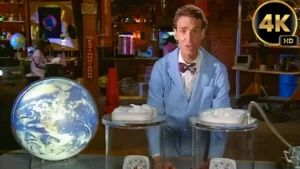
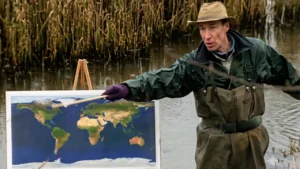
71 percent! If you look at a globe, nearly three quarters of the world is completely covered in water. Almost all of it is an unexplored frontier that humans have never laid eyes on.
Put Your Instincts to the Test
Think about what you already know about gravity, water pressure, and geography. Pick an answer for each question, then see if your instincts were right.
The water pressure is too heavy for your lungs to expand. Bill Nye the Science Guy demonstrates that the pressure pushing against your chest is much higher than the air pressure above the water. No matter how hard you try, you physically cannot draw the air down the tube into your body.
It is full of massive mountains, canyons, and volcanoes. The ocean floor is incredibly dramatic. It features spectacular landscapes and rifts that are much larger and deeper than anything you can see on dry land.
They bounce pulses of sound off the bottom. This is called echo sounding. Scientists time exactly how long it takes for the sound to travel down and bounce back to the ship, allowing them to map out the invisible underwater mountains and valleys.
Understanding the Science
Tap each card to reveal the engineering and physics required to survive the deepest parts of our planet.
Key Concepts
The Blue Planet
Tap to learn moreEarth is truly a water world. Approximately 71 percent of the planet's surface is covered by the ocean. If you include the freshwater rivers, lakes, and streams, three quarters of the entire world is underwater. Because humans are land animals, the vast majority of our own planet remains a mysterious, unexplored frontier.
Water Pressure
Tap to learn moreWater is heavy. When you swim downwards, the entire column of water above you pushes down on your body. The deeper you go, the more water there is stacked above you, resulting in massively higher water pressure. Just ten metres underwater adds an entire extra atmosphere of crushing pressure against your chest.
SCUBA
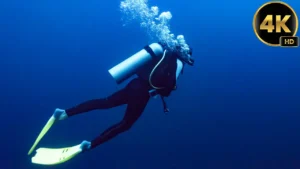
Tap to learn moreBecause humans cannot use long snorkels to fight water pressure, we invented SCUBA, which stands for Self Contained Underwater Breathing Apparatus. A SCUBA diver carries a tank of incredibly high pressure air on their back. A special valve delivers exactly the right amount of pressurised air into their lungs, pushing back against the water and allowing them to breathe comfortably.
Corrosive Seawater
Tap to learn moreThe ocean is a remarkably harsh environment. Seawater is absolutely full of salt and dissolved chemicals that are highly corrosive. The salty water aggressively rots away wood and rapidly rusts strong metals. This means exploration ships and submarines must be built with specialised materials, and regularly hauled out of the water to be scrubbed clean and repaired.
Ocean Topography
Tap to learn moreWe often imagine the bottom of the sea as a flat, sandy beach. In reality, the ocean floor features an incredibly extreme topography. If you drained away all the water, you would reveal massive underwater mountain ranges, gigantic valleys, deep rifts, and towering volcanoes. Because sunlight gets absorbed by seawater, this dramatic seascape remains entirely hidden in pitch darkness.
Echo Sounding
Tap to learn moreTo safely navigate and map the invisible ocean floor, ships use echo sounding equipment, or sonar. The ship sends pulses of sound straight down through the water. By precisely timing how long it takes for the echo to bounce off the bottom and return, computers can calculate the exact depth of the water, revealing the hidden mountains below.
The Deep Abyss
Tap to learn moreThe deepest part of the global ocean is the Mariana Trench. It plunges a staggering 11,000 metres straight down into the Earth's crust. To put that into perspective, you could easily stack 36 Empire State Buildings inside it. Reaching the bottom of the trench is far more difficult than reaching the Moon due to the deadly, crushing pressure.
ROVs and Submersibles
Tap to learn moreTo survive the abyss, scientists build manned submersibles like Alvin, which features a thick titanium sphere to protect the crew from thousands of pounds of pressure. For the most extreme depths, they deploy an ROV (Remotely Operated Vehicle) like Jason. These brave robots are connected to the ship by kilometres of cable, acting as our eyes in the dark.
Try It: Deep Ocean Surveyor
Take command of the ROV Jason. Press Begin Dive to descend into the abyss. Move your mouse to sweep your bright headlights through the darkness. Click on the interesting objects as they drift past to document how crushing pressure affects the world below.
Apply Your Knowledge
Let us see if you can connect what you have learned about ocean geography and physics to the tools scientists use to survive.
Match the Concepts
Click an object to select it, then click the matching description to place it.
Real-World Challenge
Imagine you have been hired as the lead engineer to build a brand new scientific research station that sits permanently on the bottom of the ocean floor. Based on what you have learned about water pressure, breathable air, and corrosive saltwater, what specific materials and systems would you need to include in your design to keep the scientists inside safe?
What Has Changed Since This Episode Aired
This episode first aired in 1997. Since then, marine technology and our understanding of the deep ocean have taken some massive leaps forward. Here is what we know now.
Updated: Yes! In recent years, engineers have developed Full Ocean Depth (FOD) submersibles, like the Limiting Factor. These incredibly advanced titanium vehicles can now safely carry human beings to 100 percent of the ocean floor, including the very deepest point of the Mariana Trench.
Updated: While ships still use sonar for high resolution mapping of specific areas, we now map the entire global ocean floor from space! Modern satellites use radar altimetry to measure microscopic bumps on the surface of the ocean. These bumps are actually caused by the gravitational pull of the massive underwater mountains hiding below.
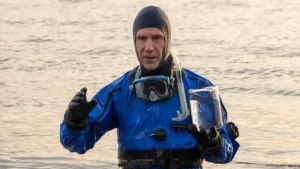
Updated: SCUBA has advanced incredibly. Today, technical divers use closed-circuit Rebreathers that recycle the diver's breath, and they breathe specialised mixed gases (like Trimix, which adds helium) to safely prevent toxicity. This allows modern divers to reach extreme depths well over 300 metres without traditional SCUBA limits.
Test Your Understanding
Answer these questions and get instant feedback. How many can you get right?
Results
Your score:
Reflection
Think about the incredible technology required just to send a robot to the bottom of the ocean. Why do you think humans spend so much money and effort trying to explore this dark, freezing, crushing environment?
Episode Discussion
Share your thoughts on this Bill Nye The Science Guy episode